
NVR’s Asset-Light Model Faces Margin Compression as Homebuilding Cycles Shift
Despite a disciplined lot acquisition approach and strong historical profitability, NVR’s recent quarters underscore the vulnerability of even efficient homebuilders to demand volatility and margin pressure. The company’s ability to maintain high returns on capital is being tested by declining settlements and industry-wide headwinds.
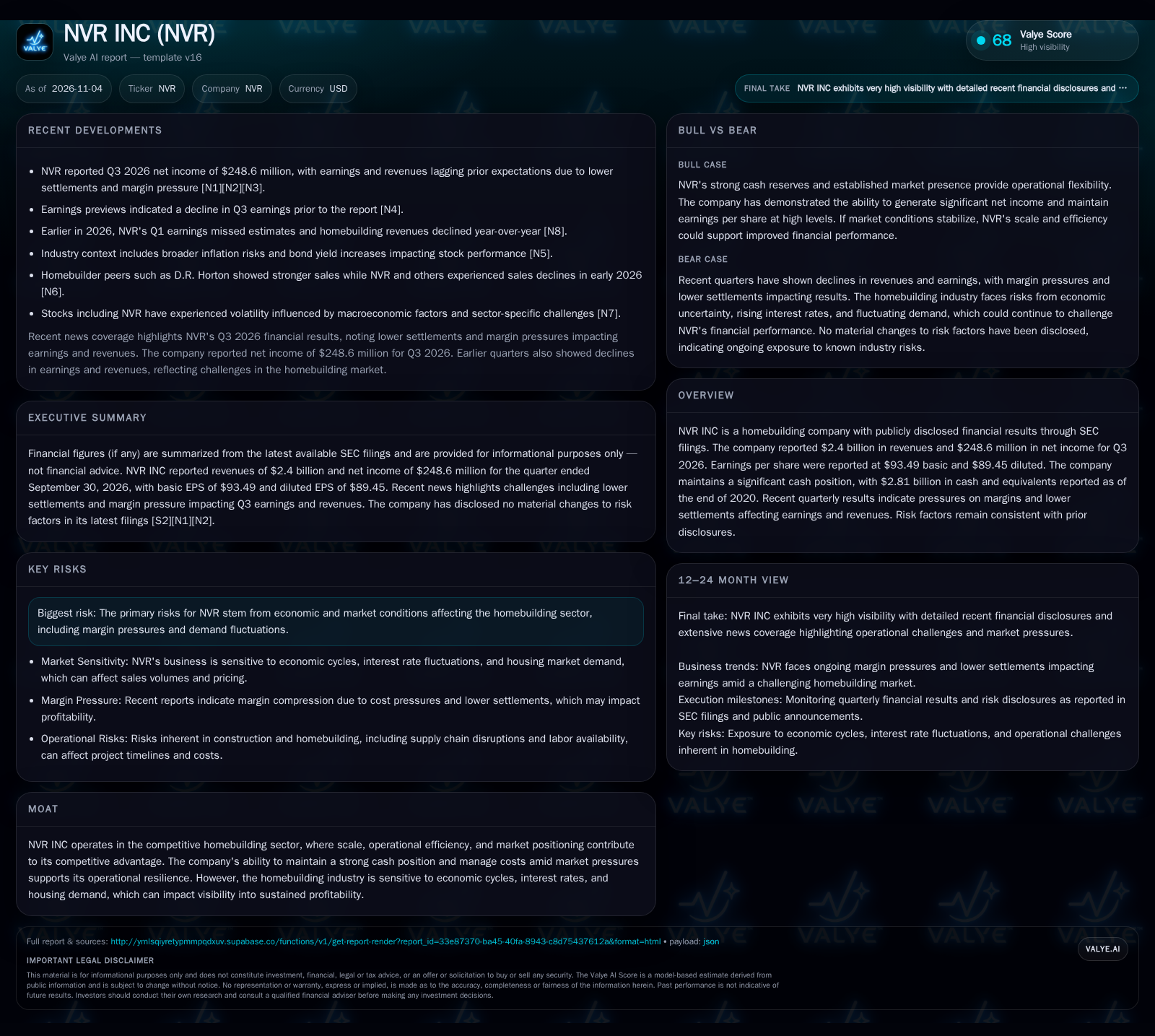
NVR reported $2.4 billion in Q3 2026 revenue and $248.6 million in net income, but both earnings and settlements fell short of expectations due to margin compression and lower sales volume. The company’s asset-light lot acquisition strategy has historically supported high returns, but recent declines highlight the cyclical risks inherent in homebuilding. Ongoing margin pressure and demand sensitivity will test NVR’s operating model as the market environment remains challenging. [S2] [N1] [N3]
NVR Inc.’s third-quarter 2026 results highlight the limits of operational discipline in a cyclical industry. While the company has long distinguished itself through a capital-light approach to land acquisition and strong geographic positioning in mature U.S. markets, recent quarters have brought declining revenues and net income, with margin pressure and lower settlement volumes underscoring sensitivity to the broader homebuilding downturn. As the industry faces rising interest rates and demand headwinds, NVR’s ability to defend profitability and sustain its historical return profile will hinge on its execution, pricing discipline, and the resilience of its asset-light model.
Recent Margin Pressures and Settlement Declines Shape the Narrative
NVR reported third-quarter 2026 revenues of $2.4 billion and net income of $248.6 million, with basic earnings per share of $93.49 and diluted EPS of $89.45 [S2]. These results lagged prior expectations due to a combination of lower settlements and margin compression, as highlighted in recent news and the company’s quarterly disclosures [N1] [N3]. Earlier in 2026, NVR also reported year-over-year declines in homebuilding revenues and missed earnings estimates in Q1 [N8]. Notably, these challenges have occurred despite the absence of new material risk disclosures, suggesting that the headwinds are tied to well-understood industry factors rather than company-specific shocks [S2]. The company’s experience contrasts with some homebuilding peers who have managed to grow sales, highlighting the competitive and cyclical dynamics at play [N6].
How NVR’s Asset-Light Model Drives Returns—and Where It’s Vulnerable
NVR’s business model centers on constructing and selling single-family homes, townhomes, and condominiums—primarily on a pre-sold basis. The most distinctive feature is its avoidance of direct land development: rather than owning and developing raw land, NVR acquires finished building lots through fixed-price purchase agreements with third-party developers, generally requiring only modest deposits (up to 10% of the lot price) [S2]. This approach limits exposure to land value swings, reduces capital intensity, and accelerates inventory turnover, which historically has supported high returns on equity and total capital.
However, this efficiency comes with trade-offs. NVR’s fixed-price lot agreements can insulate it from land inflation, but the company is still exposed to fluctuations in construction costs, labor, and market pricing for new homes. Pre-selling homes reduces speculative inventory risk but means that settlements (closings) are highly sensitive to shifts in demand and mortgage affordability. The company’s operating leverage—high fixed costs relative to variable margins—means that volume shortfalls can quickly translate into margin compression, as seen in recent quarters. While the asset-light model reduces the risk of major capital write-downs, it does not shield earnings from industry-wide slowdowns or cyclical demand shocks.
Defending Market Share in a Shifting Homebuilding Landscape
NVR operates primarily in mature, contiguous U.S. markets, leveraging local scale and brand recognition to drive efficiencies in construction, sales, and customer service [S2]. Its focus on market share gains within existing regions, rather than aggressive geographic expansion, has historically enabled deeper local relationships and operating discipline. However, the broader homebuilding sector is characterized by intense competition from both national peers—such as D.R. Horton, Lennar, and Pulte—and regional builders.
The recent outperformance of some competitors, notably D.R. Horton, in sales growth suggests that market share is fluid, particularly when demand softens [N6]. NVR’s reliance on third-party land developers for lot supply could also pose constraints if competitors gain preferential access to desirable land or if lot prices rise. Additionally, the company’s avoidance of raw land development, while protective in downturns, may limit its ability to capture outsized upside during strong markets or in high-growth regions. Substitutes for new homes, such as resales, and macro factors like mortgage rates further constrain pricing power and sales velocity.
Margin Recovery if Demand Stabilizes and Input Pressures Ease
A favorable scenario for NVR would involve stabilization or recovery in new home demand, coupled with easing of construction input costs. If mortgage rates moderate and consumer confidence improves, settlement volumes could rebound, boosting both revenues and operating leverage. NVR’s disciplined lot acquisition model could magnify returns in this environment by allowing the company to scale efficiently without large capital outlays.
Evidence that would confirm this scenario includes a reversal of recent settlement declines, rising backlog or order rates, sequential improvement in gross margins, and favorable commentary on input costs or pricing power in future disclosures. Conversely, persistent declines in settlements, continued margin compression, or further market share losses to peers would falsify the bullish thesis.
Navigating Through Cyclical Headwinds with Operational Discipline
The most plausible outlook is that NVR continues to experience periodic margin pressure and volume volatility in line with broader homebuilding cycles. The company’s asset-light structure should allow it to avoid severe capital losses, but profitability will remain sensitive to settlement rates and the competitive environment. Modest revenue and earnings growth may resume if macro conditions stabilize, but upside is likely to be capped until demand normalizes and cost inflation abates.
Confirmation of this scenario would come from relatively stable, if subdued, settlement activity, maintenance of industry-typical gross margins, and the absence of major impairments or cash flow disruptions. If NVR can hold or gain share in its core markets while containing costs, it may preserve its historical return profile, albeit at lower absolute levels than in recent peak periods.
Margin Compression Deepens Amid Prolonged Demand Weakness
In a more adverse scenario, the combination of persistent demand softness, elevated input costs, and intensifying competition could drive further declines in settlements and more acute margin compression. If mortgage rates remain high or economic uncertainty increases, buyer hesitation could lengthen sales cycles and force price concessions, eroding profitability.
Sustained negative trends in settlements and gross margins, deteriorating backlog, or evidence of NVR accepting lower returns to maintain volume would support this scenario. Additional risk factors include disruptions in lot supply from third-party developers or significant increases in lot acquisition costs, which could undermine the company’s asset-light advantage.
Testing the Resilience of NVR’s Asset-Light Approach: What Will Matter Most
Quarterly settlement volumes and order rates: Tracking whether NVR can stabilize or grow closings in the face of industry headwinds will be critical for gauging future revenue and margin trends.
Gross margin trajectory: Monitoring changes in construction input costs and pricing discipline will reveal whether margin pressure is abating or worsening.
Lot pipeline and access to finished lots: Any constraints in acquiring finished lots, or shifts in lot pricing, could impact both growth and margins.
Market share trends in core regions: Comparing NVR’s performance to regional and national peers will clarify whether the company is maintaining or losing competitive ground.
Cash flow from operations and capital commitments: Sustained positive cash flow will help validate the resilience of the asset-light model through a downturn.
Management commentary on pricing, incentives, and input costs: Qualitative disclosures will help assess whether NVR is able to defend margins or is being forced into more aggressive discounting.
Disclaimer: This is research-only, informational analysis and not investment advice. It may include AI-generated interpretation and general industry context. Always verify important details using primary sources.

Comments