
Design Therapeutics: GeneTAC® Platform’s Clinical Progress and the Stakes of Rare Disease Innovation
Design Therapeutics advances its proprietary GeneTAC® small-molecule platform targeting inherited nucleotide repeat expansion diseases, with multiple candidates in clinical trials and a substantial reported cash balance. The upcoming RESTORE-FA readouts and continued R&D investment will test both the breadth and depth of its novel approach in a competitive rare disease landscape.
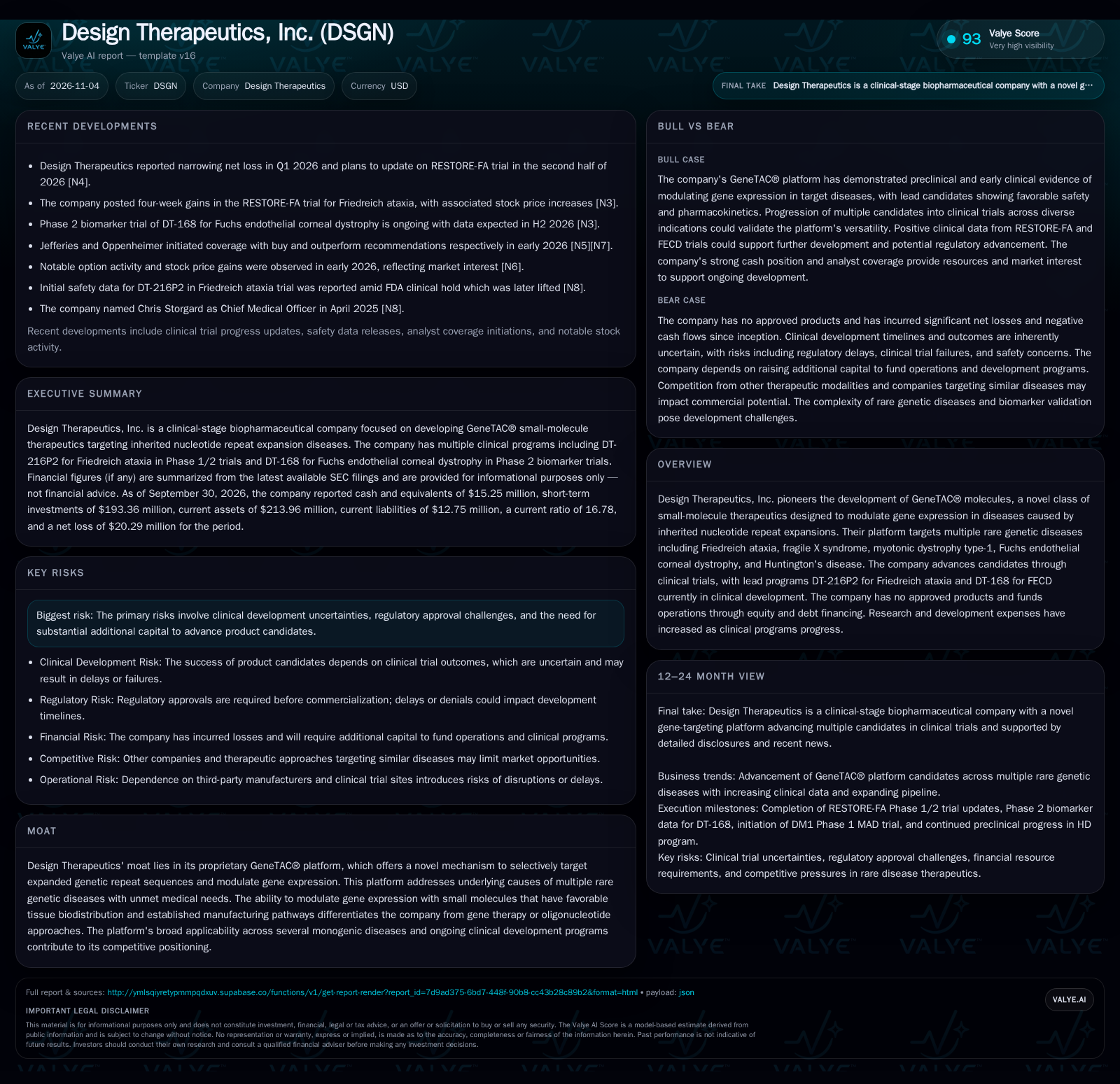
Design Therapeutics, Inc. is a clinical-stage biotech focused on small-molecule GeneTAC® therapeutics for rare, inherited repeat expansion diseases. With the FDA lifting a clinical hold on its lead Friedreich ataxia candidate and a reported cash position, the company is poised for pivotal trial updates in H2 2026. Key risks include clinical and regulatory hurdles, high cash burn, and unproven commercial viability. Market interest has risen with early data, but future value hinges on clinical outcomes and the platform’s versatility across indications. [S2] [N3] [N4] [N8]
Design Therapeutics, Inc. stands at a critical juncture as its GeneTAC® platform—targeting the root causes of rare, inherited nucleotide repeat expansion diseases—moves deeper into clinical development. With the FDA’s recent green light for its Friedreich ataxia candidate and a reported cash position, the company is positioned for potentially transformative clinical readouts in the coming year. Yet, with no approved products and sustained operating losses, the next phase will test whether Design’s novel small-molecule approach can deliver meaningful clinical benefit, attract further capital, and carve out a defensible niche in an increasingly competitive rare disease landscape. [S2] [N4] [N8]
Clinical Hold Lifted and Cash Reserves Set the Stage for 2026 Milestones
Design Therapeutics recently cleared a significant regulatory hurdle: the FDA lifted its clinical hold on the DT-216P2 IND in December 2025, allowing the Friedreich ataxia program to resume clinical studies. This event unblocked the company’s lead asset and put it back on a potentially value-defining development path. [S2] [N8]
Financially, as of September 30, 2026, Design reported $15.25 million in cash, $193.36 million in short-term investments, and a current ratio of 16.78. The company reported cash and liquidity metrics for the period; these figures do not by themselves establish operating runway, investment capacity, financial flexibility, or financing capacity. [S2]
Clinical and investor momentum has increased following reported four-week gains in the RESTORE-FA trial and narrowing net losses in Q1 2026. The company anticipates further RESTORE-FA trial updates in the second half of 2026. [N3] [N4]
R&D-Driven Model: Burn Rate, Platform Leverage, and the Long Road to Revenue
Design Therapeutics remains pre-commercial, with no revenue and a business model entirely dependent on external funding to support research and development. Its economics are currently defined by high R&D intensity: research and development expenses increased to $59.1 million in 2025, up from $44.4 million in 2024, as clinical programs advanced. [S2]
The company’s platform approach theoretically allows for pipeline breadth, as GeneTAC® molecules could be tailored to multiple rare diseases, potentially yielding portfolio effects if multiple candidates succeed. However, each new indication also brings incremental cost, regulatory risk, and extended timelines typical of rare disease drug development.
Fixed costs are dominated by personnel, clinical operations, and regulatory activities, with variable costs scaling as more candidates enter the clinic. There is currently no commercial infrastructure, so future go-to-market economics—pricing, gross margins, and payor dynamics—remain speculative. The key economic inflection will come only if a candidate demonstrates clear clinical benefit and advances toward regulatory approval, opening the door to high-value orphan drug pricing and potential partnerships or licensing.
A critical dimension of Design Therapeutics’ R&D-driven model is the balance between pipeline breadth and depth. While the GeneTAC® platform’s modularity enables targeting multiple rare diseases, each indication demands significant upfront investment in disease-specific biology, preclinical validation, and clinical trial design. This creates a tension: expanding the pipeline can diversify risk but also amplifies capital requirements and operational complexity. Strategic prioritization and milestone-based resource allocation become essential to avoid overextension. Moreover, the rarity of target diseases often leads to small patient populations, which can limit trial enrollment speed and impact the statistical power of efficacy readouts, potentially prolonging development timelines and increasing uncertainty around regulatory approval.
GeneTAC® Platform’s Differentiation Versus Gene Therapy, Oligonucleotides, and Other Modalities
Design Therapeutics’ competitive positioning derives from its proprietary GeneTAC® platform, which aims to modulate gene expression with small molecules rather than with gene therapy vectors or oligonucleotide drugs. This approach could offer advantages in tissue biodistribution, manufacturability, and potentially oral delivery, distinguishing it from viral vector-based or intrathecally administered competitors.
However, the rare disease space is crowded with both established biopharma players and innovative startups, including those pursuing gene therapies, RNA-targeted oligonucleotides, and genome editing. For indications like Friedreich ataxia and Huntington’s disease, competition includes gene therapy developers and antisense oligonucleotide programs.
The question is whether the GeneTAC® mechanism can deliver superior efficacy, safety, or convenience. Validation in the clinic—particularly with durable, disease-modifying effects—would be required to meaningfully differentiate the platform and justify premium pricing or attract partners.
Platform Validation Through Positive RESTORE-FA Data and Pipeline Expansion
The most favorable scenario is that Design’s RESTORE-FA trial delivers robust, statistically significant improvements in Friedreich ataxia patients, with a safety profile that supports continued development. Such clinical success would validate the GeneTAC® platform for nucleotide repeat expansion diseases and could substantially increase the probability of success for other pipeline programs.
Confirmation would come from positive clinical trial readouts in H2 2026, regulatory feedback supporting accelerated development, and potential partnership or licensing announcements. Analyst upgrades and further market enthusiasm would likely follow. [N4] [N5] [N7]
This scenario would be further bolstered if Design could initiate additional trials in other indications (such as Huntington’s disease or FECD) without major delays or setbacks, signaling platform scalability and increasing the addressable market.
Incremental Progress: Clinical Data Builds Slowly, Cash Burn Continues, and Platform Risks Remain
The most plausible middle path is that Design’s lead programs progress through clinical development with mixed but encouraging data—enough to justify continued investment and pipeline expansion, but not yet sufficient for regulatory submission or commercial partnerships.
Evidence for this scenario includes ongoing trial enrollment and updates, continued R&D spending, and a lack of major clinical or regulatory setbacks—but also the absence of transformative efficacy signals or early approvals. Any delays in trial readouts or ambiguous data would reinforce this incremental trajectory.
Further financing would likely be required before commercialization, either via equity raises or partnering, as the platform continues to mature.
Clinical Setbacks, Regulatory Delays, and Cash Constraints Undermine the Platform Thesis
The principal risk is that clinical readouts from RESTORE-FA or other GeneTAC® programs fail to demonstrate meaningful efficacy or raise safety concerns, leading to regulatory delays or new clinical holds. In this scenario, the lack of clear clinical benefit undermines confidence in the platform’s mechanism.
Confirmation would come from negative or inconclusive clinical trial results, FDA feedback requiring additional studies or protocol changes, or a halt in pipeline expansion. If cash burn continues at current rates without new financing or partnerships, the company could face funding constraints or be forced to deprioritize programs.
Increased competition, or the approval of alternative therapies by other developers, would further erode the perceived value of Design’s approach and limit future fundraising or partnering options.
What Will Test Design Therapeutics’ Platform Promise in the Next 12–18 Months?
RESTORE-FA clinical trial efficacy and safety data releases—especially any statistically significant improvements in functional endpoints for Friedreich ataxia.
Regulatory feedback or new clinical holds impacting the development timeline or trial protocol for DT-216P2 or other GeneTAC® candidates.
Cash burn trends and updated disclosures regarding runway, especially in the context of ongoing R&D expansion and the absence of revenue.
Initiation or progress of clinical trials for additional pipeline candidates, such as in Huntington’s disease or FECD.
Updates on partnership, collaboration, or licensing discussions that could provide non-dilutive funding or external validation.
Competitive developments, such as the approval or clinical success of alternative therapies in target indications.
If disclosed, patient enrollment rates in ongoing and future trials, as a proxy for operational momentum and trial execution.
Analyst coverage shifts, option activity, or other market signals that might reflect changing investor sentiment around key catalysts.
Disclaimer: This is research-only, informational analysis and not investment advice. It may include AI-generated interpretation and general industry context. Always verify important details using primary sources.

Comments