
DIRTT Environmental Solutions: Debt Discipline, Cash Flow, and the Cross-Border Tariff Dilemma
DIRTT Environmental Solutions posts positive net income and cash flow, actively manages its capital structure, and extends credit facilities through 2029. Yet, tariff threats and covenant sensitivities could disrupt operational momentum, leaving the path ahead dependent on both macro and company-specific triggers.
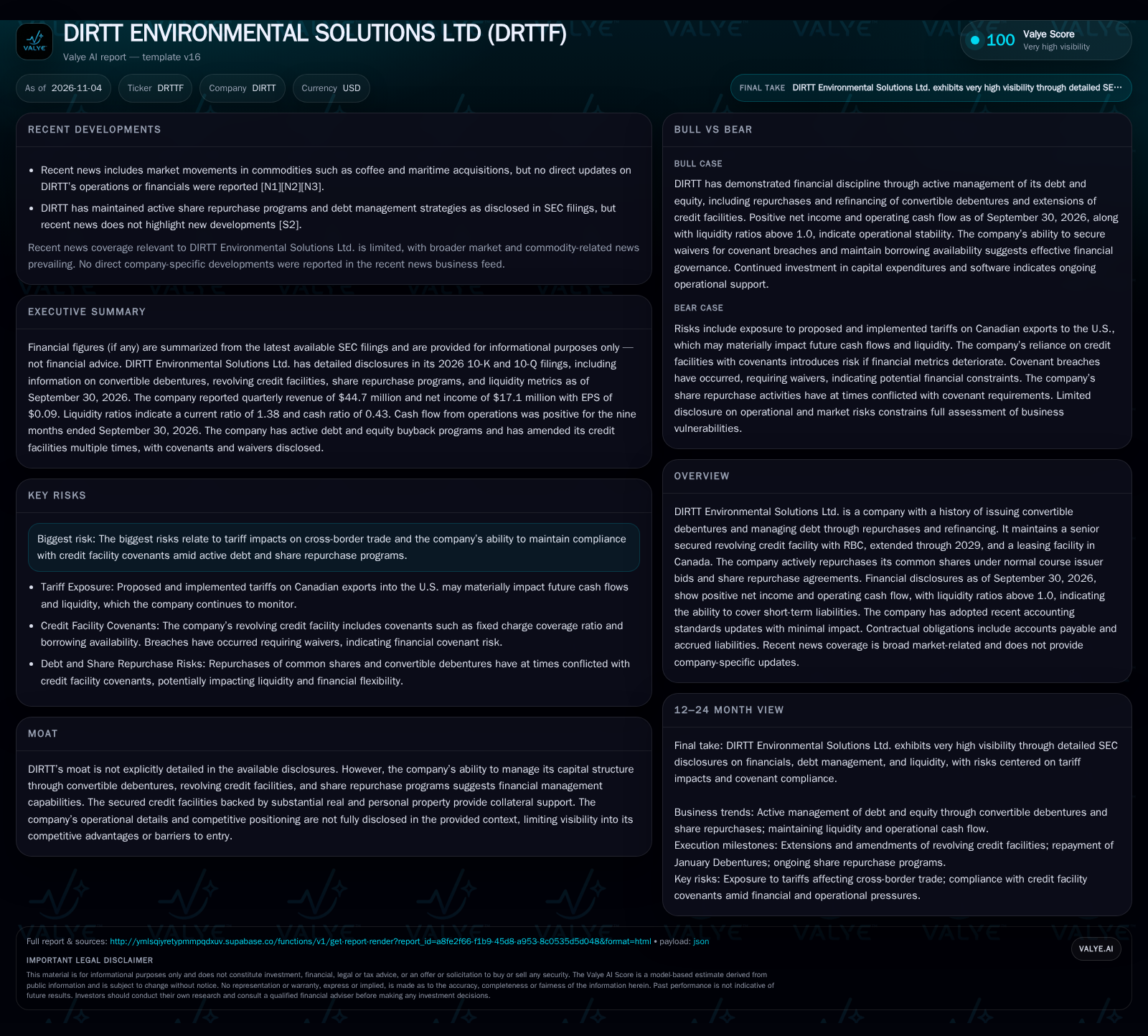
DIRTT Environmental Solutions reported $44.7 million in quarterly revenue and $17.1 million in net income as of September 30, 2026, with a current ratio of 1.38 and active debt and equity repurchase programs. While extending its senior secured credit facility to 2029, the company has required waivers for covenant breaches and faces material risks from potential U.S. tariffs on Canadian exports. [S2]
DIRTT Environmental Solutions sits at the intersection of disciplined capital management and external vulnerability. As of Q3 2026, the company delivered positive net income and operating cash flow, supported by a revolving credit facility now extended through 2029. Its active approach to repurchasing both equity and debt reflects a focus on capital efficiency. However, recurring covenant breaches—albeit managed through waivers—signal a delicate balance between financial engineering and underlying operational resilience. With looming uncertainty around U.S. tariffs on Canadian exports, DIRTT’s prospects will hinge on both its ability to navigate these external shocks and maintain internal fiscal discipline. [S2]
Recent Financial Performance and Capital Structure Developments
DIRTT Environmental Solutions reported $44.7 million in revenue for the quarter ended September 30, 2026, achieving net income of $17.1 million and basic and diluted EPS of $0.09. The company’s cash and equivalents stood at $19.3 million, with current assets of $61.7 million against current liabilities of $44.6 million, resulting in a current ratio of 1.38 and a cash ratio of 0.43. Operating cash flow was positive at $5.2 million for the nine-month period, while investing and financing activities reflected ongoing capital management, including repayments and new loan proceeds. The company has repurchased and cancelled millions of shares and debentures via active NCIB programs. DIRTT has extended its senior secured revolving credit facility with RBC to November 2029, but has required waivers for breaches of covenants tied to its share repurchase activity. These factors collectively define a business that is cash-generative but operating within tight financial guardrails. [S2]
How DIRTT’s Operating Model and Capital Choices Shape Its Economics
At its core, DIRTT’s business model appears to combine manufacturing or modular solutions—likely for interiors or construction—with a capital structure designed for flexibility and opportunistic value return. The company’s positive net income and operating cash flow suggest that its gross margins and cost discipline have stabilized, at least in the near term. Fixed costs are likely significant, given the asset-backed nature of its revolving credit facility and equipment leasing lines, but active repurchasing of shares and debentures indicates management’s focus on optimizing capital returns.
The economic engine is shaped by a mix of recurring project or product revenue and the need to maintain operating leverage. If DIRTT’s projects are lumpy or cyclical, the company’s reliance on revolvers and leasing could expose it to cash flow volatility, especially if customer demand is sensitive to macroeconomic cycles or construction sector swings. Capital needs are managed through a blend of traditional debt, convertible debentures, and equipment financing, with each layer carrying covenants that can restrict operational flexibility. The frequent need for waivers suggests that capital allocation decisions—such as share buybacks—are finely balanced against liquidity and covenant headroom. Pricing power may be constrained if DIRTT operates in a competitive, commoditized segment, making cost control and working capital efficiency critical levers for sustaining profitability.
Competitive Dynamics: Where DIRTT Sits in a Fragmented, Capital-Intensive Sector
DIRTT’s disclosures do not specify its precise market niche, but the combination of equipment-backed financing, project-driven revenues, and cross-border trade exposure suggests participation in the construction, modular interiors, or commercial fit-out markets. These sectors are typically fragmented, with competitors ranging from traditional construction suppliers to newer modular and prefab solution providers. Barriers to entry are moderate—requiring both physical assets and project delivery expertise—but not insurmountable for larger, better-capitalized players.
DIRTT may benefit from a reputation for financial discipline and the ability to structure bespoke financing for clients, but it faces counterforces in the form of price-based competition, customer switching to integrated or digital-first offerings, and exposure to macro shocks such as tariffs or supply chain disruptions. The absence of explicit evidence for proprietary technology, network effects, or sticky recurring contracts suggests that DIRTT’s moat, if any, is more about execution and capital flexibility than structural advantage. Its ability to secure waivers and extend credit lines does provide some resilience, but competitors with deeper balance sheets or more diversified revenue streams could have an edge in weathering economic downturns or absorbing regulatory shocks.
Unlocking Value: What Could Drive a Sustained Positive Re-rating for DIRTT?
A sustained rerating for DIRTT would likely require a confluence of internal execution and external stability. An improving macro backdrop—such as the resolution or avoidance of U.S. tariffs on Canadian exports—would remove a major overhang, allowing DIRTT to plan longer-term and perhaps take on more ambitious growth projects.
Upside would be confirmed by evidence of margin expansion, reduced frequency of covenant waivers, and disclosures of multi-year customer agreements or backlog that enhance revenue visibility. If DIRTT can leverage its capital flexibility to invest in higher-return projects or adjacent markets, and if it can demonstrate customer retention or network effects, this would further support a premium valuation. Conversely, a return to regular covenant breaches, margin compression, or renewed tariff risk would falsify the upside scenario.
Stable Operations, Ongoing Constraints: The Most Likely Trajectory
DIRTT’s most plausible near- to medium-term trajectory is one of continued stability, punctuated by careful capital management and periodic external stress. The company is likely to maintain positive operating cash flow and modest net income, using its extended credit facilities for working capital and project financing. Active repurchasing may persist, but only to the extent that it does not trigger fresh covenant breaches—suggesting a tactical, rather than aggressive, approach to capital return.
This base scenario would be confirmed by steady or slightly improving liquidity ratios, continued access to waivers when needed, and the absence of major adverse regulatory or macro shocks. Signs of stress would include increasing frequency of covenant breaches, inability to secure waivers, or a material deterioration in operating cash flow. The company’s exposure to tariffs and cross-border trade remains a persistent risk factor, but barring a significant escalation, DIRTT appears positioned to manage through the current environment with incremental improvements rather than dramatic shifts in strategy.
External Shocks and Tightening Financial Constraints: The Bearish Chain Reaction
The negative case for DIRTT centers on a scenario where either macro or company-specific shocks overwhelm its current financial guardrails. A material escalation in tariffs on Canadian exports to the U.S. could sharply reduce revenue and cash flow, undermining the ability to service debt and comply with credit facility covenants. If operating performance deteriorates—whether due to demand contraction, pricing pressure, or project execution issues—the company could breach covenants more frequently, potentially losing access to waivers and triggering default remedies from lenders.
This scenario might be confirmed by a sharp decrease in liquidity ratios, negative operating cash flow, unsuccessful negotiations for covenant relief, or forced curtailment of share repurchase programs. If DIRTT is forced into distressed asset sales or emergency capital raises, the downside could be compounded by dilution and loss of strategic flexibility. The risk is exacerbated by the lack of explicit evidence for durable competitive advantages, leaving DIRTT vulnerable to both internal missteps and external headwinds.
Factors That Could Shape DIRTT’s Thesis Over the Next 12-24 Months
Quarterly operating cash flow trends, especially the ability to consistently generate positive cash from operations.
Frequency and terms of credit facility covenant breaches, and DIRTT’s ongoing ability to secure waivers from lenders if disclosed.
Disclosure of any new or escalated tariffs on Canadian exports to the U.S., and management’s commentary on potential financial impact.
Changes in the company’s share and debenture repurchase activity, particularly if they coincide with tighter liquidity or covenant constraints.
Evidence of customer concentration, multi-year contracts, or backlog—if disclosed—that would improve revenue visibility and reduce volatility.
Gross margin and SG&A expense evolution, as indicators of pricing power and cost discipline.
Availability and utilization of the equipment leasing facility and revolving credit lines, including any amendments to borrowing terms.
Any strategic investments, divestitures, or new market entries that could signal a shift in DIRTT’s business model or risk profile.
Disclaimer: This is research-only, informational analysis and not investment advice. It may include AI-generated interpretation and general industry context. Always verify important details using primary sources.

Comments