
QUALCOMM in 2026: Margin Swings, Handset Headwinds, and the Stakes of Diversification
QUALCOMM’s 2026 results highlight a sharp profit rebound despite modest revenue decline, as handset weakness is offset by automotive, IoT, and strategic gains. The company’s licensing engine and R&D investments face mounting pressure from customer vertical integration and China exposure, raising the stakes for diversification into new silicon and embedded markets.
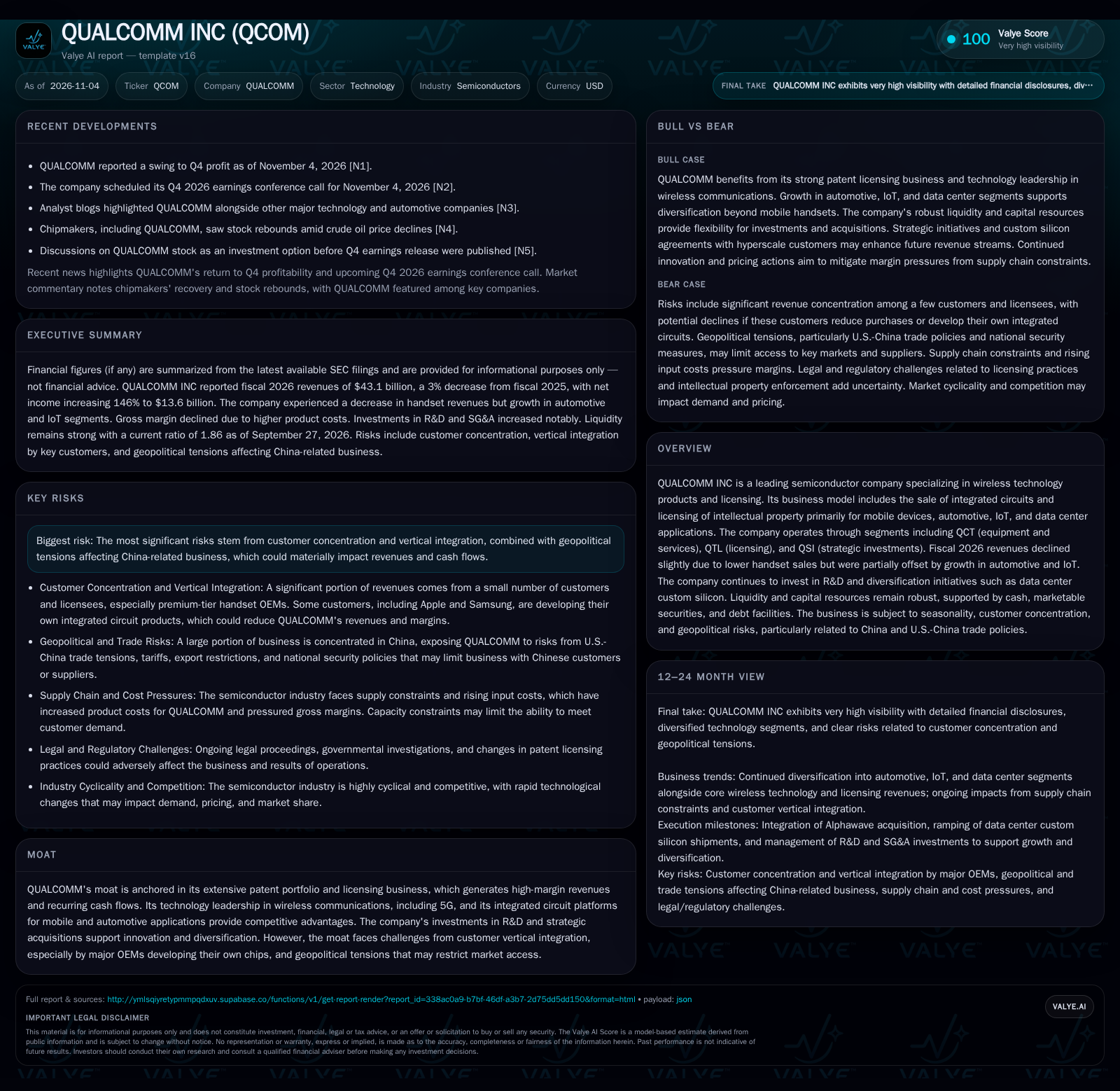
QUALCOMM posted a 3% revenue decline in fiscal 2026 to $43.1B, but net income surged 146% to $13.6B, due in part to a large tax benefit. Handset sales fell, but automotive and IoT contributed to segment resilience. Gross margin slipped to 53% on higher product costs, while R&D and SG&A spending rose. The company faces customer concentration, vertical integration by OEMs, and geopolitical risks, especially linked to China. Diversification into automotive, IoT, and data center silicon is now central to the forward thesis. [S1]
QUALCOMM’s 2026 results reveal a business in transition. Despite a modest revenue decline, the company reported a dramatic profit surge, largely on the back of a one-time tax benefit. Handset market weakness—long the company’s core—was only partially offset by gains in automotive and IoT, while gross margin slipped under cost pressure. With customer concentration and vertical integration by major OEMs intensifying, and with a large portion of revenue tied to China, QUALCOMM is leaning more heavily on its licensing engine and new verticals. The sustainability of this pivot will define its risk/reward over the next several years.
Profit Surges Amid Shrinking Handset Revenues and Margin Pressure
QUALCOMM reported fiscal 2026 revenue of $43.1 billion, down 3% from the prior year, primarily due to lower handset sales in its QCT segment. Despite this, net income soared 146% to $13.6 billion, a result heavily influenced by a $5.7 billion income tax benefit from the release of a valuation allowance on federal deferred tax assets. Gross margin declined to 53% from 55% in 2025, reflecting higher product costs, particularly in QCT. Meanwhile, automotive and IoT segments showed growth, partially cushioning the handset downturn. R&D and SG&A spending both increased, as the company targeted new markets and absorbed higher compensation expenses. [S1]
How QUALCOMM Makes—and Risks—Its Money: Licensing, Chips, and Expanding Verticals
QUALCOMM’s economics are driven by two core engines: its high-margin licensing business (QTL) and its chip/platform business (QCT). The QTL segment, anchored by a broad wireless patent portfolio, delivers recurring revenue with strong margins, as device makers pay royalties for access to essential intellectual property. This model is capital-light and resilient, provided industry participants remain reliant on QUALCOMM’s standards.
QCT, which includes integrated circuits and platforms for handsets, automotive, IoT, and networking, is more cyclical and exposed to competitive and input cost pressures. The fixed-cost base tied to R&D is significant, and incremental volume in new verticals (automotive, IoT, data center) could deliver operating leverage if QUALCOMM can scale these businesses faster than cost inflation. However, handset demand softness and rising product costs squeezed segment margins in 2026. The company’s strategic push into custom silicon for data centers and automotive chips requires sustained capital allocation and may face long adoption cycles before meaningfully shifting the revenue mix.
The sizable tax benefit in 2026 boosted net income but is non-recurring, and thus not indicative of underlying business momentum. Management’s ability to control opex while investing in new verticals will determine whether operating leverage improves as the business diversifies.
Competitive Pressure Intensifies as Customers Build In-House and Geopolitics Loom
QUALCOMM’s competitive moat has historically been built on standards-essential patents and system-level wireless innovation. However, the competitive landscape is evolving rapidly. Major customers such as Apple and Samsung are investing heavily in their own integrated circuits, threatening QUALCOMM’s share and pricing power in premium handsets. This vertical integration trend could erode both QCT volumes and QTL royalty streams if these OEMs successfully deploy proprietary technology and reduce their dependence on QUALCOMM IP.
In parallel, geopolitical risks—especially U.S.-China trade tensions—present existential threats to QUALCOMM’s China-derived revenue, both in chip sales and licensing. Export controls, shifting supply chains, and potential retaliatory measures could restrict market access or force Chinese OEMs to adopt domestic solutions. While QUALCOMM’s technology leadership in 5G, automotive, and IoT remains significant, the durability of its licensing model and hardware attach rates will be tested as the ecosystem fragments and national interests interfere with global standards.
Competitively, QUALCOMM faces pressure from other semiconductor designers (e.g., MediaTek, AMD, Nvidia for data center/AI) and from in-house silicon at large OEMs. Its ability to maintain leadership depends on continued R&D investment and success in embedding its platforms into high-growth applications beyond smartphones.
Diversification Delivers: Automotive, IoT, and Custom Silicon Gain Traction
In a favorable scenario, QUALCOMM’s investments in automotive, IoT, and data center silicon yield tangible revenue and profit growth, offsetting ongoing handset weakness. Automotive chip adoption accelerates as OEMs standardize on QUALCOMM’s platforms for connectivity, infotainment, and ADAS, driving multi-year supply agreements and higher average content per vehicle. IoT revenues scale as embedded wireless and edge compute become ubiquitous in industrial and consumer devices. Early wins in custom silicon for hyperscalers expand the company’s addressable market and establish new high-margin recurring revenue streams.
If this scenario materializes, confirming evidence would include: segment reporting that shows sustained double-digit growth in automotive and IoT revenues; expanding design wins with global automakers and industrial IoT leaders; and publicized multi-year silicon supply agreements with data center customers. Falsification would be visible if these segments stagnate or fail to compensate for handset declines, or if gross margin does not stabilize despite revenue mix shift.
Incremental Progress in New Verticals Offsets Handset Plateau, but Margin Recovery Is Uneven
The most plausible path is a slow, uneven transition: handset revenues remain under pressure due to customer vertical integration and market saturation, but automotive and IoT continue to deliver moderate growth. Licensing remains resilient but faces incremental erosion as top OEMs internalize more of the wireless stack. Gross margin remains compressed relative to historical norms, as higher input costs and a less favorable segment mix persist.
In this scenario, QUALCOMM’s overall revenue stabilizes or grows modestly, but margin volatility continues. Evidence would include flat to low-single-digit total revenue growth, modest but consistent expansion in automotive and IoT, and stable but not expanding QTL royalties. Confirmation would come from disclosures of new customer wins in growth segments, while failure to achieve scale in these verticals or further gross margin compression would falsify the base case.
Handset Decline and China Shocks Overwhelm Diversification Efforts
An adverse outcome would see handset revenues fall faster than automotive and IoT can grow, as OEMs like Apple and Samsung shift to in-house chips and licensing rates come under regulatory and customer pressure. At the same time, escalating U.S.-China trade tensions or new export restrictions could sharply curtail QUALCOMM’s China business, both in chip shipments and licensing streams.
This scenario would likely be confirmed by successive quarters of double-digit revenue declines in QCT, shrinking QTL royalty base, and management guidance cuts tied to lost market access or customer attrition. Gross margin could fall further if product cost inflation outpaces pricing power or if R&D spending cannot be scaled back proportionally. Evidence that automotive and IoT are failing to deliver material growth, or that cash flows are pressured by legal or regulatory settlements, would also support the downside view.
What Will Determine QUALCOMM’s Next Act: Segment Trajectories and Structural Shifts
Quarterly and annual revenue growth rates in automotive and IoT segments—sustained double-digit growth would strengthen the diversification thesis. [S1]
QCT segment gross margin trends—improvement would indicate successful cost control or pricing power in new verticals; further deterioration would signal margin risk. [S1]
QTL royalty base and rate disclosures—stability or erosion in licensing revenues, especially as top customers pursue in-house silicon, would test the moat. [S1]
Geographic revenue mix, particularly proportion of sales and royalties derived from China—shifts would highlight exposure or resilience to geopolitical risk. [S1] [S2]
Major disclosed design wins or multi-year agreements in automotive, IoT, or data center silicon—would confirm traction outside handsets, if disclosed.
R&D and SG&A expense growth relative to new revenue generation—a widening gap would pressure margins, while improved leverage would support profitability. [S1]
Material legal or regulatory developments affecting licensing practices—new rulings or settlements could alter the economics of the QTL segment, if disclosed.
Evidence of customer concentration changes, such as diversification of the top-10 customer list or new large OEM wins—would reflect progress against concentration risk, if disclosed.
Disclaimer: This is research-only, informational analysis and not investment advice. It may include AI-generated interpretation and general industry context. Always verify important details using primary sources.

Comments