
Tianci International: Asset-Light Logistics Meets High-Risk Diversification into Mining and Digital Infrastructure
Tianci International remains anchored in global logistics through its asset-light subsidiary, Roshing International, but is pivoting into new verticals including cryptocurrency mining and mineral development.
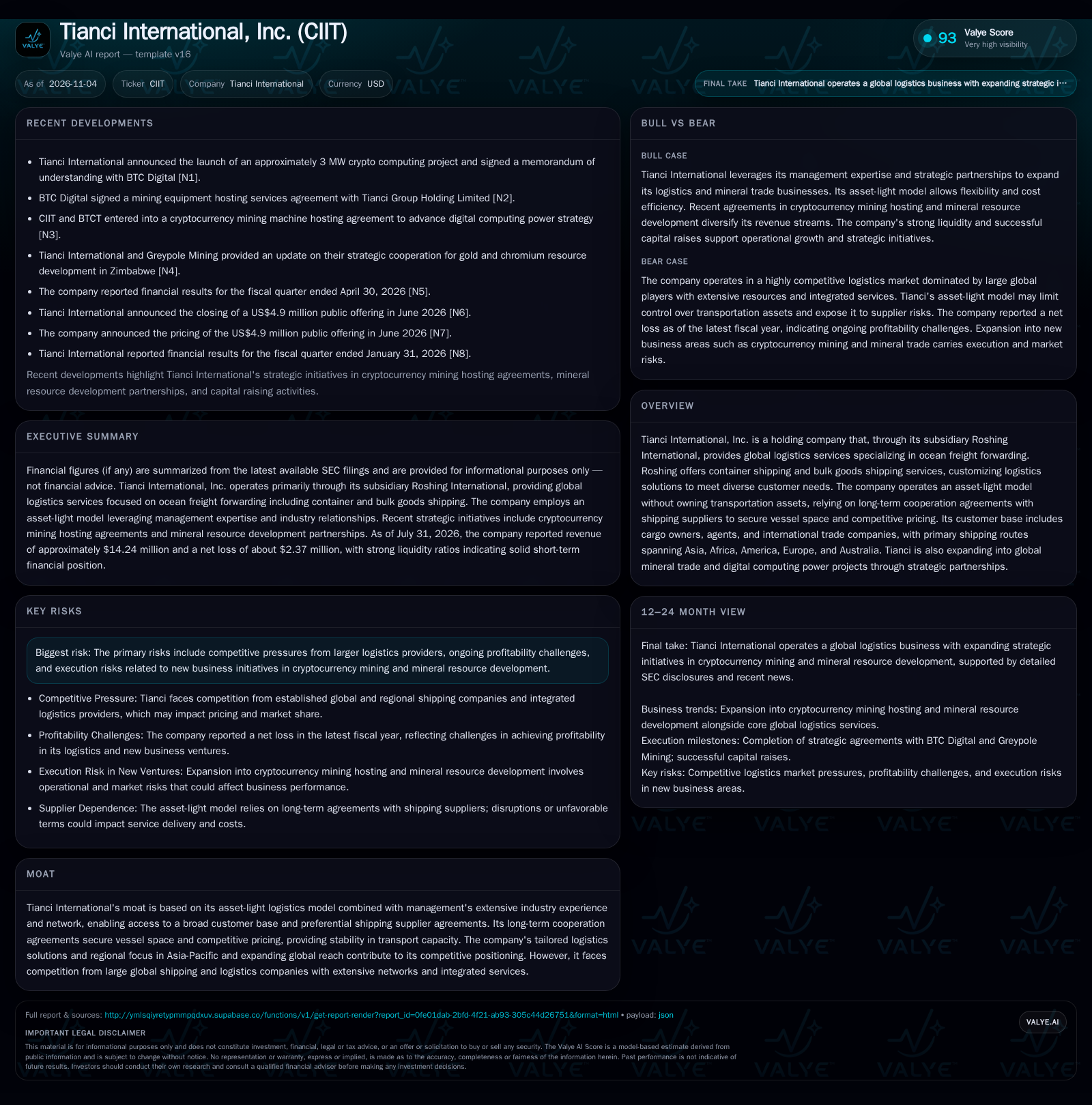
Tianci International remains anchored in global logistics through its asset-light subsidiary, Roshing International, but is pivoting into new verticals including cryptocurrency mining and mineral development. Near-term results will hinge on Tianci’s ability to integrate and scale these new ventures without undermining its core logistics franchise. [S1] [N1] [N6]
Tianci International, Inc. stands at a crossroads between operational discipline and ambitious diversification. Its core business—asset-light, global ocean freight logistics—offers flexibility and margin resilience in an industry notorious for volatility and capital intensity. However, the company’s new ventures into cryptocurrency mining and mineral resource development signal a bold but risky attempt to capture growth beyond traditional logistics.With recent capital infusions and a reported current ratio, Tianci possesses near-term financial stability, but persistent net losses and the complexity of its expansion raise questions about whether it can generate sustainable returns or will face the pitfalls of overextension. [S1] [N1] [N6]
Recent Capital Raise and Diversification Efforts Reshape Tianci’s Risk Profile
As of July 31, 2026, Tianci International reported $14.24 million in revenue and a net loss of $2.37 million, reflecting ongoing profitability challenges. The company reported cash and liquidity metrics for the period; these figures do not by themselves establish operating runway, investment capacity, financial flexibility, or financing capacity. Recent operational moves include launching a 3 MW crypto computing project and entering hosting agreements with BTC Digital and BTCT, as well as mineral development partnerships in Zimbabwe. These facts highlight both the company’s potential financial flexibility and its increasing exposure to new, higher-risk business lines. [S1] [N1] [N4] [N6]
Asset-Light Logistics Economics and the Uncertain Path of New Ventures
Tianci’s logistics business, conducted through Roshing International, is built on an asset-light model. By not owning vessels or large physical infrastructure, the company limits capital expenditures, benefiting from low fixed costs and scalable operations. Revenue is generated through freight forwarding, contract management, and customized logistics services, with margins dependent on volume, supplier pricing, and Tianci’s ability to secure preferential rates via long-term agreements. This model can deliver moderate operating leverage: incremental growth in shipments or customer contracts can enhance margins if fixed overhead is tightly managed.
However, the economics of Tianci’s new ventures in cryptocurrency mining and mineral trading are fundamentally different. Crypto mining hosting is typically capital-intensive, subject to volatile demand, energy costs, and rapid hardware obsolescence. Profitability in mineral trading hinges on commodity price cycles, supply chain integration, and inventory risk. Both verticals introduce potential for higher gross margins but also for greater earnings volatility, working capital swings, and execution missteps. The company’s recent capital raise provides resources for these expansions, but without clear evidence of recurring revenue or cost discipline in these segments, sustained profitability remains uncertain. [S1] [N1] [N4] [N6]
Navigating Global Giants: Tianci’s Niche Strategy Versus Integrated Logistics Titans
In the core container shipping and logistics market, Tianci faces formidable competition from global shipping giants such as Maersk, MSC, and CMA CGM, as well as integrated logistics providers like DHL and FedEx. These incumbents possess vast fleets, end-to-end service portfolios, and considerable pricing power. Tianci’s asset-light approach allows for flexibility and lower overhead, but it also means dependence on third-party vessel operators and exposure to supplier risk.
The company’s differentiation hinges on management’s industry expertise, long-term supplier agreements, and the ability to offer tailored solutions on Asia-Africa-Americas-Europe routes. This may allow Tianci to serve niche customer segments underserved by larger players. However, in the newer domains of crypto mining and mineral resources, the competitive landscape is even more fragmented and volatile, with well-capitalized industrial, technology, and mining firms already entrenched. Tianci’s lack of operating history and scale in these sectors raises questions about its ability to carve out a defensible position or secure sustainable margins.
If Diversification Pays Off: Synergy and Margin Expansion Possibilities
The most optimistic scenario is that Tianci successfully leverages its logistics platform to vertically integrate mineral trading and digital infrastructure, creating new revenue streams that are both higher margin and synergistic. For instance, the company could use its logistics expertise to optimize global mineral shipments, reduce delivery times, and control costs, while also capturing value from crypto hosting through energy arbitrage or partnerships with mining equipment providers.
Evidence that would confirm this upside includes: accelerating revenue growth with improving gross and operating margins, successful onboarding of new crypto hosting customers with visible, recurring contracts, and material mineral trading volumes that demonstrate operational integration. A shift from net loss to profitability, alongside stable or improving cash flow from operations, would strongly validate this scenario. Announcements of new, multi-year customer wins or renewals in the new business lines would also suggest traction.
Core Logistics Remains Steady While New Ventures Prove Incremental—Not Transformative
The most plausible near-term outcome is that Tianci’s logistics business continues to operate at modest scale, generating steady but unspectacular revenue with limited margin expansion due to competitive pressures and supplier dependence. The company’s foray into crypto mining and mineral trading yields incremental revenue, but these segments remain volatile and margin-dilutive, absorbing management attention and working capital without materially improving group-level profitability.
Confirmation of this scenario would come from stable logistics revenue, continued net losses or only marginal improvement in profitability, and periodic announcements of small-scale contracts or pilot projects in the new verticals—without evidence of large, recurring customer wins or significant margin expansion. If cash burn accelerates or working capital needs rise sharply, it would further support the view that diversification is not yet delivering transformative results.
Overextension and Execution Risk: When Diversification Erodes the Core
The adverse scenario is that Tianci’s aggressive expansion into capital- and risk-intensive sectors distracts management, strains resources, and exposes the company to losses from unproven ventures. Crypto mining hosting could suffer from underutilized capacity, power cost spikes, or unfavorable contract terms, while mineral trading could tie up capital in inventory or expose the company to commodity price swings and counterparty defaults.
Evidence for this scenario would include: persistent or widening net losses, deteriorating cash flow from operations, material write-downs or impairments in crypto or mineral assets, and signs of customer or supplier churn in the core logistics business.
Milestones That Will Test Tianci’s Multi-Sector Ambitions
Quarterly trends in logistics segment revenue and gross margin, to assess whether the core business is growing and maintaining profitability—or being diluted by new ventures.
Progress reports on customer wins, contract renewals, or backlog in cryptocurrency mining hosting and mineral trading, to gauge whether these segments are scaling beyond pilot phases. [N1] [N3] [N4]
Cash flow from operations and changes in working capital requirements, especially as inventory builds in mineral trading or equipment is deployed in crypto hosting. [S1]
Updates on vessel space agreements and supplier pricing in logistics, as these are critical to maintaining cost competitiveness and service reliability. [S1]
Disclosure of any write-downs, impairments, or material losses in new business lines, which would indicate execution missteps or market headwinds.
Announcements of additional capital raises or debt financing, which could signal either opportunity or stress in funding expansion plans. [N6]
Management commentary on integration progress, cross-selling opportunities, and operational synergies between logistics, mineral, and digital infrastructure operations.
Disclaimer: This is research-only, informational analysis and not investment advice. It may include AI-generated interpretation and general industry context. Always verify important details using primary sources.

Comments