
Prospect Capital’s Middle-Market Lending Model: Fee Burden, Credit Risk, and the Dividend Trade-Off
Prospect Capital’s externally managed BDC structure delivers scale and portfolio breadth in U.S. middle-market lending, but persistent net losses and high expense ratios spotlight the tension between dividend payouts and long-term shareholder value. The company’s mix of senior secured loans and equity-linked investments supports income generation, but challenges around management fees, credit risk, and market discount to NAV remain central to its investment case.
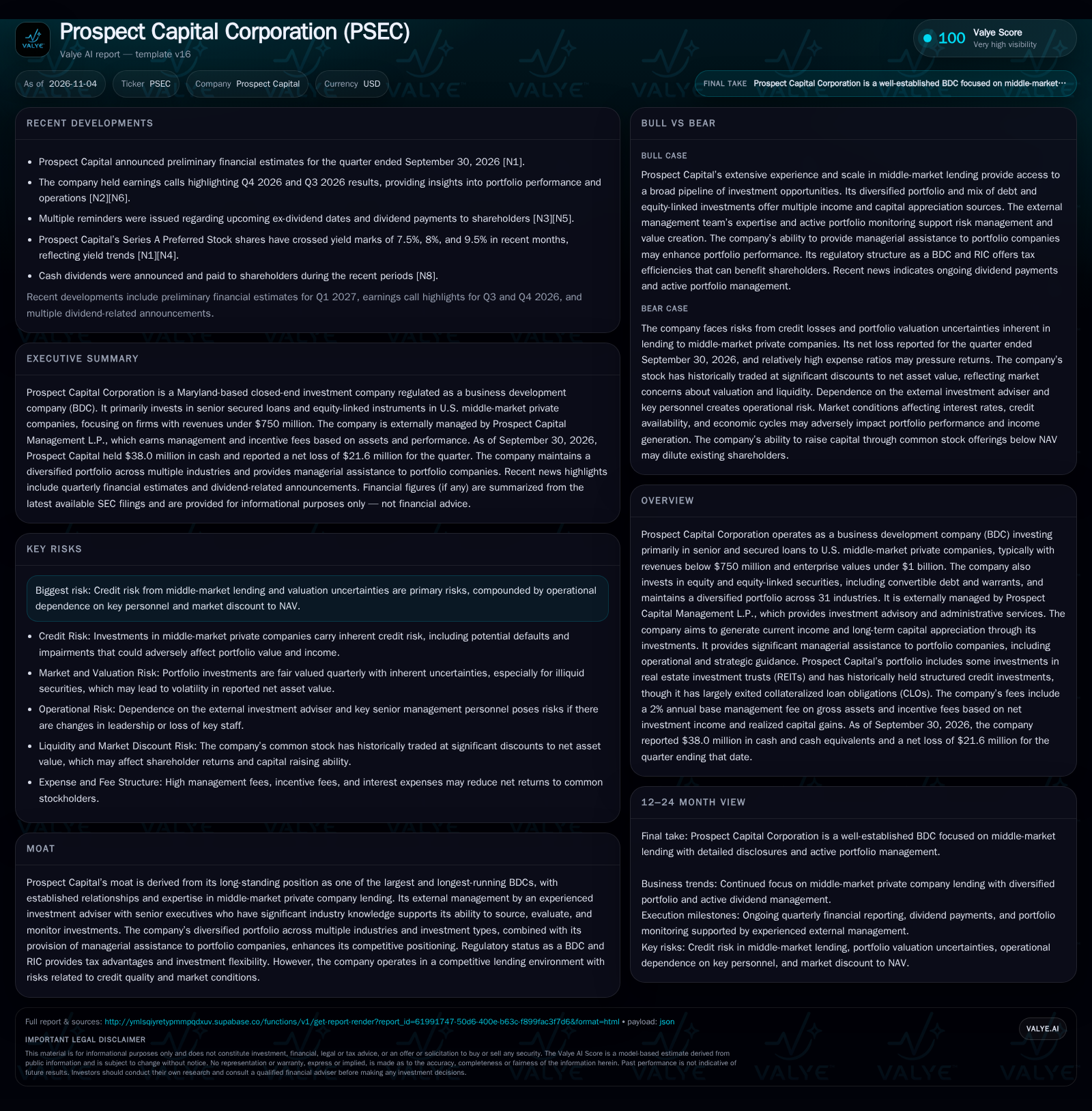
Prospect Capital reported a net loss and high expense ratios for Q3 2026, underscoring the ongoing tension between income generation and cost drag in its externally managed BDC model. The company continues to prioritize senior secured lending to U.S. middle-market companies, maintains a diversified portfolio, and pays regular dividends, but faces persistent risks from credit exposures, valuation uncertainty, and the impact of its fee structure on common shareholders. The core debate centers on whether Prospect’s scale and experience can offset the headwinds of credit and fee drag in a competitive lending environment. [S2] [N1]
Prospect Capital Corporation, one of the largest and longest-operating U.S. business development companies, sits at the intersection of middle-market credit provision and investment income delivery. The cited source reports dividend-related activity; that disclosure alone does not establish dividend-policy continuity, management confidence, or a material constraint on capital flexibility. As middle-market lending faces renewed credit and valuation uncertainties, Prospect’s ability to balance cost, risk, and income generation will define its trajectory.
Recent Results: Losses, Fee Drag, and Dividend Continuity
Prospect Capital reported a net loss of $21.6 million for the quarter ended September 30, 2026, with basic and diluted EPS of -$0.10 per share, reflecting ongoing profitability pressures [S2]. Total annual expenses attributable to common stockholders stood at 14.93%, a figure that already includes management and incentive fees, interest expense, and other costs, with preferred stock dividends further increasing the overall expense burden [S2]. The cited source reports dividend-related activity; that disclosure alone does not establish dividend-policy continuity, management confidence, or a material constraint on capital flexibility. [N3] [N5] [N8] These facts highlight the persistent tension between income distribution to shareholders and the structural cost of Prospect’s externally managed BDC model.
How Prospect Capital Monetizes Middle-Market Lending
Prospect Capital’s core business is to originate and hold senior and secured first-lien loans, primarily to U.S. middle-market privately-held companies, generally with revenues under $750 million and enterprise values under $1 billion [S1]. The company supplements this with second-lien loans, equity, and equity-linked instruments—such as convertible debt, preferred equity, and warrants—that offer potential for both income and capital appreciation. Revenue is generated from interest income on loans, dividend income on equity holdings, and capital gains from exits or repayments. The company’s BDC and RIC status allows it to avoid corporate income tax if it distributes at least 90% of taxable income as dividends, reinforcing the focus on current income.
However, the economics are heavily shaped by the external management structure: Prospect Capital Management L.P. collects a 2% annual base management fee on gross assets and a two-part incentive fee based on pre-incentive fee net investment income and realized capital gains [S1]. These fees are paid regardless of the company’s performance to common shareholders, creating a fixed cost base that compresses net returns. Layered on top are interest expenses from unsecured notes (with rates ranging from 2.25% to 8.00% and maturities out to 2052) [S2], as well as preferred stock dividends. Thus, while the lending model can generate high gross yields, the combination of fee drag and leverage magnifies downside risk in periods of credit stress or when portfolio yields compress.
Scale and Relationships Versus a Crowded Middle-Market Lending Field
Prospect Capital’s competitive strengths stem from its scale, established relationships in the middle-market lending arena, and its diversified portfolio across 31 industry categories, with no single industry exceeding 18.1% of exposure (excluding legacy CLOs) [S1]. The company’s ability to provide managerial assistance to portfolio companies can enhance risk management and value creation, helping to differentiate it from purely transactional lenders.
However, the middle-market lending environment remains highly competitive, with other BDCs, private credit funds, and regional banks all targeting similar borrowers. The external management structure, while providing access to experienced investment professionals, may put Prospect at a structural disadvantage on expense ratios compared to internally managed peers. The historical discount to net asset value (NAV) in Prospect’s stock price also suggests that the market perceives risks or inefficiencies relative to peers. The company’s exit from most CLO investments has reduced complexity but also narrowed sources of non-core income. Ultimately, Prospect’s ability to source quality credits and manage losses better than the field will determine its relative performance.
If Credit Quality Holds and Origination Spreads Widen
The most constructive scenario for Prospect Capital is one in which credit conditions in the U.S. middle market remain benign, and competitive pressures or rising rates allow for higher spreads on new loan originations. In this environment, Prospect’s scale and origination relationships could allow it to cherry-pick attractive risk-adjusted opportunities, while modestly increasing portfolio yields.
Confirmation would come from future quarters showing: a return to positive net income, improved net investment income coverage of dividends, a reduction in non-accruals or realized losses, and evidence of higher yields on new investments. A sustained narrowing of the market discount to NAV would also signal increased investor trust in the model. Falsification would come from increased credit losses, continued net losses, or further widening of the NAV discount.
Dividend Maintenance Amid Fee Drag and Credit Cyclicality
Net investment income may fluctuate with credit cycles and interest rate moves, but the company is likely to keep distributing the bulk of its taxable income to preserve RIC status. Expense ratios will remain elevated due to the external management contract, limiting net returns to common shareholders even in stable or favorable markets.
In this scenario, NAV discounts persist as the market prices in fee drag, credit risk, and potential dilution from capital raises below NAV. Shareholder returns are driven mainly by the yield on common and preferred equity, with limited capital appreciation.
Credit Deterioration and Dividend Coverage Shortfall
The adverse scenario is dominated by rising credit losses in Prospect’s middle-market loan book—either from a cyclical downturn or sector-specific stress. Increased non-accruals and impairments would reduce net investment income and could force the company to fund dividends from asset sales or additional leverage, eroding NAV over time. Persistent net losses would heighten investor concerns and could lead to further widening of the stock’s discount to NAV.
Confirmation would include a rising trend of non-accruals, larger realized and unrealized losses, and a dividend cut or suspension. A spike in preferred and unsecured debt yields, as seen in the recent rise of Series A Preferred Stock yields above 9.5%, could also signal market concerns about credit quality or payout sustainability [N1]. Falsification of this scenario would require stabilization or improvement in credit metrics and persistent dividend coverage from recurring income.
What Will Decide Prospect Capital’s True Value Proposition?
Quarterly net investment income and its coverage of both common and preferred dividends—if disclosed—will be crucial for assessing payout sustainability.
The trend in portfolio non-accruals and realized credit losses, which would signal either improving or deteriorating credit quality.
Yields on new loan originations and changes in average portfolio yield, reflecting competitive dynamics and risk pricing.
Expense ratio (as a percentage of assets and income) to see whether fee drag is rising, stable, or declining.
Discount or premium of PSEC’s stock price to reported NAV per share, which encapsulates market confidence and perceived risk.
Duration and cost of outstanding debt, especially any refinancing of unsecured notes, as rising interest expense could pressure net returns.
Preferred stock yields and trading levels as a market signal of risk perception and payout stability.
Any change in external management terms, fee structure, or a move toward internalization, which could alter long-term economics for shareholders.
Disclaimer: This is research-only, informational analysis and not investment advice. It may include AI-generated interpretation and general industry context. Always verify important details using primary sources.

Comments