
Stepan Company’s Restructuring Push: Margin Recovery, Global Complexity, and the Stakes of Chemical Portfolio Diversification
Stepan’s Q3 2026 results highlight operational momentum and cost-reduction efforts as Project Catalyst reshapes its manufacturing footprint. With broad exposure across surfactants, polymers, and specialty chemicals, the company confronts regulatory, environmental, and input-cost risks—while seeking operating leverage and scale-driven resilience.
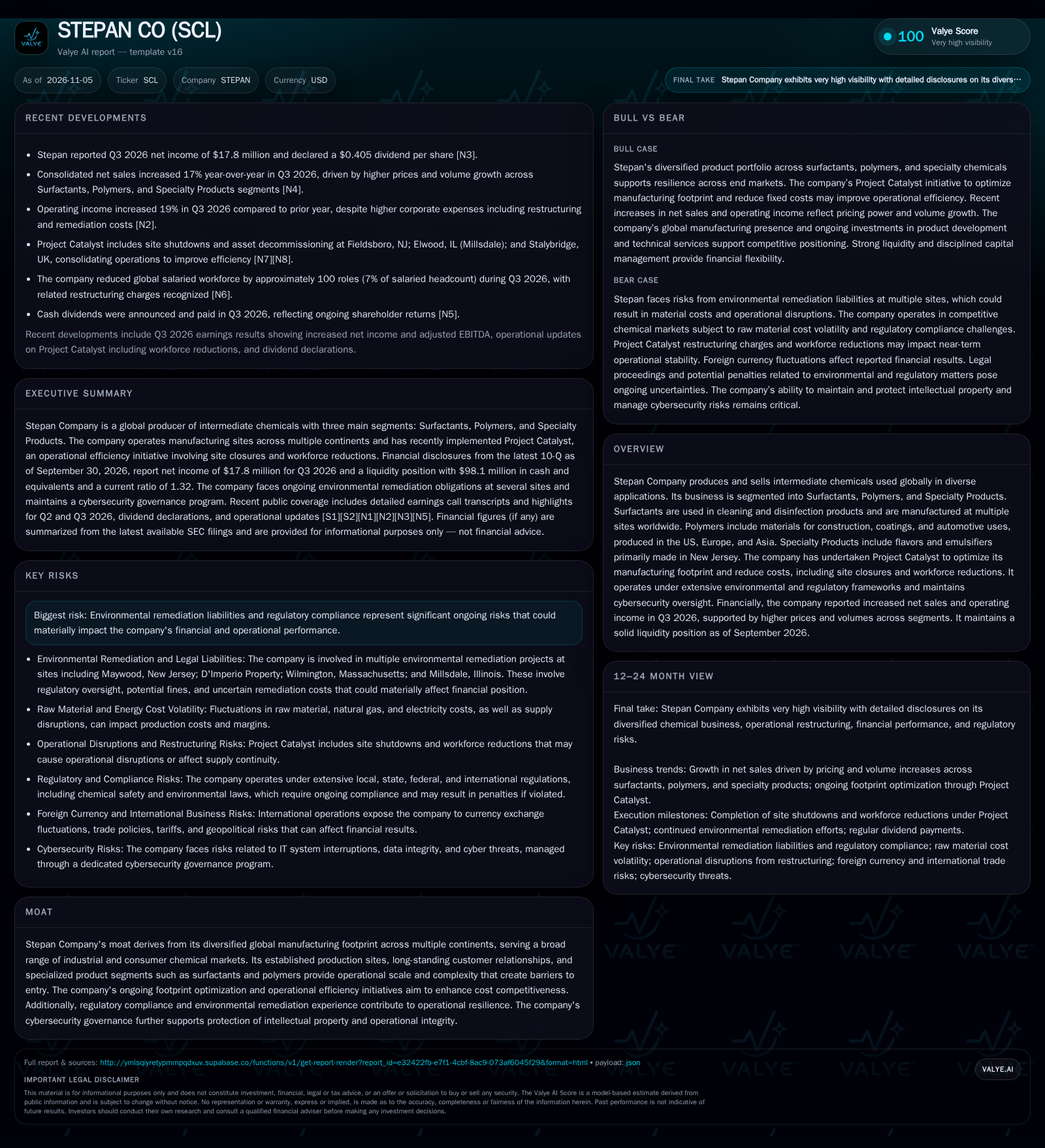
Stepan’s double-digit revenue and EBITDA growth in Q3 2026 reflect both pricing and volume gains across all segments, as the company executes Project Catalyst to rationalize its asset base and workforce. While restructuring delivers immediate cost savings, ongoing environmental liabilities and raw material volatility remain key challenges. The business model’s global reach and customer diversity may buffer shocks, but sustained margin expansion will depend on the successful realization of efficiency targets and disciplined risk management.
Stepan Company’s Q3 2026 performance punctuates a pivotal phase in its operational evolution: double-digit top- and bottom-line growth, fueled by both price and volume gains, arrives as the company executes Project Catalyst—an ambitious program to streamline manufacturing and reduce fixed costs. With a global, multi-segment chemical portfolio, Stepan’s fortunes are shaped by the interplay of scale-driven efficiencies, end-market resilience, and persistent environmental and regulatory headwinds. The company’s ability to translate recent restructuring into sustainable margin improvement, while navigating raw material volatility and remediation obligations, will define its competitive standing and shareholder value creation in the coming quarters.
Restructuring Drives Earnings Momentum Amid Broad-Based Segment Growth
Stepan reported Q3 2026 net sales growth of 17% year-over-year, with all three operating segments—Surfactants, Polymers, and Specialty Products—registering double-digit increases. The Surfactants segment, which comprises 71% of net sales, grew 15%; Polymers advanced 24%; and Specialty Products rose 12% [S2]. Adjusted EBITDA expanded by 18% year-over-year, and net income reached $17.8 million, up from $10.8 million in the prior-year quarter [S2] [N3].
Project Catalyst, Stepan’s footprint optimization initiative, led to the shutdown of Fieldsboro, NJ, and asset decommissions at Elwood, IL, and Stalybridge, UK, alongside a 7% reduction in salaried headcount—about 100 roles globally [S2] [N6]. Restructuring charges were incurred, but operating income still increased 19% year-over-year in Q3 2026 [S2].
The company’s liquidity position as of September 2026 included $98.1 million in cash and equivalents and a current ratio of 1.32 [S2]. Environmental remediation liabilities at several sites remain an ongoing financial and regulatory consideration [S1].
How Stepan’s Portfolio Mix and Cost Structure Shape Profit Potential
Stepan generates revenue by producing and selling intermediate chemicals, with the majority of sales from surfactants—a category essential in both consumer and industrial cleaning applications. The company’s value proposition is rooted in consistent demand from everyday products and infrastructure-related end markets, with polymers supplying construction, coatings, and automotive uses.
Pricing and volume are both critical levers: Q3 2026’s revenue expansion was attributed to higher average selling prices and increased volumes across all segments [S2]. This suggests some degree of pricing power, but also exposes the company to raw material cost swings, as input prices for petrochemicals, energy, and specialty feedstocks can be volatile. The company’s global manufacturing footprint allows for some hedging of regional demand and supply shocks, but also introduces complexity in logistics and regulatory compliance.
Project Catalyst’s focus on site consolidation and workforce reduction targets a lower fixed-cost base, which, if executed effectively, should enhance operating leverage. The potential for margin expansion will depend on the scale of savings relative to restructuring charges and the company’s ability to maintain service levels and customer relationships through the transition. The cited source reports dividend-related activity; that disclosure alone does not establish dividend-policy continuity, management confidence, or a material constraint on capital flexibility.
Global Scale, Product Breadth, and the Realities of Commodity Exposure
Stepan’s competitive positioning is built around a diversified product portfolio, global manufacturing reach, and long-standing customer relationships—especially in surfactants, where switching costs can be moderate given product customization and integration into customers’ supply chains. The company’s ability to serve multiple geographies and end markets provides resilience against regional downturns or idiosyncratic demand shocks.
However, the chemical industry is intensely competitive, with global and regional players competing on price, innovation, and service. For surfactants and polymers, substitutes and alternative suppliers are always a threat, especially in commodity-like applications. Differentiation in specialty products is stronger, but that segment represents a small share of sales (4% in 2025) [S2].
Regulatory experience and environmental compliance are double-edged: they create barriers to entry for less sophisticated rivals, but also saddle incumbents like Stepan with legacy remediation and compliance costs. The company’s scale and operational complexity could be a moat if operational discipline is maintained, but also a risk if restructuring disrupts supply or erodes customer trust.
If Project Catalyst Delivers: Efficiency Gains and Margin Expansion
The most favorable scenario centers on Stepan realizing substantial, sustainable cost savings from Project Catalyst. If site closures and headcount reductions yield lower fixed costs without impairing production flexibility or customer service, the company could achieve higher operating margins as volume recovers or grows.
Confirmation of this scenario would come from continued double-digit EBITDA and operating income growth in future quarters, with restructuring charges receding and margin expansion visible in segment-level results. Evidence of stable or growing customer relationships despite operational changes—such as minimal churn in surfactants or new wins in polymers—would reinforce the thesis.
Further, if Stepan leverages its global manufacturing base to win new contracts or expand into higher-value specialty products, this could drive a positive mix shift and reduce exposure to commodity cycles. Sustained pricing power—demonstrated through continued ability to pass on raw material cost increases—would also validate the upside case.
Operational Discipline Meets Persistent Headwinds
The most plausible path is that Stepan’s restructuring enables incremental efficiency gains, but these are offset by ongoing environmental liabilities, raw material volatility, and competitive pricing pressures. Revenue growth may moderate as the easy gains from price increases and post-pandemic demand normalize, but the diversified portfolio and global footprint support stable volumes.
In this scenario, margin improvement is gradual, as cost savings are partially consumed by remediation costs, compliance expenses, or the need to reinvest in operational reliability.
Evidence supporting this scenario would include stable-to-modestly rising EBITDA margins, steady dividend payments, and periodic updates on remediation progress without major new liabilities. Segment sales growth may revert to mid-single digits, with no major gains or losses in share to competitors.
Environmental Liabilities or Supply Disruptions Derail Progress
A negative scenario could play out if environmental remediation costs spike unexpectedly—due to regulatory changes, adverse legal outcomes, or unforeseen site conditions—diverting cash from growth and eroding profitability. Alternatively, if Project Catalyst’s site closures or workforce reductions disrupt supply chains or quality, Stepan could lose key customers, particularly in commodity surfactants where alternatives exist.
This downside case would be confirmed by a sharp increase in restructuring or remediation charges, margin compression, or evidence of volume losses in core segments. Negative headlines involving regulatory fines, legal judgments, or major product recalls would also signal risk materialization.
A third risk is raw material cost inflation outpacing the company’s ability to pass through price increases, causing a squeeze on gross margins. In this scenario, liquidity could become strained if remediation, restructuring, and operating costs converge at inopportune times.
What Will Prove Stepan’s Margin Story, Risk Management, and Portfolio Resilience?
Quarterly trend in adjusted EBITDA and segment operating margins—whether efficiency gains from Project Catalyst translate into sustained profitability.
Updates on environmental remediation liabilities and cash outflows, particularly for legacy sites such as Maywood, D'Imperio, Wilmington, and Millsdale.
Volume growth or retention in core surfactant customer contracts, especially if disclosed, as an indicator of post-restructuring customer stability.
Gross margin trends relative to raw material and energy cost inflation—a useful metric would be pass-through effectiveness and lag time.
Progress on site shutdowns, asset sales, and workforce reductions under Project Catalyst, including whether cost savings targets are met on schedule.
Evidence of mix shift toward higher-margin specialty products or new product launches, if disclosed in segment reporting.
Announcements or disclosures of regulatory actions, fines, or legal settlements that could impact potential financial flexibility.
Foreign currency impact on reported results and management commentary on hedging or geographic portfolio adjustments.
Disclaimer: This is research-only, informational analysis and not investment advice. It may include AI-generated interpretation and general industry context. Always verify important details using primary sources.

Comments