
Stewart Information Services Confronts Margin Pressure While Expanding Commercial Title Business
Stewart Information Services faces renewed margin pressure as Q3 2026 profits fall, even as commercial and real estate solutions revenues accelerate. The company’s ability to balance operating expenses, claims management, and market sensitivity will determine whether recent growth in high-value segments can offset cyclical headwinds.
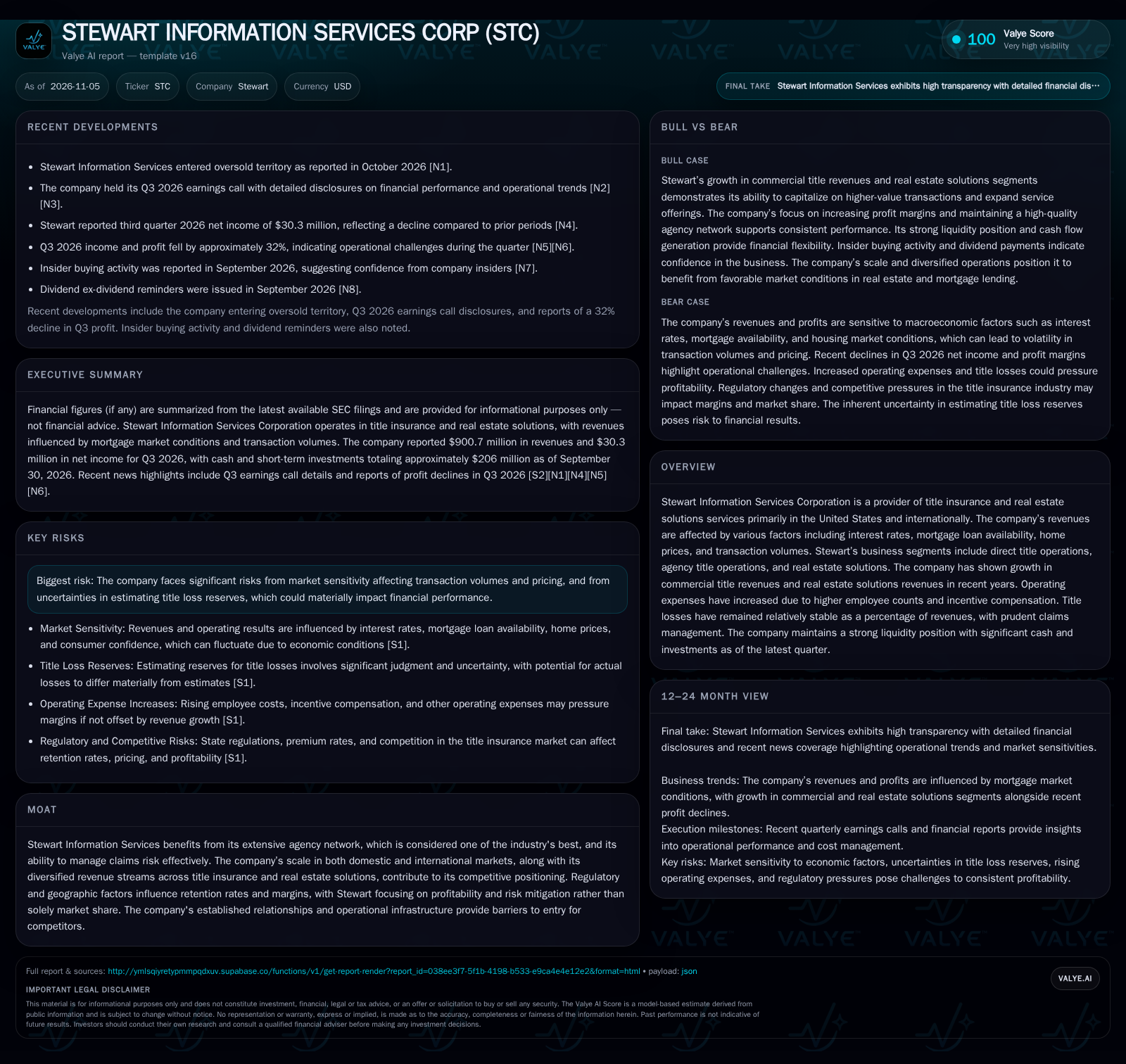
Stewart Information Services reported Q3 2026 net income of $30.3 million, a 32% decline from prior periods, despite notable growth in commercial title and real estate solutions revenues. Operating expenses rose alongside employee costs, while title losses as a percentage of revenue ticked up slightly. The company’s balance sheet remains robust, but profitability is increasingly exposed to mortgage market fluctuations and cost inflation. The key question is whether Stewart’s expansion in higher-margin business lines can outpace persistent macro and expense pressures over the coming cycle. [S2] [N4] [N5] [N6]
Stewart Information Services enters late 2026 at a crossroads: while the company is capturing growth in commercial title insurance and expanding its real estate solutions segment, its latest quarterly profit dropped sharply. With Q3 2026 net income down 32% year-over-year, cost pressures and claims volatility are squeezing margins even as topline momentum persists in select business lines. Stewart’s future trajectory will hinge on its ability to convert high-value segment growth into sustainable earnings, manage expense inflation, and adapt to a real estate market shaped by volatile interest rates and transaction flows. The balance between expansion and profitability is now front and center for Stewart’s investment thesis. [S1] [S2] [N4] [N5] [N6]
Margin Compression Evident Even as Segment Growth Continues
Stewart’s Q3 2026 net income fell to $30.3 million, a 32% decline compared to prior periods, signaling a period of margin compression despite revenue growth in key business lines. Direct title revenues increased by 13% in 2025, with commercial domestic title revenues rising an impressive 35%. Real estate solutions revenues also grew 22%, primarily from credit information and valuation management services. However, these gains were offset by higher employee and operating costs, as well as a slight uptick in title losses, which reached 3.4% of title revenues in 2025. Stewart ended September 2026 with $152.3 million in cash and $53.7 million in short-term investments, supporting a total asset base of $3.3 billion and liabilities of $1.6 billion. [S1] [S2] [N4] [N5] [N6]
Volume, Mix, and Claims Management Determine Earnings Capacity
Stewart’s principal revenue streams—direct and agency title insurance, and real estate solutions—are sensitive to transaction volumes, which are in turn driven by macro factors like mortgage rates, home prices, and consumer confidence. Commercial title transactions typically carry higher fees and margins than residential, so the recent surge in commercial revenues could boost average revenue per transaction and offset some volume cyclicality. However, rising operating expenses, particularly employee costs and incentive compensation, have eroded incremental margins. Title insurance is a scale business with significant fixed costs (technology, compliance, branch infrastructure), but variable costs such as commissions and claims can swing dramatically with market cycles. Claims rates, while prudently managed, remain a risk lever: even small increases in loss ratio can materially impact profitability. The company’s real estate solutions segment—focused on credit information and valuation services—offers higher-margin, less cyclical fee income, but currently remains a smaller contributor relative to core title operations. Stewart’s ability to sustain operating leverage depends on balancing fixed cost absorption with disciplined expense growth and robust claims management.
Agency Network and Diversification Provide Partial Buffer Against Industry Challenges
Stewart’s competitive position is anchored by its extensive agency network and established relationships in both domestic and international markets. This provides distribution reach and some customer stickiness, but the broader title insurance industry remains highly competitive and regulated. National peers in the title insurance space compete on price, service, and network breadth, while technology-driven entrants seek to streamline the closing process or offer alternative risk models. Stewart’s focus on risk management and profitability (rather than pure market share) may help protect margins, especially as regulatory scrutiny and premium rate controls limit pricing flexibility. The company’s push into real estate solutions and commercial title can diversify revenue streams and reduce sensitivity to residential market swings, but this strategy is not unique among large title insurers. Barriers to entry in the sector are meaningful due to regulatory, capital, and trust requirements, but switching costs for customers are not especially high in commoditized segments. Stewart’s long-term advantage will rest on its ability to deliver superior service, maintain claims discipline, and leverage data/technology to improve both cost structure and customer experience.
Growth in Commercial and Solutions Segments Fuels Potential Margin Improvement
In a favorable scenario, Stewart’s continued expansion in commercial title and real estate solutions segments accelerates, driving a richer revenue mix and improved margins. If mortgage rates stabilize and transaction volumes rebound, topline momentum could be further supported by pent-up demand in both residential and commercial real estate markets. Effective cost control—especially around headcount and incentive compensation—would allow a greater share of incremental revenue to flow through to the bottom line. Title loss ratios would remain stable or decline as underwriting discipline and claims management persist, protecting profitability. This scenario would likely be confirmed by sequential margin expansion, a rising share of revenue from higher-margin segments, and stable or improving claims ratios. Evidence of customer wins in commercial and solutions, and a moderation in operating expense growth, would further validate this optimistic trajectory.
Earnings Volatility Persists Amid Contrasting Market Conditions
The most plausible outcome is a continuation of mixed results: Stewart’s commercial and real estate solutions segments provide some offset to ongoing weakness in residential transaction volumes, but overall earnings remain volatile. Operating expenses continue to rise, albeit at a slower pace, and title loss ratios fluctuate within a historically normal range. The company’s reported balance sheet position, but net income growth is constrained by macro headwinds—particularly if interest rates remain elevated or housing affordability pressures persist. In this environment, Stewart’s results would show quarter-to-quarter volatility, with periods of margin compression interspersed with incremental recovery. Confirmation would come from ongoing revenue diversification, moderate claims ratios, and stable asset/liability metrics, but with no clear inflection in aggregate earnings or profitability.
Extended Housing Downturn and Rising Costs Challenge Profitability
In a more adverse scenario, persistent high interest rates and weak housing demand drive a sustained downturn in transaction volumes, affecting both residential and commercial title revenues. Rising employee costs and operating expenses outpace revenue growth, eroding margins further. Title losses increase unexpectedly, perhaps due to adverse claim developments or reserve misestimation, compounding the profit squeeze. Regulatory changes or intensified price competition among title insurers could further compress margins. In this case, Stewart’s net income would continue to decline, potentially prompting cost-cutting measures or a strategic retrenchment. This scenario would be confirmed by further declines in quarterly profits, rising loss ratios, and ongoing increases in operating expenses relative to revenue.
Operational and Market Factors Shaping Stewart’s Strategic Trajectory
Quarterly trend in commercial title and real estate solutions revenue growth, to assess whether high-value segments are offsetting cyclical pressure on residential volumes.
Sequential operating expense growth, with particular focus on employee costs and incentive compensation, as an indicator of cost discipline.
Quarterly title loss ratio (claims as a percentage of title revenues), as a leading signal for underwriting quality and risk management.
Market share changes in both commercial and agency title operations, if disclosed, to benchmark Stewart’s competitive standing.
Net income margin progression and segment-level profitability trends, to test the sustainability of margin improvement efforts.
Interest rate and housing transaction volume trends in Stewart’s core markets, as external drivers of revenue volatility.
Disclosures on regulatory developments or premium rate changes, which could alter pricing power or compliance costs.
Evidence of technology adoption or process automation in title and real estate solutions, as a lever for long-term cost efficiency and service differentiation.
Disclaimer: This is research-only, informational analysis and not investment advice. It may include AI-generated interpretation and general industry context. Always verify important details using primary sources.

Comments