
Genco Shipping: Capesize Surge, Fleet Renewal, and the Strategic Stakes of Cyclicality
Genco Shipping & Trading is riding a Capesize market boom, reinforcing its financial position and dividend profile, while rejecting takeover overtures and pursuing fleet renewal. The challenge is whether market-driven gains and a reported balance sheet position can offset structural cyclicality and capital intensity as the drybulk cycle evolves.
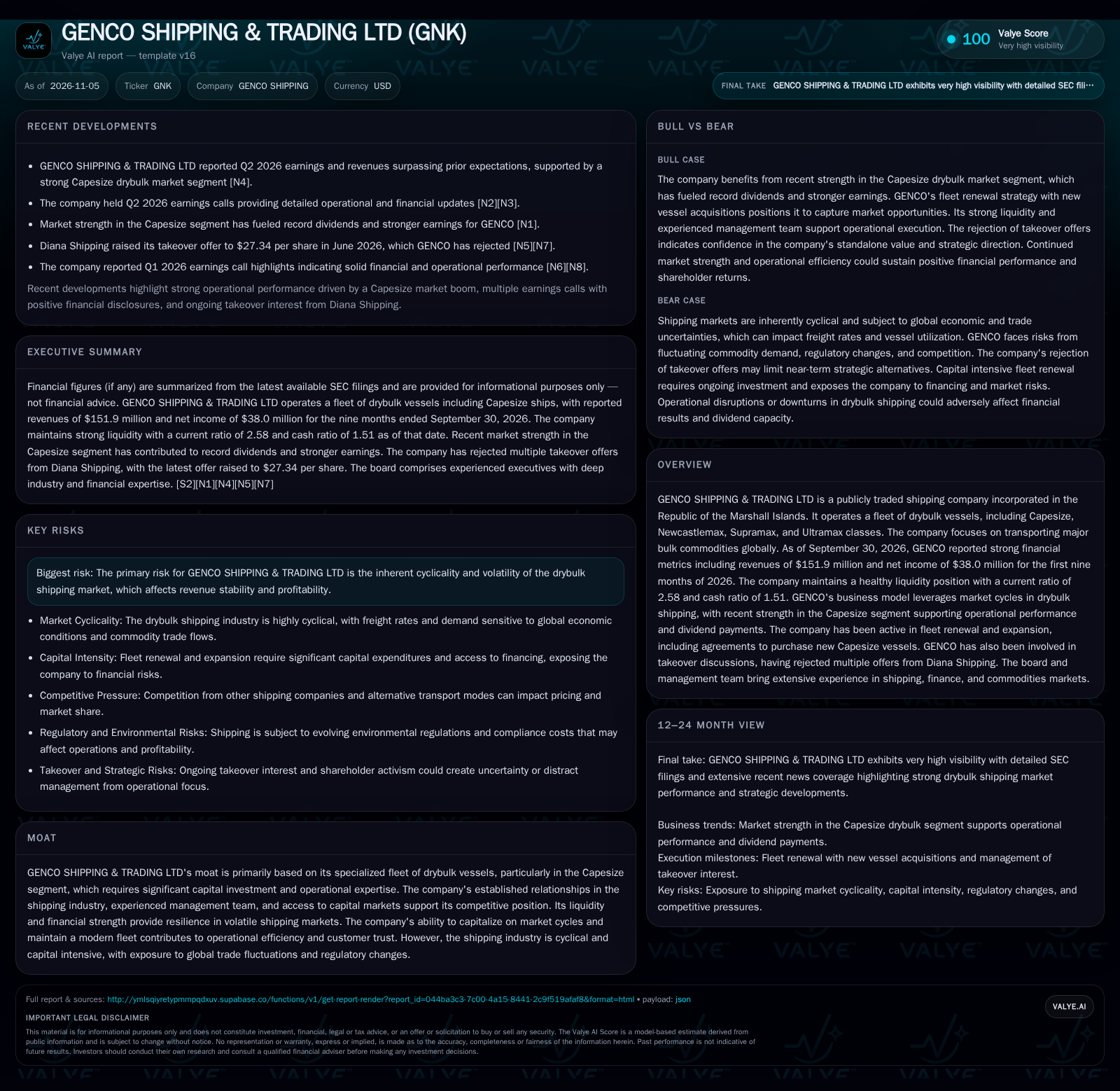
Genco Shipping reported $151.9 million in revenue and $38 million in net income for the first nine months of 2026, fueled by a surge in Capesize rates. The company maintains reported liquidity position—with $94.6 million in cash and a current ratio of 2.58—and is actively renewing its fleet. Recent takeover offers from Diana Shipping have been rejected, highlighting management's confidence in standalone value. The central question is whether current market strength and capital discipline can persist through inevitable shipping downcycles. [S2] [N1] [N5] [N7]
Genco Shipping & Trading finds itself at a pivotal juncture: a Capesize drybulk rally has driven strong earnings, record dividends, and a robust balance sheet, while the company fends off takeover bids and invests in fleet renewal. Yet, the business remains fundamentally exposed to the volatile rhythms of global commodity flows and shipping cycles. The core question is whether Genco’s recent operational and financial strength, combined with strategic fleet investments, can insulate the company from future downturns and justify its current stance on independence.
Recent Capesize Boom Drives Financial Outperformance and Strategic Decisions
Genco Shipping & Trading reported robust results for the first nine months of 2026, with $151.9 million in revenue and $38.0 million in net income. This performance was underpinned by a pronounced boom in the Capesize drybulk segment, which enabled the company to deliver record dividends and exceed earnings expectations. The company reported cash and liquidity metrics for the period; these figures do not by themselves establish operating runway, investment capacity, financial flexibility, or financing capacity. The company also rejected a $27.34 per share takeover offer from Diana Shipping, reinforcing management’s confidence in the company’s prospects as a standalone platform. Concurrently, Genco is executing a fleet renewal strategy by acquiring new Capesize vessels, aiming to capture operational and market advantages as the cycle evolves. [S2] [N1] [N4] [N5] [N7]
How Genco Monetizes Shipping Cycles: Revenue Drivers, Cost Structure, and Capital Demands
Genco’s business model is fundamentally tied to global commodity flows and the volatile freight rates of the drybulk market—especially for large Capesize vessels that transport iron ore, coal, and other bulk goods. Revenue is primarily volume-driven, based on vessel utilization and spot or time-charter rates, both of which are highly sensitive to macroeconomic demand and fluctuations in global trade. Pricing power is cyclical: during supply-demand tightness, Capesize rates can surge, driving outsized profitability—as seen in 2026. When vessel oversupply or demand weakness prevails, rates can collapse, compressing margins.
Fixed costs are significant, including crew, insurance, and ongoing maintenance, but variable costs (fuel, port charges) move with fleet activity. Operating leverage is high: incremental revenue from higher rates tends to flow disproportionately to the bottom line after covering fixed costs. However, capital intensity is persistent. Fleet renewal—such as Genco’s current Capesize acquisitions—requires large upfront outlays and ongoing access to credit, as evidenced by the company’s $680 million secured revolving credit facility. The cited source reports dividend-related activity; that disclosure alone does not establish dividend-policy continuity, management confidence, or a material constraint on capital flexibility.
Strategically, the balance between operating leverage, capital discipline, and timing fleet investments is critical. Missteps—such as overexpansion at the wrong part of the cycle—can erode value, while prudent renewal during market strength can enhance resilience and future earnings capacity.
Market Positioning: Fleet Scale, Capital Access, and the Dynamics of Cyclical Advantage
Genco’s competitive standing is shaped by the scale and composition of its drybulk fleet, its operational efficiency, and its access to capital. The company’s focus on Capesize and large bulk carriers positions it to benefit disproportionately when those markets tighten, as recently occurred. However, this also increases exposure to segment-specific volatility and cyclicality compared to more diversified peers.
Barriers to entry in drybulk shipping are moderate: while acquiring and operating large vessels requires capital and expertise, the market is fragmented and commoditized, with limited customer switching costs and low brand loyalty. Peer competition comes from other listed and private drybulk operators, as well as alternative transport modes (rail, barge) for certain routes, though these are rarely perfect substitutes for intercontinental bulk movement.
Genco’s experienced management and board, with deep backgrounds in shipping and finance, could provide an edge in timing investments, optimizing fleet utilization, and navigating regulatory or ESG-driven shifts. Still, the company’s ability to sustain outperformance hinges on prudent capital allocation and market timing rather than structural or technological moats.
If the Capesize Rally Persists and Fleet Renewal Pays Off
A favorable scenario for Genco envisions continued strength in Capesize and broader drybulk rates, driven by robust global commodity demand and disciplined vessel supply. In this environment, Genco’s fleet renewal—bringing on more efficient, larger vessels—would enhance operating leverage, lower per-unit costs, and maximize cash generation. Sustained high rates would enable the company to continue paying attractive dividends and potentially repurchase shares or further invest in the fleet.
Confirmation of this scenario would include persistently elevated Capesize spot and time-charter rates, growing net income, and further dividend increases. Evidence of successful integration and utilization of new vessels, as well as maintained or improved liquidity, would reinforce the upside. A tightening global vessel orderbook and regulatory-driven scrapping of older ships could further support the rate environment.
This scenario could be falsified if commodity demand falters, new vessel deliveries surge, or a macroeconomic shock reduces trade flows—causing rates, earnings, and dividends to retrace.
Anticipating Normalized Earnings Amid Ongoing Volatility
The most plausible outlook is a normalization of drybulk rates from recent highs, with Genco’s earnings and dividends moderating but remaining positive. The company’s renewed fleet provides some buffer against weaker rates via improved efficiency and lower operating costs, though the business remains exposed to cyclical swings.
Counterevidence would be a sharp, sustained rate collapse or a spike in fleet operating costs (e.g., regulatory-driven expenses, higher financing costs) that erode profitability.
Rate Collapse and Capital Strain: The Adverse Cycle
In a negative scenario, global macro or commodity demand weakens sharply—driven by recession, trade disruptions, or overcapacity—causing Capesize and drybulk rates to fall below cash break-even. Genco’s high operating leverage would then amplify the earnings decline, with net income turning negative and dividend payments suspended or eliminated. If the downturn is protracted, the company could be forced to sell vessels at depressed values or draw down its revolving credit facility, increasing leverage and reducing potential financial flexibility.
Confirmation of this scenario would include a rapid drop in reported revenues, operating losses, and a shrinking cash balance. Announcements of vessel sales, dividend cuts, or covenant breaches on credit facilities would further validate the bear case. A useful falsification would be evidence of effective cost containment, new long-term charter contracts locking in baseline utilization, or unexpectedly strong resilience in spot rates.
What Will Clarify Genco’s Resilience and Strategic Value in the Next Cycle?
Quarterly trends in Capesize and broader drybulk spot and time-charter rates, as reported in industry benchmarks and Genco’s earnings disclosures.
Net income and earnings per share performance, especially as rates normalize or decline.
Progress and timing of new Capesize vessel acquisitions, including integration and operational efficiency gains, if disclosed.
Utilization rates and operating costs per vessel, which would help test the effectiveness of fleet renewal and cost management.
Any renewed takeover interest, shareholder activism, or changes in strategic direction signaled by management or the board.
Impact of regulatory changes (e.g., decarbonization mandates) on fleet compliance costs and vessel marketability.
Disclaimer: This is research-only, informational analysis and not investment advice. It may include AI-generated interpretation and general industry context. Always verify important details using primary sources.

Comments