
USA Compression Partners: Strategic Expansion, Capital Intensity, and the Stakes of Scale in Gas Infrastructure
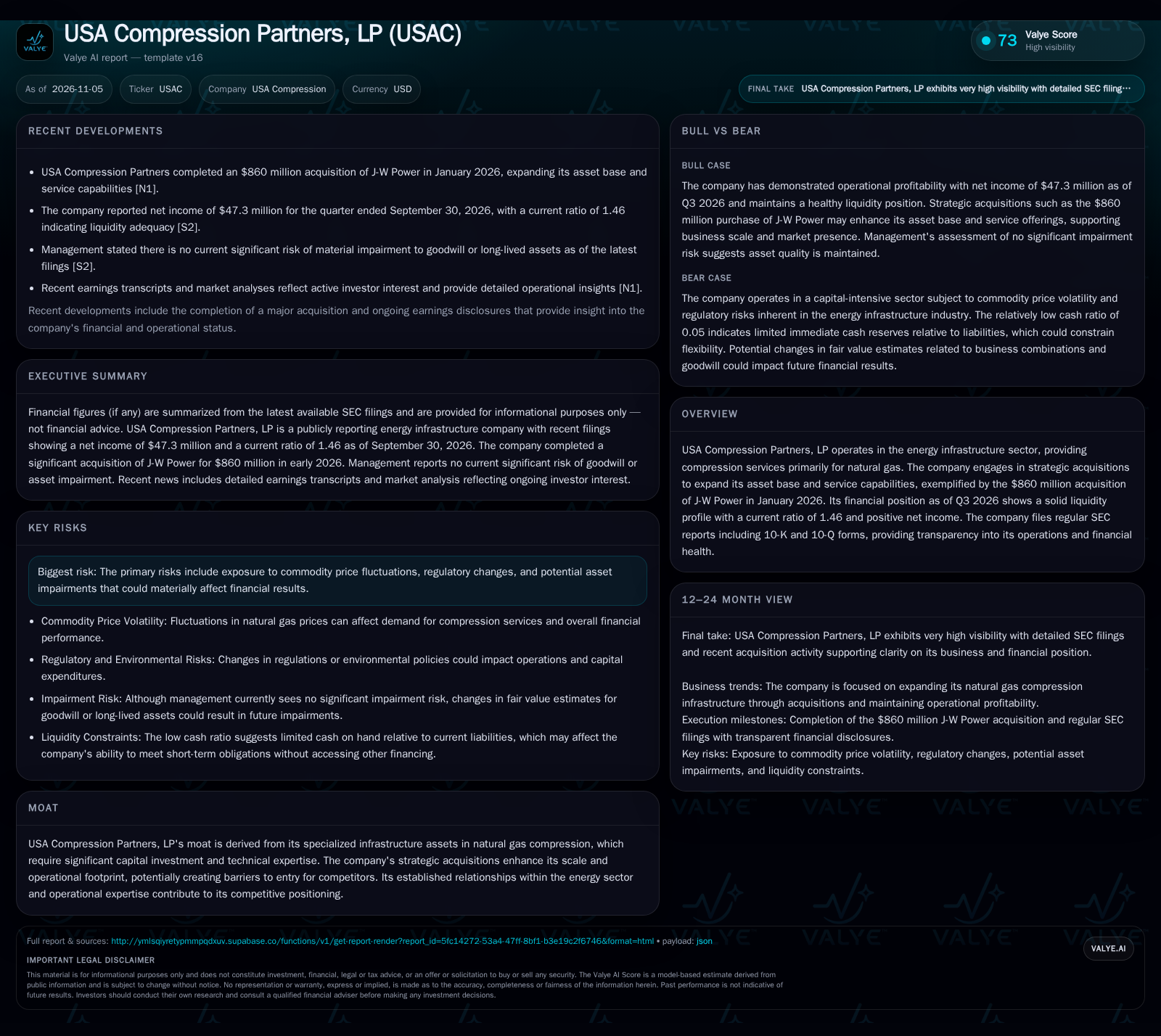
USA Compression Partners, LP has expanded its scale and service capabilities through the $860 million acquisition of J-W Power, reporting $47.3 million in net income for Q3 2026 and a current ratio of 1.46.
USA Compression Partners, LP has expanded its scale and service capabilities through the $860 million acquisition of J-W Power, reporting $47.3 million in net income for Q3 2026 and a current ratio of 1.46. The company’s future hinges on integration success, asset utilization, and the broader dynamics of the U.S. natural gas infrastructure market. [S2]
USA Compression Partners, LP stands at a critical inflection point in the U.S. energy infrastructure landscape. The $860 million acquisition of J-W Power in early 2026 has materially increased the scale of its compression fleet and service capabilities, positioning the company to address growing demand for natural gas midstream services.Yet, this expansion also intensifies the capital and liquidity demands typical of the sector—a reality underscored by a reported cash ratio despite reported profitability and a reported current ratio. The company’s ability to translate acquisition-driven scale into sustained earnings and resilience will be tested by customer demand, asset integration, and the shifting economics of natural gas infrastructure. [S2]
Acquisition and Financial Snapshot: Where USA Compression Stands Post-J-W Power Deal
USA Compression Partners, LP completed the acquisition of J-W Power for an initial purchase price of $860 million in January 2026, with the final aggregate payment reaching approximately $911.6 million after adjustments, paid half in cash and half in equity units. This move consolidated J-W Power and its parent into USA Compression’s portfolio, substantially increasing its fleet and service footprint. For the quarter ended September 30, 2026, the company reported net income of $47.3 million, indicating operational profitability following the transaction. The balance sheet as of September 30, 2026, shows current assets of $340.9 million and current liabilities of $233.7 million, resulting in a current ratio of 1.46. Management states that asset impairments are not currently a significant risk, suggesting that the acquired and legacy asset base remain productive. [S2]
Compression Services Economics: Fixed Contracts, Capital Intensity, and Utilization Leverage
USA Compression’s core business model revolves around providing compression services for natural gas producers and midstream operators. These services are typically structured under fixed-term contracts, which can provide revenue predictability and partial insulation from short-term commodity price swings. However, the economics are heavily influenced by fleet utilization rates, pricing discipline, and the ability to deploy capital efficiently.
The business is highly capital-intensive: acquiring, maintaining, and upgrading large compression units requires substantial upfront and ongoing investment. Operating leverage is significant—higher utilization spreads fixed costs over a larger revenue base, potentially amplifying margins as deployment increases. Conversely, idle fleet or unmarketable equipment can quickly erode profitability, especially if maintenance or retrofit costs become prohibitive. The J-W Power acquisition likely increased both the scale and the capital requirements, raising the stakes for asset integration and utilization efficiency.
Liquidity management is a persistent challenge. This structure necessitates careful working capital management and access to external financing, especially when pursuing large acquisitions or navigating market shocks.
Barriers, Substitutes, and Strategic Positioning in U.S. Gas Infrastructure
USA Compression’s competitive position is defined by its scale, asset specialization, and long-term customer relationships in U.S. natural gas production regions. Significant capital and technical expertise are required to build and operate a large, modern compression fleet, creating high barriers to entry for new competitors. The industry remains fragmented, with competition ranging from other large public compression providers to smaller regional operators.
Switching costs for customers may be moderate: while contract terms and on-site integration can make transitions costly, alternative providers exist, and price or reliability concerns can drive churn. The company’s recent acquisition activity suggests a strategy of consolidating share and expanding service breadth, which could reinforce customer stickiness if integration is handled well.
Substitution risk is largely tied to changes in U.S. energy mix or upstream production volumes. If natural gas demand or production growth slows, compression needs could decline, especially in mature or declining basins. Conversely, regulatory or technological shifts toward electrification or alternative energy could eventually erode the long-term addressable market.
Integration Success and Utilization Gains Drive Margin Expansion
In a favorable scenario, USA Compression fully integrates J-W Power’s fleet and customer base, achieving higher utilization rates and operational efficiencies. If the company successfully deploys acquired assets into high-demand basins and leverages scale to negotiate better terms with suppliers and customers, margins could expand. Fixed-term contracts would lock in revenue visibility, while improved fleet management reduces idle time and maintenance overhead.
Evidence supporting this scenario would include rising utilization rates, margin expansion in subsequent quarters, and disclosure of new or renewed long-term customer contracts at favorable rates. A reduction in unmarketable or impaired equipment, along with stable or growing cash flow from operations, would further confirm successful integration and capital discipline.
This pathway could be falsified by persistent idle fleet, cost overruns on integration, or an uptick in asset impairments—particularly if newly acquired units prove less marketable than anticipated or if customer churn increases post-acquisition.
Sustained Profitability with Moderate Risk from Capital and Commodity Cycles
The most plausible scenario is one where USA Compression maintains steady utilization and profitability, but faces ongoing capital intensity and exposure to energy cycle volatility.
Operational performance would be characterized by consistent net income, stable fleet utilization, and manageable levels of asset retirement or impairment. The company continues to rely on a mix of contract renewals and moderate new business, with revenue growth tracking industry demand for compression services. Liquidity is closely managed, possibly through revolver capacity or refinancing, with no immediate distress but also little room for aggressive expansion without external funding.
This scenario would be confirmed by stable net income, current ratio maintenance, and a lack of major asset impairments or contract losses. It could be falsified by a sudden downturn in natural gas activity, a spike in maintenance costs, or difficulty integrating the J-W Power assets leading to lower than expected utilization.
Liquidity Stress and Asset Impairments Emerge as Market Shifts or Integration Falters
In an adverse scenario, the combined company experiences weaker than expected demand, resulting in elevated levels of idle or unmarketable compression equipment. If integration of J-W Power’s assets is problematic—due to technical incompatibility, customer attrition, or higher maintenance costs—the risk of asset impairments rises.
Regulatory changes, commodity price declines, or a slowdown in U.S. gas production could further compress margins and utilization.
This scenario would be supported by disclosures of asset impairments, rising debt or financing costs, declining utilization rates, or negative cash flow from operations. Early warning signs could include increased retirement of compression units, missed contract renewals, or a sustained drop in net income.
Factors to Scrutinize as USA Compression’s Scale and Strategy Are Tested
Quarterly fleet utilization rates, especially for newly acquired J-W Power assets—higher utilization would indicate successful integration and deployment.
Trends in asset impairments or retirements; a spike could signal challenges in integrating or marketing the expanded fleet.
Disclosure of new long-term customer contracts, renewals, or pricing changes—these would provide insight into demand stability and pricing power.
Gross and operating margin trends post-acquisition, which would help test whether scale is translating into improved economics or being offset by integration costs.
Any announcements of additional capital raises, debt refinancing, or changes to credit facilities, as indicators of liquidity stress or flexibility.
Updates on regulatory, environmental, or policy changes affecting natural gas infrastructure, as these could alter demand for compression services.
Management commentary or SEC disclosures regarding the pace and cost of J-W Power integration, including synergies or unexpected challenges.
Disclaimer: This is research-only, informational analysis and not investment advice. It may include AI-generated interpretation and general industry context. Always verify important details using primary sources.

Comments