
Ascent Industries’ Specialty Chemicals Transformation: Platform Ambitions, Margin Dynamics, and the Stakes of Customer Concentration
Ascent Industries is accelerating its shift toward a pure-play specialty chemicals platform, targeting $120 million in revenue and leveraging a Chemicals-as-a-Service model. Recent results highlight strong top-line growth and improved operating leverage, but customer concentration and raw material volatility remain structural challenges.
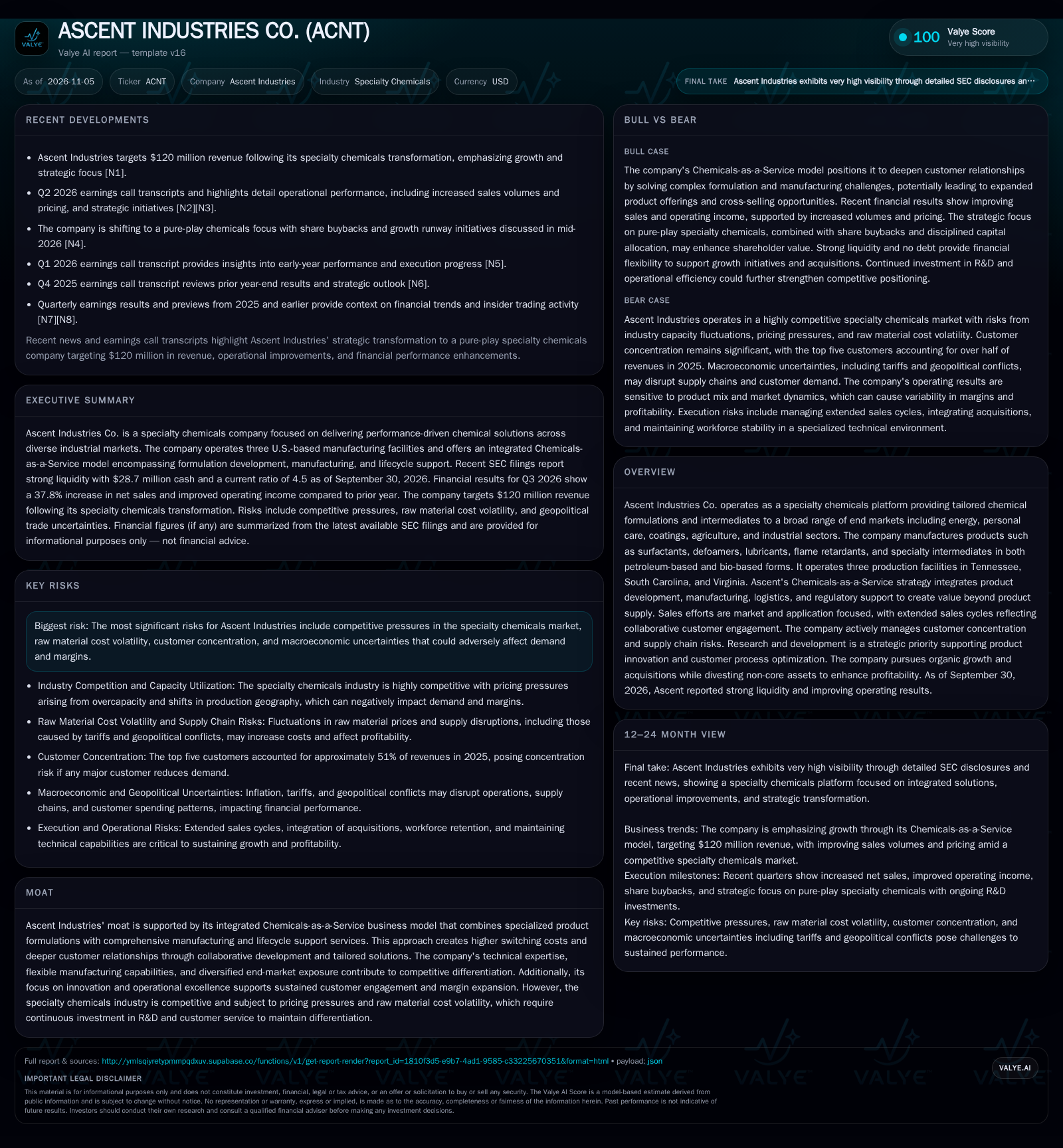
Ascent Industries is executing a strategic transformation into a focused specialty chemicals platform, reporting 37.8% Q3 2026 sales growth and a return to operating income. Its integrated Chemicals-as-a-Service approach aims to deepen customer relationships and enable premium pricing, but customer concentration and input cost risks require close monitoring.
Ascent Industries Co. is repositioning itself as a pure-play specialty chemicals platform, with a bold $120 million revenue target and a differentiated Chemicals-as-a-Service strategy. The company’s recent financials show a sharp rebound in sales and a swing to operating profitability, supported by disciplined cost management and ongoing R&D investment. However, the company’s reliance on a concentrated group of customers and exposure to raw material volatility remain key sources of uncertainty, making its ability to diversify revenue streams and defend margins central to the investment thesis.
Recent Performance and Strategic Direction: What’s Changing for Ascent Industries
Ascent Industries reported a 37.8% year-over-year increase in Q3 2026 net sales, reaching $27.1 million, with volume and pricing both contributing to the top-line gain. Despite the sales surge, gross margin slipped to 26.2% from 29.7% in the prior year, highlighting ongoing cost and mix pressures. Operating income turned positive at $1.6 million, reversing a loss in the prior year period, with leverage from higher sales and reduced SG&A spend. As of September 30, 2026, the company held $28.7 million in cash, a current ratio of 4.5, and no outstanding debt, positioning it to pursue growth initiatives and weather potential volatility [S2].
Strategically, Ascent has articulated a transformation toward a specialty chemicals pure-play, targeting $120 million in revenue. The company is sharpening its focus on integrated, value-added solutions via its Chemicals-as-a-Service model. However, customer concentration remains pronounced: the top five customers represented 51% of 2025 revenue, underscoring both the stickiness and the risk inherent in its commercial footprint [S1] [N1].
Chemicals-as-a-Service and the Economics of Tailored Solutions
Ascent’s business model combines the manufacturing of specialty chemical intermediates with a service-heavy, customer-centric approach. The Chemicals-as-a-Service (CaaS) platform is designed to create incremental value by integrating formulation development, regulatory support, blending, logistics, and delivery. This model could allow Ascent to command premium pricing and embed itself more deeply in customer workflows, potentially reducing price sensitivity and raising switching costs.
Revenue drivers include product volume, mix, and the proportion of highly tailored, service-intensive solutions. The company’s fixed cost base is anchored in three U.S. production facilities, which suggests potential for operating leverage as utilization rates rise. Variable costs are dominated by raw materials—primarily sourced domestically—which exposes Ascent to margin volatility depending on input price swings.
The drop in gross margin in Q3 2026, despite higher sales, implies that cost pass-through or mix improvements may not always keep pace with commodity and energy price movements. SG&A leverage in the quarter signals some success in cost discipline, but sustainable profit expansion likely hinges on the company’s ability to scale higher-margin offerings and maintain pricing power in the face of competitive and customer pressures [S2].
Navigating a Crowded Specialty Chemicals Landscape
The specialty chemicals sector is highly fragmented, with competition from both global conglomerates and regionally focused niche players. Ascent’s competitive positioning rests on its ability to deliver differentiated formulations and provide holistic, integrated support through its CaaS model. If successful, this approach could lock in customers through technical collaboration and process integration, raising switching costs versus commodity chemical suppliers.
However, the sector is characterized by aggressive pricing, frequent product substitutions, and the risk of commoditization—especially in lower-value segments. Larger competitors in the sector may have broader product portfolios, lower per-unit costs, and deeper R&D resources, which could pressure Ascent’s margins and customer retention if they target similar CaaS strategies.
Customer concentration amplifies the threat: if one or more large clients are lost or reduce volumes, revenue and utilization could be materially impacted. Conversely, a diversified end-market exposure—energy, personal care, agriculture, water treatment, and more—offers a degree of resilience if managed proactively [S1].
Unlocking Value Through High-Margin Solutions and Strategic Customer Expansion
A favorable scenario for Ascent Industries sees the company successfully deepening its Chemicals-as-a-Service relationships, leading to increased cross-selling, premium pricing, and stronger customer retention. This would enable a shift in revenue mix toward higher-margin, service-rich products, supporting sustainable gross margin expansion. If R&D investment yields proprietary formulations or process innovations that are difficult for competitors to replicate, Ascent could further differentiate itself and build long-term contracts.
Confirmation of this scenario would come from rising gross margins quarter-over-quarter, reduced customer concentration (i.e., no single customer accounting for more than 20% of sales), and evidence of multi-year agreements that embed Ascent’s solutions into customer supply chains. Successful bolt-on acquisitions or organic wins in new end markets would also validate the platform’s scalability and growth ambition [N1].
Integrated Platform Delivers Growth, but Margin Volatility Persists
The most plausible path is that Ascent grows revenue at a healthy clip, driven by the CaaS platform and ongoing R&D-led product launches. However, margin improvement is uneven—gross margins fluctuate due to raw material volatility and competitive pricing, while operating leverage is realized only in periods of strong volume growth. Customer concentration gradually eases but remains an ongoing watchpoint.
Evidence for this scenario would include steady, but not dramatic, improvements in gross margin, SG&A as a percent of sales, and gradual dilution of the top five customers’ revenue share over several reporting periods [S2] [N1].
Prolonged Margin Squeeze and Customer Losses Challenge the Transformation
In a more adverse scenario, Ascent is unable to offset raw material and energy cost inflation with price increases or mix improvements, leading to persistent gross margin compression. If a major customer reduces or exits its relationship, the company could experience a steep drop in revenue with limited ability to redeploy fixed costs quickly, exacerbating the impact on profitability.
Competitive responses—such as price undercutting or rival CaaS offerings—could erode Ascent’s customer base, especially if its technical differentiation proves insufficient or R&D investments fail to generate meaningful new business. Worsening macroeconomic or geopolitical conditions could further disrupt supply chains and demand. This scenario would be confirmed by declining gross margins, a spike in customer concentration, negative operating income, and management guidance revisions downward.
Milestones and Metrics That Will Shape Ascent’s Chemicals Platform Trajectory
Quarterly gross margin trends: Persistent improvement would signal pricing power and mix shift; declines could indicate cost or competitive pressures.
Top five customer revenue share: A declining concentration ratio would show progress in diversifying the revenue base and reducing single-customer risk.
New product and formulation launches: The number and commercial adoption rate of new offerings, if disclosed, would test R&D effectiveness and customer engagement.
SG&A as a percentage of sales: Sustained reductions would confirm operating leverage and cost discipline.
Plant utilization rates: Higher and more stable utilization, if disclosed, would suggest effective scaling of the fixed asset base.
Acquisition activity and integration outcomes: Evidence of accretive bolt-on deals or successful divestitures would support the transformation thesis.
Long-term customer contracts or multi-year supply agreements: Disclosure of such agreements would validate deeper customer integration and revenue visibility.
Raw material cost management: The company’s ability to mitigate input volatility—via hedging, supplier diversification, or cost pass-through—would be critical to margin stability.
Disclaimer: This is research-only, informational analysis and not investment advice. It may include AI-generated interpretation and general industry context. Always verify important details using primary sources.

Comments