
ZoomInfo: Data Platform Ambitions Confront Margin Compression and Competitive Shifts
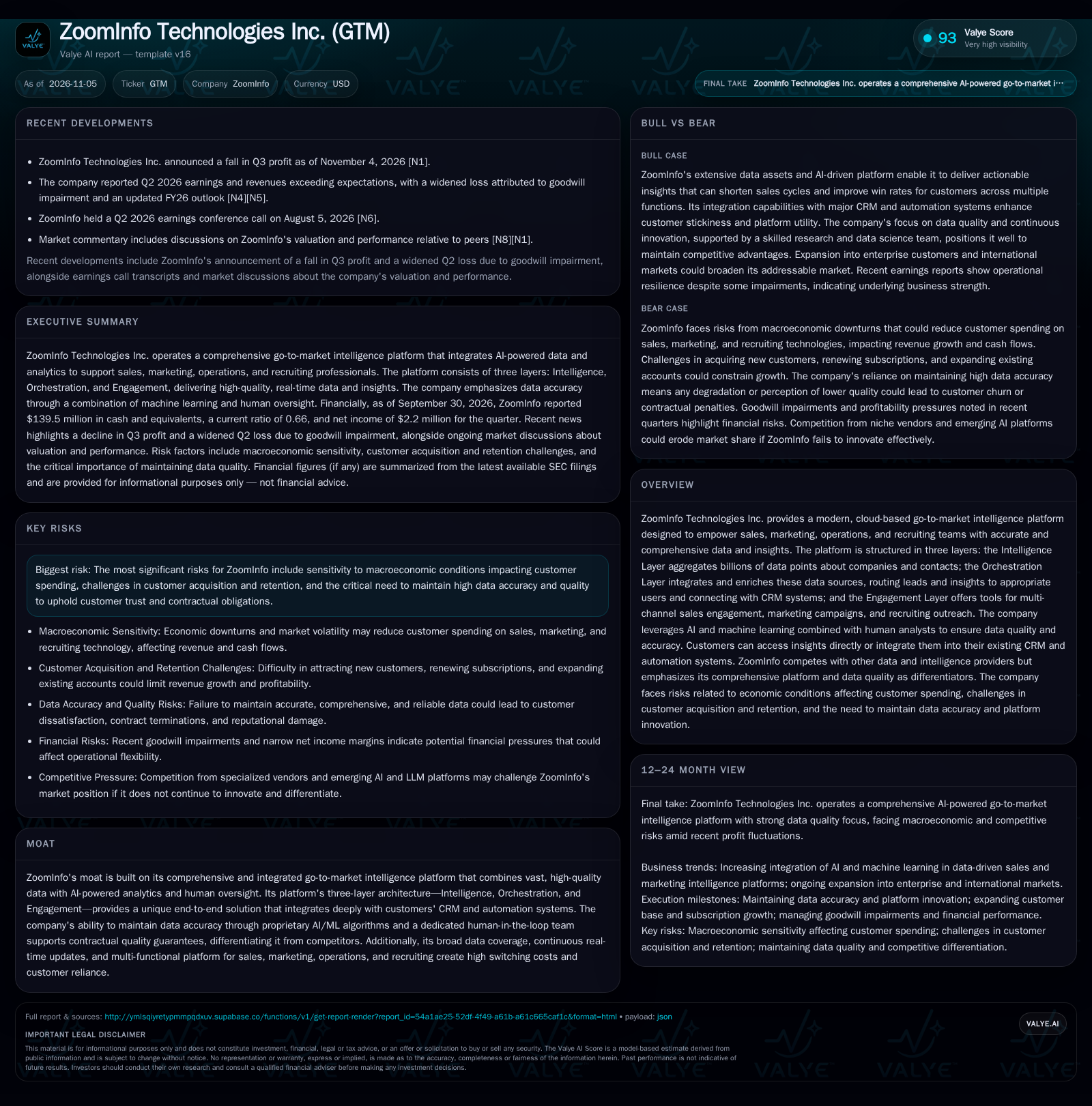
ZoomInfo’s AI-powered go-to-market intelligence platform continues to expand its integration and data quality capabilities, but recent profit declines, goodwill impairment, and a tightening balance sheet highlight mounting pressures. The company’s ability to sustain differentiation in a rapidly evolving data/AI landscape and to drive durable subscription growth will determine whether today’s platform investments translate to long-term economic strength.
ZoomInfo’s Q3 2026 profit decline and widened Q2 loss underscore the challenge of balancing platform innovation and data quality investment against intensifying competition and macro-driven customer caution. While the company’s three-layer platform and AI/human-verified data remain core strengths, success will hinge on sustaining customer acquisition, retention, and pricing power even as capital needs and quality expectations rise. [S2] [N1] [N5]
ZoomInfo Technologies Inc. stands at a crossroads: its flagship AI-powered data platform remains mission-critical for sales, marketing, and recruiting teams, but the company’s latest financial results signal tightening margins and heightened operational risk. With Q3 2026 profit declining and recent goodwill impairments weighing on results, the company’s ability to defend its data quality edge and drive subscription growth is under scrutiny. [S2] [N1] [N5]
Profitability Pressures and Liquidity Constraints Define the Latest Operating Environment
ZoomInfo’s Q3 2026 profit declined, as announced on November 4, 2026, following a Q2 where revenues exceeded expectations but losses widened due to goodwill impairment. Net income for the quarter ended September 30, 2026, was $2.2 million, with basic and diluted EPS at $0.01 per share. [S2] [N1] [N4] [N5] The balance sheet shows $139.5 million in cash and equivalents, a current ratio of 0.66, and a cash ratio of 0.23 as of September 30, 2026, indicating a relatively tight near-term liquidity position. [S2] The backdrop is further complicated by ongoing market debate over ZoomInfo’s valuation and performance versus peers, reflecting skepticism about its ability to sustain growth and margin resilience. [N8]
Economic Model: Subscription Revenue and the Stakes of Data Quality Investment
ZoomInfo generates revenue by selling access to its cloud-based go-to-market intelligence platform, with customers typically subscribing to access real-time company and contact data, intent signals, and workflow integration capabilities. While the platform’s multi-layered architecture—Intelligence, Orchestration, and Engagement—enables value-based pricing for differentiated insights and integration, the economics are increasingly shaped by the cost of data acquisition, AI/ML investment, and human-in-the-loop quality assurance. [S1]
Operating leverage is plausible in software models as fixed R&D and data infrastructure can support incremental user growth; however, rising customer expectations for accuracy and integration have driven continued investment in both technology and human analysts. This dynamic may compress margins if pricing power or user growth does not outpace cost inflation. The company reported cash and liquidity metrics for the period; these figures do not by themselves establish operating runway, investment capacity, financial flexibility, or financing capacity. [S2]
Capital needs are likely to remain elevated, particularly if the company pursues international expansion or deeper integrations with large enterprise systems—both of which can extend sales cycles and working capital requirements before revenue is realized.
Defending Platform Differentiation as AI-Native and Niche Rivals Accelerate
ZoomInfo’s competitive set includes broad-based data providers like D&B Hoovers, workflow-embedded platforms such as LinkedIn Sales Navigator, and a wave of emerging AI/LLM-powered vendors promising targeted, real-time insights. [S1] The company’s moat has historically rested on the breadth and accuracy of its data, the tight integration with CRM and marketing automation systems, and a multi-layered approach that enables end-to-end go-to-market orchestration.
However, new entrants leveraging generative AI, hyper-specialized vertical datasets, or proprietary intent signals are lowering the switching costs for certain customer segments and compressing the perceived value of generic contact data. At the same time, larger enterprise customers are demanding deeper integration, more granular data quality guarantees, and evidence of ROI, raising the bar for platform stickiness.
ZoomInfo’s ongoing investment in both AI-driven data processing and human verification is a potential differentiator—especially if contractual SLAs or regulatory frameworks around data accuracy become more stringent. Still, the company must demonstrate that this hybrid approach translates to better customer outcomes and lower churn than fully automated or low-cost competitors.
If Platform Quality and Integration Win: Subscription Expansion and Margin Recovery
A favorable outcome would see ZoomInfo’s continued investment in AI/human-verified data and platform integration drive higher customer retention and new enterprise wins, particularly among organizations seeking robust, multi-source go-to-market intelligence. If the company is able to prove ROI through measurable sales acceleration or marketing efficiency gains, it could justify price increases or expanded seat deployments, improving operating leverage.
International expansion and deeper partnerships with CRM/automation vendors could further broaden the addressable market, while improvements in data processing efficiency may allow margin recovery even as quality standards rise.
Evidence supporting this scenario would include sequential acceleration in net new subscription growth, rising average contract values, improved gross and operating margins, and reductions in customer churn or contraction rates—if disclosed in future filings or commentary. A return to consistent positive net income and an reported liquidity-ratio trends would also signal execution traction. [S2]
Balancing Platform Investment and Margin Pressure in a Competitive, Price-Sensitive Market
The most plausible trajectory is one where ZoomInfo maintains moderate subscription growth—driven by ongoing need for sales/marketing data and workflow integration—but faces persistent margin pressure from elevated data quality investment and competitive pricing. Customer acquisition and retention may remain challenged by macroeconomic caution, especially among smaller and mid-sized businesses.
The company likely continues to invest in both AI/ML and human data verification, but must carefully balance innovation with financial discipline given the current liquidity constraints. Goodwill impairments and modest net income suggest that the margin recovery will be gradual, and further setbacks in customer churn or pricing could pressure cash flows.
Confirmation would come from steady but unspectacular revenue growth, stable or slightly improving profitability metrics, and management commentary focused on operational efficiency and platform differentiation. A flat or only modestly reported liquidity-ratio trends would signal ongoing capital constraint. [S2] [N1]
If Customer Churn and Pricing Erode: Margin Compression and Strategic Vulnerability
The adverse scenario would be triggered if macroeconomic headwinds or competitive pressures lead to an uptick in customer churn, price concessions, or contract downgrades, undermining subscription growth. If customers perceive alternative vendors as sufficiently accurate or integrated—especially at a lower price—ZoomInfo could face a negative mix shift and rising acquisition costs.
If goodwill impairments continue, they may signal deeper issues with acquisition ROI or asset value assumptions.
Evidence of this scenario would include sequential declines in net customer count, falling average revenue per user, further profitability deterioration, and additional balance sheet stress—especially if accompanied by negative revisions to outlook or cautionary management commentary. [S2] [N1] [N5]
Milestones to Test ZoomInfo’s Data Quality Edge and Subscription Durability
Sequential net subscription growth rates, especially for enterprise and international customers, would help clarify whether platform investments are translating into durable expansion.
Average contract value or seat expansion among existing customers—if disclosed—would indicate success in upselling and deepening platform adoption.
Gross and operating margin trends will reveal whether investments in AI/human verification are driving operating leverage or simply offsetting competitive price pressure.
Customer churn and contraction rates (if disclosed) are critical to assess retention risk amid rising competition and economic headwinds.
Evidence of further goodwill impairment or asset write-downs would signal ongoing challenges in acquisition strategy or asset value realization.
Management commentary or disclosures around integration depth with CRM/automation partners can help gauge whether ZoomInfo is defending its workflow moat.
Any new regulatory or contractual requirements for data quality, and ZoomInfo’s ability to meet them, would be a key litmus test for the sustainability of its hybrid AI/human data curation model.
Disclaimer: This is research-only, informational analysis and not investment advice. It may include AI-generated interpretation and general industry context. Always verify important details using primary sources.

Comments