
Geron After the IMpactMF Discontinuation: RYTELO’s Commercial Stakes, Pipeline Reset, and the Battle for MDS Market Share
Geron’s commercial launch of RYTELO® in lower-risk MDS is set against the backdrop of a recently discontinued Phase 3 myelofibrosis trial, leaving the company’s growth prospects highly dependent on U.S. and European uptake. The next phase will test whether a first-in-class telomerase inhibitor can secure commercial traction, fund new pipeline bets, and defend against intensifying competition in hematologic malignancies.
Geron’s future now hinges on maximizing RYTELO’s adoption in lower-risk MDS after the high-profile discontinuation of its Phase 3 myelofibrosis trial.
Geron’s transition from a clinical-stage to a commercial-stage biopharma is now defined by the success—or vulnerability—of RYTELO®, its first-in-class telomerase inhibitor for lower-risk MDS. With the abrupt end of its Phase 3 myelofibrosis program, Geron must execute flawlessly on RYTELO’s commercial rollout in the U.S. and Europe while recalibrating its pipeline ambitions.
RYTELO’s Commercial Launch and Pipeline Setback Define Today’s Geron
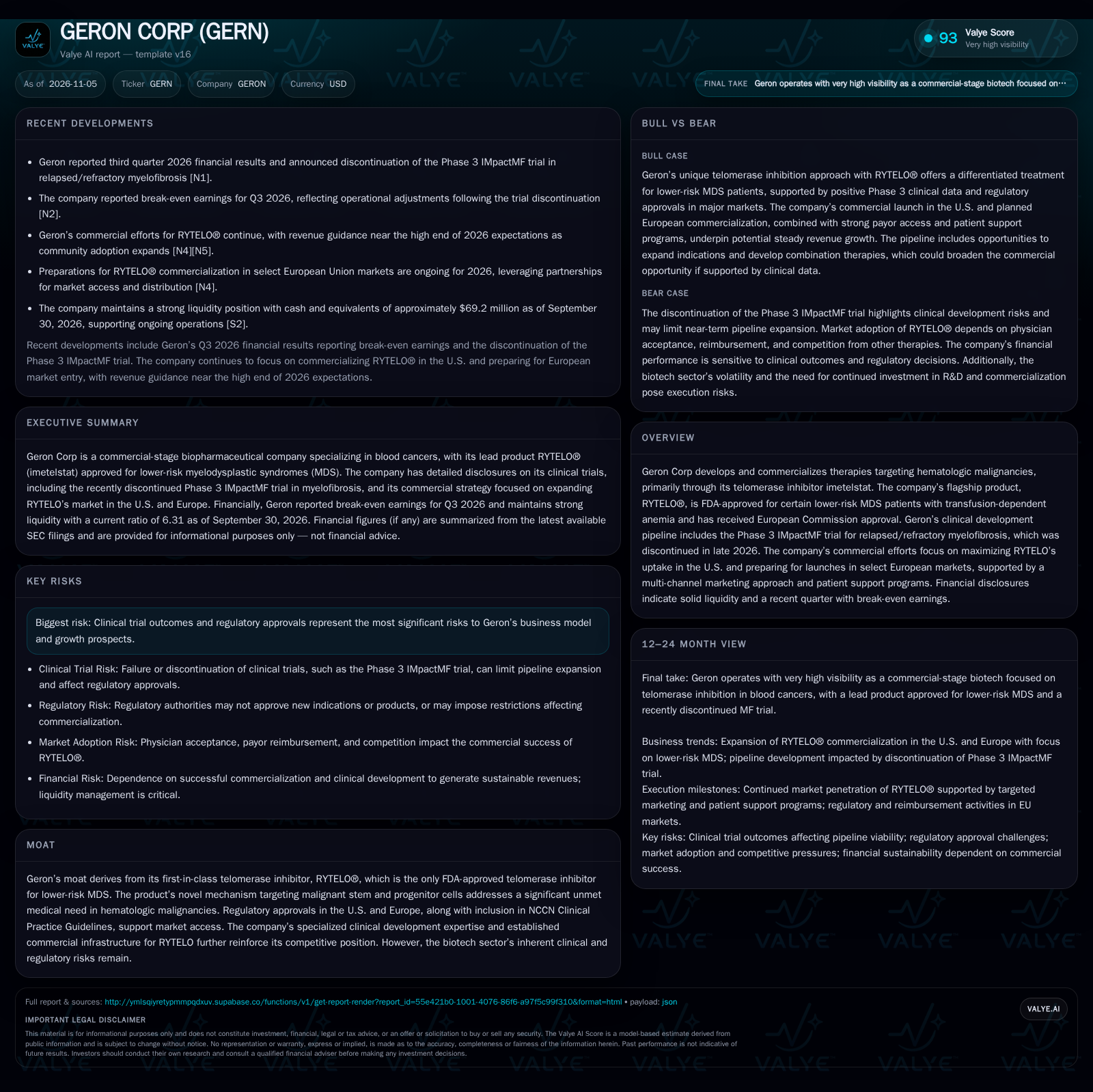
Geron’s lead product, RYTELO® (imetelstat), is now FDA- and European Commission-approved for lower-risk myelodysplastic syndromes (MDS) with transfusion-dependent anemia, targeting patients who are ineligible for or refractory to erythropoiesis-stimulating agents (ESAs). The U.S. launch began in June 2024, and the company is actively preparing for commercial entry in select European markets in 2026, leveraging third-party partnerships for distribution and local market access [S2] [N4] [N5].
A pivotal recent development is the discontinuation of the Phase 3 IMpactMF trial in myelofibrosis, which had aimed to expand imetelstat’s label into higher-risk disease. This removes Geron’s only late-stage pipeline catalyst and concentrates all near-term value on RYTELO’s commercial performance in lower-risk MDS [N1].
RYTELO’s revenue is trending toward the upper end of 2026 guidance as adoption broadens among community hematology practices [N4] [N5].
How RYTELO Could Reshape Geron’s Revenue Model
RYTELO’s economics are fundamentally driven by the size and penetration rate of the lower-risk MDS market, pricing dynamics relative to other anemia treatments, and the ability to secure broad reimbursement and inclusion in treatment guidelines. As a specialty oncology product, RYTELO is likely priced at a premium to generic ESAs and other supportive care agents, but faces payer scrutiny given the cost sensitivity in hematologic malignancies. The company’s strategy emphasizes targeting high-volume hematology accounts and leveraging a cross-functional commercial team, which suggests a focus on maximizing per-account revenue and patient throughput.
Geron’s cost structure is transitioning from R&D-heavy to a more commercial-weighted model. Fixed costs now include a growing field force, digital marketing investments, and patient support infrastructure (e.g., REACH4RYTELO®). Variable costs are tied to production, distribution, and ongoing post-marketing commitments. With break-even earnings in Q3 2026, initial U.S. sales appear sufficient to offset commercial launch expenses, but further margin improvement will depend on scaling volume and controlling SG&A as European operations come online.
The discontinuation of the IMpactMF trial reduces near-term R&D spend but also eliminates the possibility of a second, potentially larger, addressable market in higher-risk myelofibrosis. This places even greater pressure on maximizing RYTELO’s share in lower-risk MDS and exploring label expansions or combination regimens in adjacent indications to drive future growth.
Defending a First-Mover Edge in a Crowded Hematology Landscape
RYTELO offers a differentiated mechanism—telomerase inhibition—for transfusion-dependent lower-risk MDS patients, a group with significant unmet need, especially after ESA failure. Its inclusion in NCCN Clinical Practice Guidelines and dual U.S./EU approvals confer initial credibility and market access advantages. However, competition is fierce: established agents such as ESAs and luspatercept already serve this population, and newer therapies could erode RYTELO’s addressable share if they demonstrate superior efficacy, safety, or convenience.
Switching costs may be moderate: while clinical inertia and physician familiarity could favor RYTELO as the only approved telomerase inhibitor, payor-driven step therapy and the presence of alternative anemia management options limit pricing power. Additionally, the lack of a broader imetelstat label (following the MF trial discontinuation) removes the possibility of cross-indication bundling or multi-segment physician loyalty.
Geron’s competitive advantages will depend on continued real-world evidence supporting durable transfusion independence, successful navigation of reimbursement hurdles, and the ability to respond to evolving standards of care as new agents are approved.
What a RYTELO-Driven Inflection Could Look Like
The most favorable scenario for Geron would see rapid physician adoption of RYTELO in both academic and community settings, supported by further positive real-world data and minimal new competition in lower-risk MDS. If payors broadly reimburse RYTELO and barriers to access remain low, the company could achieve sustained revenue growth—especially if EU launches in 2026 meet or exceed initial uptake expectations.
Pipeline momentum could also return if Geron advances new studies in combination regimens or label expansions for imetelstat (e.g., in other hematologic malignancies), leveraging its unique mechanism. This would diversify risk and reinvigorate investor confidence in long-term growth.
Evidence that would confirm this scenario includes: accelerated U.S. sales growth, strong formulary wins, rapid reimbursement approvals in European markets, and early-stage clinical trial initiations or partnerships targeting new indications.
RYTELO Anchors a Single-Product Story—With Measured Expansion
The most plausible trajectory is one in which RYTELO gradually expands its U.S. footprint, capturing a meaningful but not dominant share of the lower-risk MDS market, while European launches proceed but face the typical hurdles of reimbursement negotiations and slower physician adoption outside the U.S.
Margins may improve modestly as SG&A is leveraged over a growing revenue base, but the absence of late-stage pipeline catalysts means Geron’s valuation and cash flow will remain tightly coupled to RYTELO’s performance. The company will likely invest judiciously in early pipeline opportunities, but progress will be incremental and subject to clinical and regulatory risk.
This scenario would be confirmed by steady quarter-over-quarter revenue growth, modest profitability, and disciplined R&D spend, with no immediate breakthroughs in new indications.
Vulnerabilities if RYTELO Adoption or Expansion Falters
Should RYTELO experience slower-than-expected uptake—due to either physician skepticism, payor pushback, or rapid emergence of new competitive therapies—Geron’s revenue base could stagnate or contract, especially as the company lacks other late-stage assets to offset weakness.
If European reimbursement is delayed or restricted, the company’s international expansion would be materially impaired, reducing future growth optionality. Additionally, without a robust pipeline, Geron could face a strategic crossroads: pursue costly in-licensing or acquisitions, or risk long-term decline if RYTELO’s window of opportunity closes.
Evidence for this scenario would include: plateauing or declining U.S. sales, negative formulary/reimbursement decisions in Europe, rising SG&A without corresponding revenue growth, or the need to raise dilutive capital to sustain operations.
Testing the RYTELO Thesis: Seven Concrete Developments to Track
Quarterly RYTELO revenue growth and U.S. market share among lower-risk MDS patients—especially relative to ESA and luspatercept use.
Updates on EU market access: timing and breadth of reimbursement approvals, and first full quarter of European sales if disclosed.
Trends in SG&A as a percentage of revenue, indicating whether commercial leverage is being achieved as sales scale.
New clinical trial initiations or pipeline announcements, particularly in combination therapy or expansion into related hematologic malignancies.
Real-world evidence on duration of transfusion independence, safety, and patient quality-of-life improvements for RYTELO.
Any new competitive product approvals or guideline updates that could alter the MDS treatment landscape.
Company disclosures on capital allocation: potential for business development, in-licensing, or return of capital if cash flow allows.
Disclaimer: This is research-only, informational analysis and not investment advice. It may include AI-generated interpretation and general industry context. Always verify important details using primary sources.

Comments