
Seaport Entertainment: Diversification, Capital, and the Challenge of Operational Visibility
Seaport Entertainment Group Inc. stands at a strategic crossroads with a diversified asset base across landlord, hospitality, and entertainment segments, supported by substantial recent capital raises. Yet, persistent net losses and opaque segment-level disclosures complicate a clear read on sustainable cash flow and competitive edge.
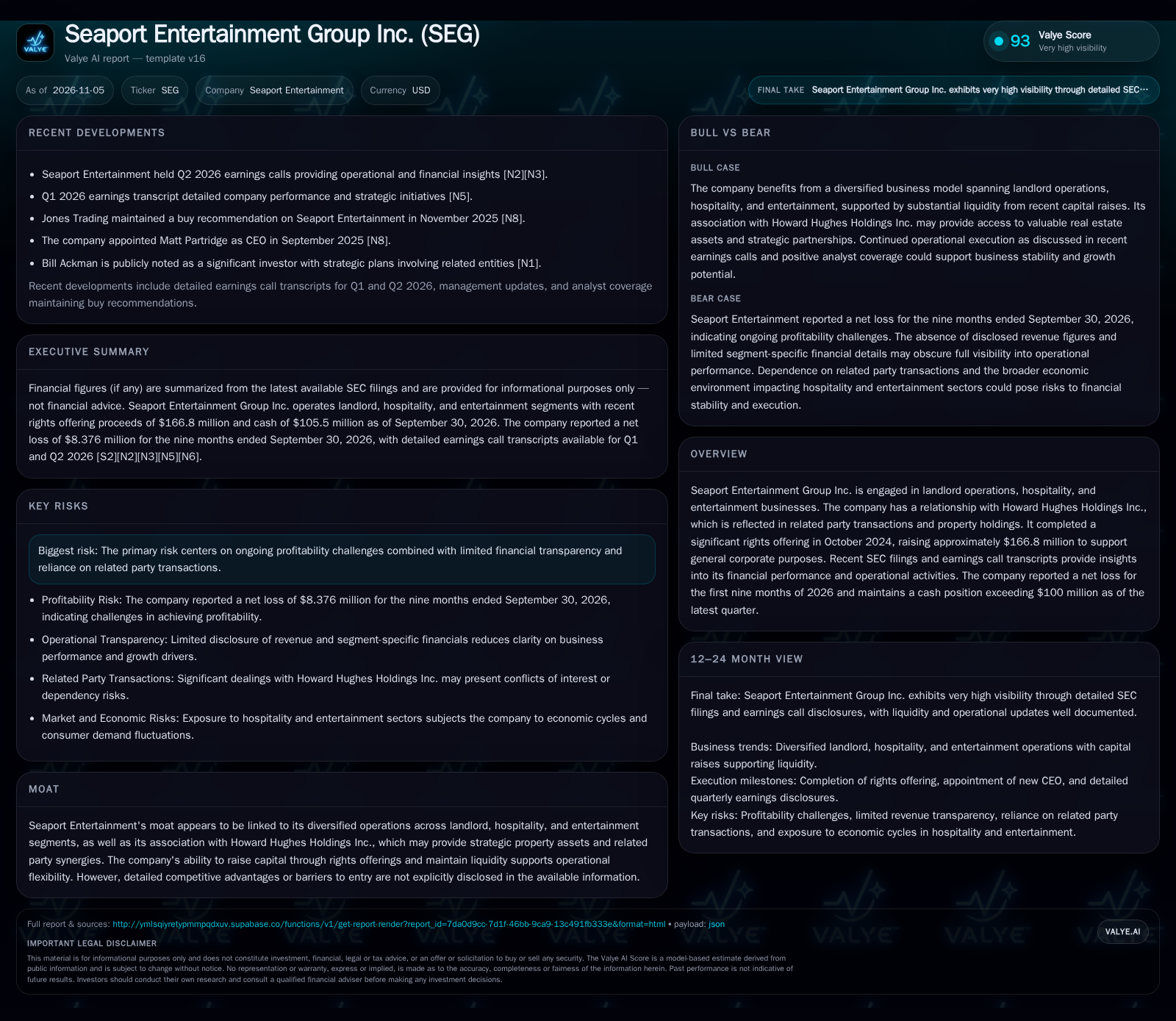
Seaport Entertainment has raised significant capital and maintains over $100M in cash, but continues to operate at a net loss as of September 2026. The company’s diversified structure and relationship with Howard Hughes Holdings offer potential strategic advantages, but limited segment-level transparency and ongoing dependency risks cloud the long-term earnings picture. Investors must weigh the optionality of its asset platform against persistent profitability challenges and sector cyclicality. [S2]
Seaport Entertainment Group Inc. enters late 2026 with a substantial cash reserve from its recent rights offering and an operating footprint spanning landlord, hospitality, and entertainment businesses. While these factors suggest both diversification and liquidity, the company’s persistent net loss and sparse revenue disclosures make it challenging to assess true operational momentum or the path to profitability. The relationship with Howard Hughes Holdings and high-profile investor interest add strategic intrigue, but investors face a complex picture where the real drivers of value—and risks—are not fully visible.
Recent Capital Raises and Persistent Losses Define the Current Landscape
As of September 30, 2026, Seaport Entertainment reported cash and cash equivalents of $105.473 million, bolstered by a $166.8 million rights offering completed in October 2024. The company reported cash and liquidity metrics for the period; these figures do not by themselves establish operating runway, investment capacity, financial flexibility, or financing capacity. However, Seaport posted a net loss of $8.376 million for the first nine months of 2026, with basic and diluted EPS at -$0.65 per share—highlighting ongoing profitability challenges [S2].
The company operates across landlord, hospitality, and entertainment segments, and maintains a close relationship with Howard Hughes Holdings Inc. through related party transactions and property holdings [S1] [S2]. While recent quarterly earnings calls have detailed operational activities, there remains a notable lack of segment-level financial granularity or disclosed revenue figures [N2] [N3] [N5] [N6].
How Seaport’s Asset Mix and Capital Structure Could Drive Economics
Seaport Entertainment’s business model spans three intertwined segments: landlord operations (presumably leasing and property management), hospitality (hotels, restaurants, or event venues), and entertainment (possibly including attractions, live events, or experiential venues). The economics of such a platform depend heavily on asset utilization, occupancy/mix, variable cost control, and the ability to generate high-margin ancillary revenues (e.g., food and beverage, sponsorship, event ticketing).
Landlord operations typically offer recurring, relatively stable rent streams but require significant upfront capital and ongoing maintenance capex. Hospitality and entertainment businesses are more cyclical and margin-volatile, with revenue sensitive to consumer demand swings, seasonality, and macroeconomic shocks. The absence of disclosed segment financials makes it difficult to assess the company’s revenue mix, fixed vs. variable cost structure, or operating leverage.
However, persistent net losses raise questions about whether current operations can scale to profitability without further capital infusions or restructuring.
A deeper understanding of Seaport’s capital structure nuances could also illuminate its economic resilience. For instance, the proportion of debt versus equity financing, and the terms attached to each, directly influence potential financial flexibility and cost of capital. If the company relies heavily on short-term or high-interest debt, this could exacerbate cash flow pressures, especially in cyclical downturns. Conversely, a capital structure favoring long-term, low-cost financing might provide a buffer to weather operational volatility. Furthermore, the interplay between fixed and variable costs across segments will determine operating leverage; a higher fixed cost base without commensurate revenue growth could amplify losses, whereas a more variable cost profile might enable quicker adjustment to demand fluctuations.
Assessing Strategic Advantages Amid Industry Cyclicality and Related Party Complexity
Seaport’s potential competitive advantage lies in its diversified portfolio and its association with Howard Hughes Holdings Inc., which may provide access to valuable real estate, development expertise, and synergistic partnerships [S1]. In theory, such relationships could create favorable terms for property acquisition, redevelopment, or co-branded experiences. However, significant related party transactions also introduce the risk of conflicts of interest, dependency, or non-arm’s-length economics.
The landlord, hospitality, and entertainment sectors are all highly competitive, with major peers ranging from REITs and hotel chains to specialized entertainment operators and mixed-use developers. Barriers to entry are moderate in hospitality and entertainment but higher in unique urban or destination real estate—if Seaport controls such assets. The company’s ability to differentiate may hinge on curating unique experiences, leveraging location, or integrating offerings across its segments.
Without disclosure of tenant concentration, contract terms, or occupancy rates, it is unclear whether Seaport enjoys pricing power, sticky customer relationships, or distinctive operating efficiencies compared to peers.
Unlocking Asset Synergies and Margin Expansion: What Would Signal a Turnaround?
A favorable scenario would see Seaport leveraging its diversified platform to drive higher occupancy, increased event activity, and improved operating margins—potentially through cross-segment synergies (e.g., bundling entertainment offerings with hospitality stays or activating underutilized real estate). If the company can convert its cash reserves into high-return capital projects or acquisitions, and if related party relationships deliver below-market asset access or tenant pipelines, EBITDA margins could expand meaningfully.
Confirmation of this scenario would require disclosure of rising segment revenues, positive operating cash flow, and clear evidence of cost discipline or margin improvement. Additional signals would include new high-profile tenant signings, successful event launches, or redevelopment projects that drive foot traffic and ancillary sales. Analyst upgrades or management guidance pointing to sustainable profitability would further support the thesis.
Stability Through Diversification—But Profitability Remains Elusive
The most plausible trajectory is that Seaport maintains operational stability, supported by its reported cash balance and diversified business model, but continues to face headwinds achieving consistent profitability. The company may generate steady, if unspectacular, base revenues from landlord operations while hospitality and entertainment remain sensitive to macroeconomic and sector-specific demand cycles.
Evidence for this scenario would be continued net losses or break-even results, ongoing but moderate capital expenditures, and management commentary focused on incremental improvements rather than transformational growth. The absence of segment financial transparency would likely persist, making it difficult for investors to assess which divisions are driving results.
Capital Dilution, Dependency Risks, and Prolonged Losses Could Undermine Equity Value
In a negative scenario, Seaport’s ongoing net losses exhaust its cash reserves before operations become self-sustaining, forcing further dilutive capital raises or asset sales. If related party transactions with Howard Hughes Holdings prove unfavorable, or if economic conditions depress hospitality and entertainment demand, revenue shortfalls could accelerate.
Confirmation would come from rising losses, shrinking cash balances, or management disclosures regarding restructuring, asset divestitures, or emergency financing. Ratings downgrades, analyst downgrades, or material adverse changes in related party agreements would also signal stress. A lack of progress on segment reporting or persistent negative operating cash flow would further undermine investor confidence.
Milestones and Data Points That Will Reveal Seaport’s Trajectory
Disclosure of segment-level revenue, margin, and occupancy data—if provided—would clarify which business lines are driving performance and where risks reside.
Quarterly trends in operating cash flow and capex would help test whether the business is moving toward self-sufficiency or burning cash.
Updates on major property redevelopments, new tenant signings, or entertainment/hospitality initiatives could signal momentum or execution risk.
Changes in related party transaction terms or the scope of dealings with Howard Hughes Holdings should be monitored for potential conflicts or dependency shifts.
Management guidance on profitability timelines, margin targets, or capital allocation priorities would provide forward-looking insight.
Analyst rating changes or shifts in institutional investor sentiment—especially from high-profile backers—could reflect changing expectations.
If disclosed, customer or tenant concentration metrics would help assess revenue visibility and vulnerability to individual counterparty risks.
Announcements of additional capital raises, debt issuances, or asset sales would indicate liquidity pressures or strategic pivots.
Disclaimer: This is research-only, informational analysis and not investment advice. It may include AI-generated interpretation and general industry context. Always verify important details using primary sources.

Comments