
Nature’s Sunshine: Direct Selling Ambitions, Margin Targets, and the Leverage of Product Breadth
Nature’s Sunshine is pushing for transformational growth, aiming for $1 billion in sales and a 15% EBITDA margin. Success hinges on energizing its global network of independent consultants and navigating regulatory and competitive pressures in the supplement and wellness industry.
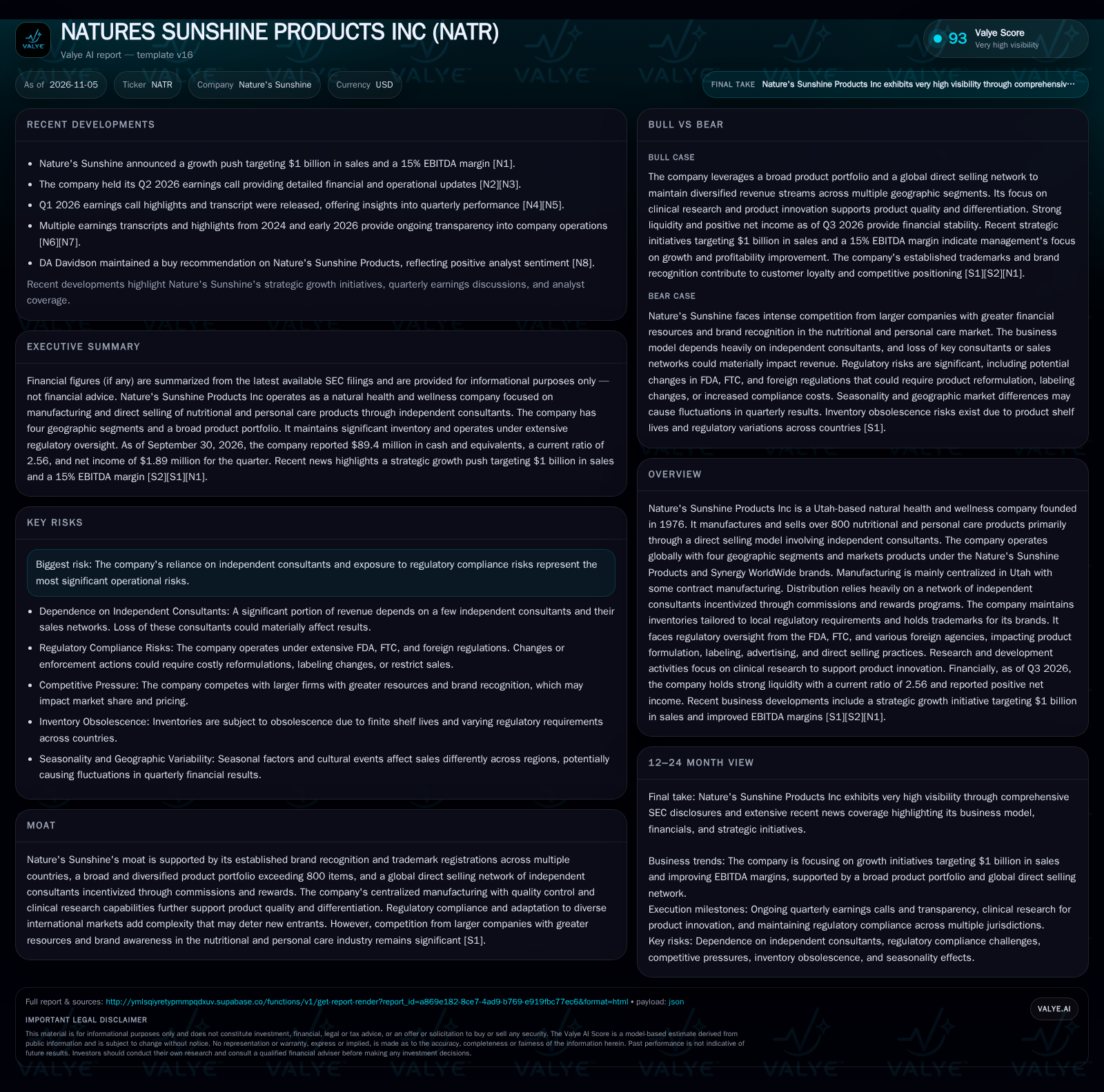
Nature’s Sunshine is targeting $1 billion in sales and higher EBITDA margins, relying on its global direct selling network and broad product portfolio. The company’s future will depend on its ability to drive volume through its consultant base while maintaining product innovation and operational discipline. [S1] [S2] [N1]
Nature’s Sunshine Products, a veteran in the natural health and wellness sector, is embarking on a bold growth initiative: targeting $1 billion in sales and a step-change in profitability. The company’s fortunes are intertwined with its global network of independent consultants, who are both its distribution engine and a potential point of fragility. With a broad portfolio of over 800 products and a clear emphasis on clinical research and brand protection, the challenge for Nature’s Sunshine is to convert its operational strengths into sustained, scalable growth—while weathering the perennial headwinds of regulation, channel risk, and intense competition.
Growth Targets and Financial Position Define the Strategic Moment
Nature’s Sunshine has publicly set its sights on reaching $1 billion in annual sales and achieving a 15% EBITDA margin, signaling a desire for transformative scale and profitability. This is a marked escalation from its current run-rate and requires significant acceleration in consultant-driven sales volume or pricing/mix improvements to bridge the gap. [N1]
As of Q3 2026, the company reports $89.4 million in cash and equivalents, current assets of $188.4 million, and current liabilities of $73.5 million, with a current ratio of 2.56 and net income of $1.89 million for the quarter. While this snapshot reflects a reported liquidity position and operational profitability, the scale of the growth ambition will test the existing model’s scalability and cost structure. [S2]
Recent analyst coverage remains constructive, with DA Davidson maintaining a buy recommendation, suggesting external confidence in the company’s strategic direction. [N8]
Direct Selling Model: Incentives, Fixed Costs, and Margin Leverage
Nature’s Sunshine generates revenue by manufacturing and selling over 800 nutritional and personal care products through a network of independent consultants. The direct selling model shifts much of the variable cost structure to the consultant base, reducing the need for fixed retail infrastructure but creating dependence on maintaining and motivating a large, active sales force. [S1]
Revenue growth in this model typically depends on recruiting and retaining consultants, increasing order volume per consultant, and expanding product penetration. Consultant incentives, training, and rewards programs are central expense levers—investments here can drive top-line growth but may compress margins if not offset by higher volumes or pricing.
The company’s centralized manufacturing in Utah and selective use of contract manufacturers allow for some scale economies, but the broad product range and geographic complexity likely increase inventory and regulatory compliance costs. Achieving the stated 15% EBITDA margin will require careful management of these costs, as well as continued innovation that could support premium pricing or upsell opportunities.
Capital needs are moderate compared to asset-heavy models, but working capital is tied up in inventories of raw materials and finished goods across multiple countries. Seasonality and regulatory-driven inventory adjustments add complexity to forecasting and margin management.
How Brand, Product Breadth, and Consultant Loyalty Shape Market Standing
Nature’s Sunshine competes in a crowded landscape of nutritional and personal care products, facing both global supplement giants and regionally entrenched direct-selling peers. Its competitive position is anchored by several factors: established brand recognition, trademark protections across many countries, and a product portfolio that spans general health, immune support, cardiovascular, digestive, and weight management categories. [S1]
The company’s moat is partially built on consultant loyalty and the complexity of international regulatory compliance, which can slow new entrants. However, the direct selling channel is structurally vulnerable to turnover, attrition, and the ability of larger competitors to offer higher commissions or more compelling incentive programs.
Product innovation—supported by in-house clinical research—offers differentiation, but the efficacy and marketing claims must continually withstand regulatory scrutiny. Brand trust and perceived product quality are crucial, especially as the wellness market attracts both sophisticated competitors and regulatory crackdowns on misleading claims.
Substitution risk is high: consumers can often switch to retail, e-commerce, or other direct sales brands with low friction unless there is a strong consultant-client relationship or product efficacy that is difficult to replicate.
What Drives a Breakout: Consultant Engagement, Category Expansion, and Margin Discipline
The most favorable outcome for Nature’s Sunshine would be a virtuous cycle in which strong consultant recruitment and retention power robust volume growth, supported by new product launches and deeper penetration in existing categories. Effective training, attractive incentives, and digital tools could help consultants reach broader audiences and improve order frequency.
If the company succeeds in leveraging its clinical research to launch differentiated products that command premium pricing, revenue per consultant could rise, supporting both revenue and margin expansion. Geographic expansion into fast-growing regions or underserved markets could further accelerate top-line growth.
Sustained operating leverage—where incremental volume growth outpaces increases in incentive or compliance spending—would be necessary to approach the targeted 15% EBITDA margin. Evidence that would confirm this scenario includes material increases in consultant headcount and productivity, successful product launches with strong uptake, and sequential margin improvement over multiple quarters.
Sustaining Moderate Growth Amid Channel and Regulatory Complexity
A more plausible middle path is one where Nature’s Sunshine continues to grow revenues through incremental consultant network expansion and ongoing product refreshes, but faces periodic setbacks from consultant attrition, regulatory changes, or competitive pricing pressure. The company likely manages to retain profitability and positive cash flow, but margin expansion is gradual and falls short of the 15% EBITDA target without a step-change in scale or mix.
Quarterly results may remain volatile, reflecting seasonality, shifting consultant engagement, and the timing of major product launches or regulatory approvals. Continued investment in training and digital tools supports consultant productivity, but the cost base rises in tandem, limiting operating leverage.
Evidence that would support this scenario includes relatively stable consultant numbers, steady but unspectacular revenue growth, and EBITDA margins improving only modestly or remaining flat despite ongoing strategic initiatives. Regulatory interventions or inventory write-downs would serve as headwinds, but not existential threats.
Consultant Attrition, Regulatory Shocks, and Competitive Displacement
The primary risk for Nature’s Sunshine is a negative feedback loop in which consultant attrition accelerates, either due to more attractive opportunities elsewhere or waning confidence in the company’s incentive programs. If key consultant leaders or networks defect, regional sales could decline sharply, leading to excess inventory, margin erosion, and potential write-offs.
A significant regulatory action—such as new restrictions on product claims, required reformulations, or direct selling practices—could disrupt sales channels, force costly compliance adjustments, or damage brand trust. Inventory obsolescence is a related risk if products become unsellable due to regulatory or labeling changes.
Competitive dynamics could worsen if larger supplement companies aggressively target Nature’s Sunshine’s core markets with better pricing, more compelling brands, or direct-to-consumer channels. Early warning signs would include declining consultant headcount, negative revenue growth, margin compression, and increased regulatory compliance costs or legal proceedings.
Benchmarks for Assessing Growth, Channel Health, and Execution Risk
Quarterly changes in active consultant headcount and productivity—if disclosed—would provide early insight into channel momentum and engagement.
Sequential revenue growth by geographic segment can reveal where the company’s growth initiatives are gaining or losing traction.
Gross and EBITDA margin trends, especially relative to the 15% target, will test the effectiveness of cost management and incentive program discipline.
Revenue per consultant—if disclosed—would help assess the impact of product innovation and upselling strategies.
The pace and success of new product launches, measured by sales contribution in the first 6–12 months, will indicate the power of the company’s R&D pipeline.
Inventory turnover and levels by region would help monitor risks of obsolescence and working capital drag.
Any material regulatory actions, warning letters, or forced product withdrawals will be crucial to track, given the compliance-heavy nature of the business.
Consultant attrition rates—if disclosed—would offer a direct window into channel stability and future sales risk.
Disclaimer: This is research-only, informational analysis and not investment advice. It may include AI-generated interpretation and general industry context. Always verify important details using primary sources.

Comments