
ADMA Biologics: Manufacturing Efficiency and Strategic Growth in Specialty Plasma-Derived Products
Recent FDA-approved yield enhancements and operational scaling have shifted ADMA Biologics into sustained profitability, but the company’s dependence on third-party contractors, regulatory complexity, and market unpredictability continue to shape its risk-reward profile. How much operating leverage and product differentiation can the business extract from its vertical integration and clinical positioning?
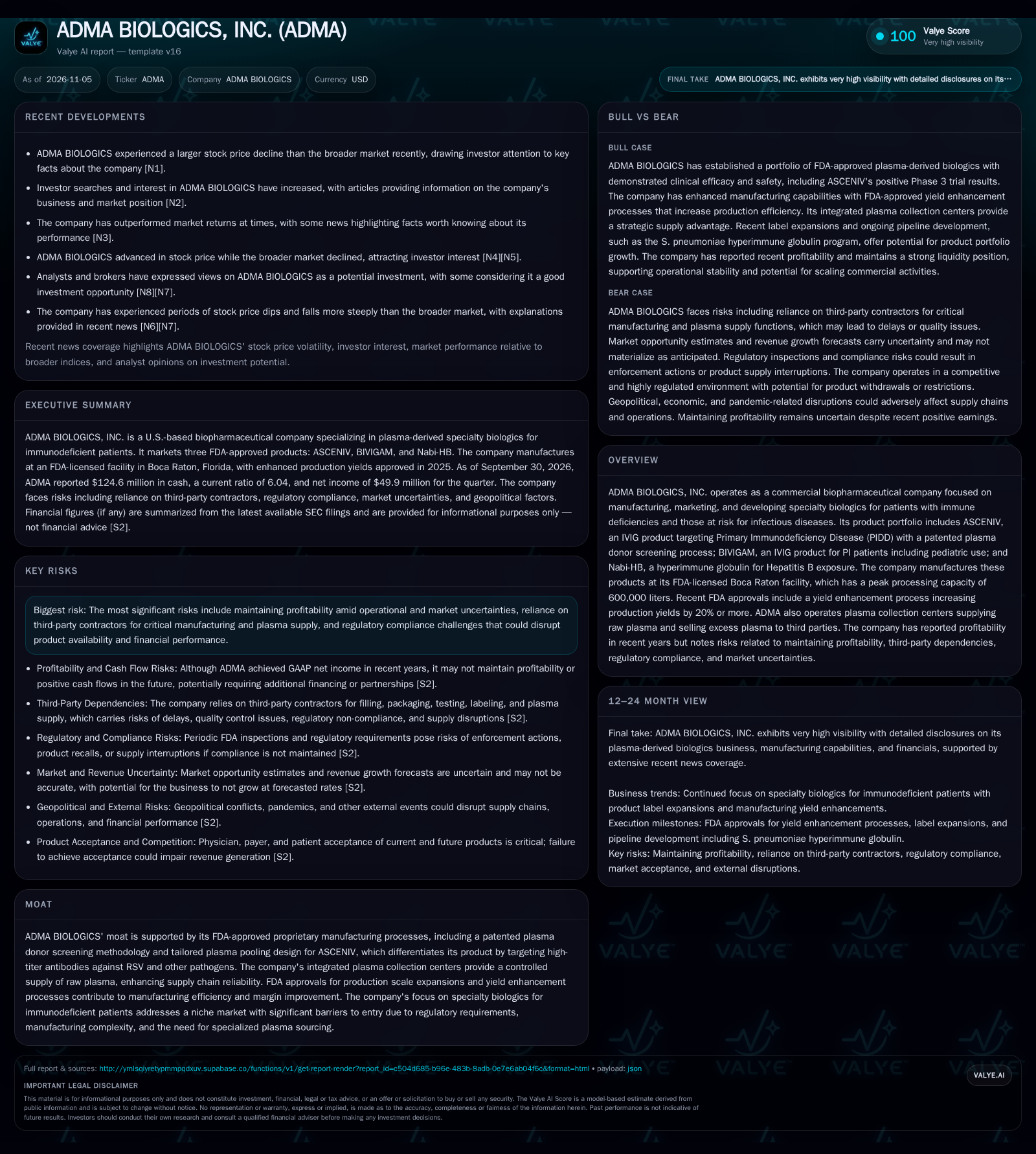
ADMA Biologics has achieved notable production yield improvements and reported consecutive periods of GAAP profitability, leveraging proprietary processes and a vertically integrated plasma supply. However, future growth and margin durability hinge on maintaining regulatory compliance, managing third-party dependencies, and navigating uncertain market dynamics. The company’s ability to further optimize manufacturing, expand its portfolio, and defend its niche will determine the sustainability of its recent financial progress [S1] [S2].
ADMA Biologics has transitioned from years of investment and operational buildup to a period of sustained profitability and margin improvement, powered by FDA-sanctioned manufacturing enhancements and a vertically integrated plasma supply chain. With three FDA-approved specialty biologics targeting immunodeficient and infectious disease populations, the company has capitalized on both clinical differentiation and operational leverage. Yet, the durability of this transformation remains tested by regulatory scrutiny, third-party dependencies, and market unpredictability. The central question for investors and operators alike: Can ADMA’s integrated strategy and manufacturing edge deliver lasting economic advantage in an industry defined by complexity and compliance risk?
Recent Advances in Yield and Profitability for ADMA Biologics
ADMA Biologics has achieved a step-change in manufacturing efficiency, with FDA approval in April 2025 for a yield enhancement process that boosts ASCENIV and BIVIGAM production yields by at least 20% from the same plasma input. This operational improvement comes alongside a reported net income of $49.9 million for the quarter ending September 30, 2026, and consecutive fiscal years of GAAP profitability [S1] [S2]. The company’s Boca Raton facility now operates with a peak annual processing capability of up to 600,000 liters, supported by the July 2025 acquisition of additional real estate for expansion [S1]. These developments have shifted the company’s financial and operational baseline, providing greater fixed-cost absorption and the possibility of improved gross margins. However, ADMA continues to flag risks in sustaining these positive earnings, citing ongoing uncertainties around contractor reliability, regulatory compliance, and market dynamics [S2].
Leveraging Manufacturing Scale to Enhance Cost Efficiency
The core economics of ADMA Biologics depend on extracting maximum value from each liter of collected plasma while managing the high fixed costs inherent to biologics manufacturing. The FDA-approved yield enhancement process increases the output of finished product per unit of plasma, which, if maintained, should expand gross margins by spreading fixed overhead (facility, quality control, regulatory compliance) across more saleable units. The Boca Raton facility’s capacity of 600,000 liters supports significant operating leverage, particularly as incremental volumes can be processed with relatively modest increases in variable costs such as labor and consumables.
ADMA’s vertically integrated model—owning plasma collection centers and manufacturing—offers some insulation from raw material price swings and supply shocks, but the company still relies on third-party contractors for critical steps like filling, packaging, and testing. This hybrid structure may limit the full realization of integration benefits. Revenue mix is driven by three FDA-approved products: ASCENIV (with a differentiated clinical profile and patented sourcing methodology), BIVIGAM (now benefiting from expanded plasma pool production), and Nabi-HB (a long-standing hepatitis B immune globulin). Each product targets a relatively niche but high-value patient segment, suggesting pricing power may be sustainable if clinical differentiation and supply reliability are maintained.
The company reported cash and liquidity metrics for the period; these figures do not by themselves establish operating runway, investment capacity, financial flexibility, or financing capacity. [S2]
Clinical Differentiation Coupled with Vertical Integration Strengthens Position
ADMA’s competitive position is anchored in three main pillars: proprietary manufacturing processes (notably the patented ASCENIV plasma pooling and screening), vertical integration of plasma supply, and a focus on specialty, often underserved, patient populations. These factors confer potential advantages in both product differentiation and supply chain reliability. The ability to source high-titer plasma for ASCENIV, for example, is not easily replicated by generic competition, as it requires both specialized donor identification and regulatory clearance.
However, the broader plasma-derived therapeutics landscape is marked by entrenched multinational competitors with greater scale, diversified portfolios, and deeper resources. While ADMA’s niche focus and integration may provide resilience against commoditization, it is not immune to competitive pricing pressure, payer negotiations, or the threat of new therapies (including recombinant or gene-based alternatives) that could erode demand for plasma-derived IVIG over time.
Customer concentration—common in hospital- and specialty-pharmacy channels—could also expose the company to volume and pricing risk if purchasing patterns shift or new competitors win formulary positions. The company’s moat depends on maintaining clinical relevance, operational reliability, and regulatory compliance—any slippage in these areas could quickly narrow its competitive gap.
Potential for Margin Growth and Portfolio Expansion to Boost Performance
If ADMA can sustain or further improve its yield enhancement processes, the resulting margin expansion could drive higher operating income even at flat or modestly growing top-line levels. Successful commercialization of pipeline candidates—such as the S. pneumoniae hyperimmune globulin—would diversify revenue and further leverage fixed manufacturing assets. Additional FDA approvals for label expansions (e.g., broader indications or age groups) would unlock new patient populations without the need for major new infrastructure.
Upside would be confirmed by continued sequential growth in net income, rising gross and operating margins, and evidence of successful new product launches or label expansions. Further, a growing share of plasma sourced internally (versus purchased from third parties) would suggest increasing supply chain control and cost efficiency. Finally, positive clinical trial outcomes for pipeline assets and a stable or improving regulatory inspection record would reinforce the case for durable differentiation and operational execution.
Maintaining Profitability Despite Regulatory and Supply Chain Challenges
The most plausible trajectory for ADMA involves incremental volume growth across its core biologics portfolio, supported by the recent yield enhancements and expanded facility capacity. Operating leverage should support stable, if not gradually improving, margins as long as plasma sourcing and manufacturing remain uninterrupted. However, the company will likely continue to face periodic regulatory inspections, supply chain friction from third-party dependencies, and pricing/volume pressures from payers or competitors.
Base case confirmation would come from steady, though perhaps lumpy, net income and cash flow, with no major regulatory setbacks or supply disruptions. Modest increases in product volumes, stable average selling prices, and maintenance of current gross margin levels would reinforce the scenario. Conversely, any material product recall, regulatory warning, or sudden spike in contractor-related delays would challenge the sustainability of this trajectory.
Risks from Operational Hurdles and Regulatory Delays Could Pressure Margins
The primary downside risks for ADMA are clustered around operational and regulatory execution. A significant quality issue, FDA enforcement action, or persistent delays from third-party contractors could interrupt product supply, trigger recalls, or necessitate costly remediation, eroding both revenue and margin. Market-side risks include increased competition (from new plasma-derived or non-plasma therapies), payer-driven price cuts, or a loss of key hospital/pharmacy contracts due to supply reliability concerns.
Downside would be confirmed by a return to net losses, shrinking gross margins, and cash flow deterioration. Reductions in plasma collection volumes, extended facility downtime, or loss of regulatory approvals would further signal structural setbacks. The appearance of legal or IP disputes, negative clinical outcomes for pipeline assets, or adverse changes in reimbursement policies would compound these risks.
Key Operational and Strategic Developments Influencing ADMA’s Trajectory
Quarterly and annual trend in net income and operating cash flow, as ongoing profitability is not yet assured over the long term [S2].
Gross margin percent and yield per liter of plasma processed, especially to confirm the durability of recent FDA-approved yield enhancements [S1].
Volume of plasma collected internally versus purchased from third parties—a rising internal share would suggest improved supply chain control (if disclosed).
Regulatory inspection outcomes and any FDA warning letters or observations, which could signal compliance risk or operational disruption (if disclosed).
Progress and results from pipeline developments, such as clinical milestones for the S. pneumoniae hyperimmune globulin program (if disclosed).
Incidence and impact of product recalls, supply interruptions, or contractor-related delays (if disclosed).
Market share or formulary status for core products in hospital and specialty pharmacy channels—a useful metric would be customer retention or contract renewal rates (if disclosed).
Material changes in pricing or reimbursement for ASCENIV, BIVIGAM, or Nabi-HB, as these would directly affect revenue and margin trajectory (if disclosed).
Disclaimer: This is research-only, informational analysis and not investment advice. It may include AI-generated interpretation and general industry context. Always verify important details using primary sources.

Comments