
ProtoKinetix, Inc.: Assessing Survival Prospects Amid Severe Liquidity and Disclosure Constraints
ProtoKinetix’s latest filings reveal a company with negligible liquidity, overwhelming current liabilities, and no recently disclosed revenue. With no substantive operational updates or visible commercial traction, the core question is whether any latent intellectual property or strategic pivot could plausibly reverse its trajectory.
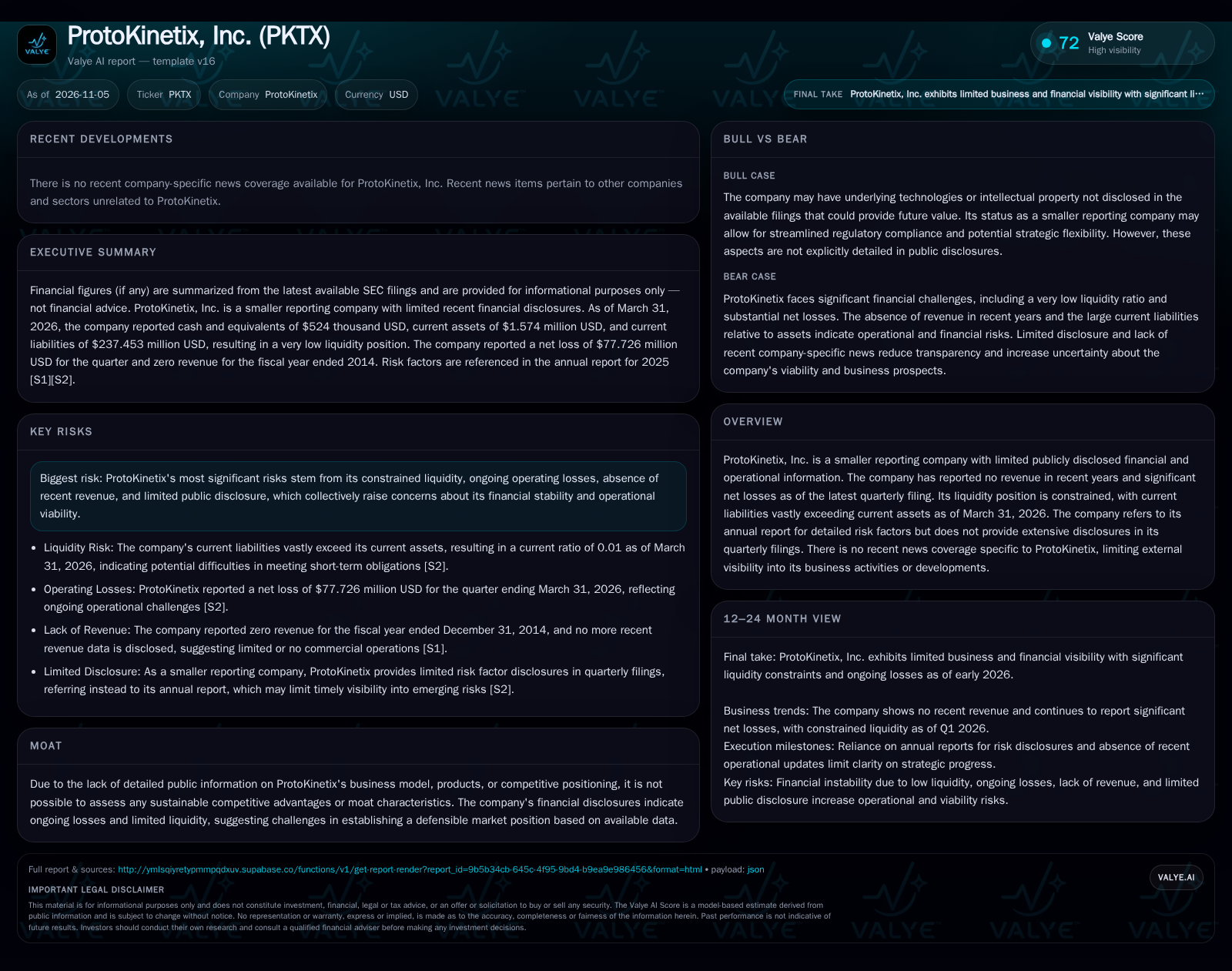
ProtoKinetix, Inc. faces acute financial distress, with current liabilities vastly outstripping current assets and a net loss of $77.7 million in the latest quarter. The absence of reported revenue and minimal public disclosure deepen uncertainty about its business prospects or any underlying value. The company’s survival likely hinges on undisclosed assets, external funding, or a dramatic strategic shift, but available evidence offers little support for near-term stabilization or growth. [S2]
ProtoKinetix, Inc.’s most recent SEC filings paint a stark picture: minimal cash on hand, current liabilities exceeding assets by two orders of magnitude, and no sign of recent revenue or commercial progress. With no substantive operational disclosures and a reliance on annual reports for risk transparency, questions mount about both the company’s underlying assets and its ability to avoid insolvency. The critical issue for investors and stakeholders is whether ProtoKinetix possesses any hidden intellectual property, pending deals, or strategic options that could justify continued existence or attract new capital.
Liquidity Collapse and Lack of Revenue Define ProtoKinetix’s Present Reality
The most material facts from ProtoKinetix’s latest quarterly report are its extremely reported liquidity position and absence of visible business activity. As of March 31, 2026, the company held only $524 thousand in cash and cash equivalents, with total current assets of $1.574 million, dwarfed by $237.5 million in current liabilities—a current ratio of 0.01 and a cash ratio of 0. This is not a typical liquidity squeeze but a near-total collapse of short-term solvency [S2].
On the performance side, ProtoKinetix reported a net loss of $77.7 million for the quarter, and there is no evidence of revenue generation in the most recent filings. The last disclosed revenue figure is zero for the fiscal year ended December 31, 2014 [S1].
No recent company-specific news or operational milestones are available, and the company’s quarterly filings defer meaningful risk disclosure to its annual report [S2]. These facts suggest a business with little to no ongoing commercial activity and a severe liquidity crisis.
The severity of ProtoKinetix’s liquidity crisis implies that traditional short-term financing options, such as revolving credit lines or bridge loans, are likely unavailable or prohibitively expensive. In such a context, the company’s ability to sustain operations depends heavily on either immediate asset liquidation or emergency capital injections, both of which are challenging without demonstrable value or investor confidence. Moreover, the lack of recent revenue suggests that the company is not generating operating cash flow to offset its burn, further exacerbating its cash flow constraints and increasing the risk of insolvency if no remedial actions are taken promptly.
Economic Model: Hypothetical Value Chains in the Absence of Revenue
With no recent revenue and minimal disclosure about products, customers, or partnerships, ProtoKinetix’s business economics remain opaque. If the company possesses proprietary technology or intellectual property (IP)—such as biotechnological materials, drug candidates, or platform assets—its value would rest on out-licensing, asset sales, or partnership models. In such scenarios, upfront payments, milestones, and royalties could be the primary revenue levers, but these are entirely hypothetical in the absence of disclosed deals.
The company’s cost structure appears heavily weighted toward fixed costs, as evidenced by the substantial net loss despite no reported revenue. This suggests ongoing R&D, administrative, or legacy obligations. Without commercial inflows, ProtoKinetix’s capital needs are acute: bridging the gap between fixed outflows and zero operating income likely requires external capital infusions, asset monetization, or drastic cost reductions.
Any shift toward a viable business model would require clear articulation of asset value, a credible path to monetization, and the ability to fund operations through non-dilutive means or strategic partnerships.
In the absence of disclosed revenue streams, a useful analytical approach involves examining the company’s cost structure elasticity and potential for cost containment. If fixed costs dominate, as suggested by persistent net losses, scaling down operations or restructuring could reduce cash burn but might simultaneously erode the company’s intangible value, such as ongoing R&D projects or intellectual property development. Conversely, if the company has any variable costs tied to prospective product development or partnerships, these might be adjusted more flexibly to preserve capital. However, without transparent disclosures, the feasibility of such cost management strategies remains speculative and contingent on management’s willingness and ability to execute them effectively.
Competitive Landscape: No Clear Moat or Market Presence
ProtoKinetix’s current filings provide no detail on its products, IP portfolio, customer relationships, or end markets, making it impossible to assess any sustainable competitive advantages. In the life sciences or biotech sector, a defensible moat typically requires validated technology, regulatory progress, and strong partnerships or licensing agreements.
In the absence of revenue, operational updates, or partnership announcements, ProtoKinetix appears to lack the traction necessary to deter competitors or attract acquirers. If any IP or proprietary technology exists, its commercial relevance and defensibility remain untested in the marketplace.
The company’s status as a smaller reporting company may allow for regulatory flexibility, but this is not a substitute for competitive differentiation or commercial momentum. Without evidence of progress or market validation, ProtoKinetix risks being eclipsed by better-capitalized or more advanced peers in whichever sector it seeks to address.
The absence of disclosed partnerships or licensing agreements also raises questions about ProtoKinetix’s market positioning relative to competitors who may have secured strategic alliances or regulatory endorsements. In industries reliant on intellectual property, the timing and credibility of validation events—such as patent grants or clinical trial results—are critical to establishing competitive moats. Without evidence of such milestones, the company risks falling behind peers with more advanced pipelines or stronger financial backing. Additionally, the lack of market presence could impair its ability to negotiate favorable terms in potential licensing deals, thereby limiting its capacity to monetize any latent technology effectively.
Rescue or Monetization: How Hidden Assets Could Alter the Narrative
The most bullish plausible scenario would involve ProtoKinetix revealing valuable intellectual property, securing a licensing deal, or attracting a strategic acquirer for its underlying assets. In such a case, even a distressed balance sheet could be overcome if the company’s technology addresses a critical unmet need, is validated by credible partners, or is the subject of pending transactions.
Confirmation of this scenario would require concrete disclosures: a signed licensing agreement, upfront cash inflows, partnership announcements, or the publication of new scientific or regulatory milestones. A material reduction in net losses due to inflows from asset sales or deals would further support the thesis.
Falsification would occur if filings continue to show no revenue, no operational updates, and no evidence of external interest, confirming that any latent value is either immaterial or inaccessible.
Financial Distress Persists Without Visible Turnaround Efforts
The most probable scenario, absent new disclosures, is continued operational stasis and deepening financial distress. ProtoKinetix will likely remain unable to meet its short-term obligations, with ongoing net losses and no revenue to offset fixed costs.
Confirmation would come from continued reporting of severe liquidity deficits, the absence of fundraising, and no progress on revenue generation or asset monetization. Further deferral of risk disclosures or operational updates would reinforce the narrative of stagnation.
Falsification would require evidence of a turnaround initiative: a new capital raise, a strategic partnership, or the launch of a revenue-generating product or service.
Insolvency, Delisting, or Liquidation as Plausible Endpoints
Given the current ratio of 0.01 and a cash ratio of zero, a plausible adverse scenario includes technical insolvency, creditor actions, or forced asset sales at distressed valuations. The risk of delisting or bankruptcy increases with each quarter that passes without new funding or revenue.
Confirmation would appear as announcements of default, bankruptcy filings, auditor going-concern warnings, or regulatory actions. A continued pattern of silence on fundraising or operational progress would also support this scenario.
Falsification would require unexpected external intervention—such as a white-knight investor, government grant, or takeover bid that injects reported liquidity position to stabilize operations.
Milestones That Would Challenge or Reinforce the ProtoKinetix Thesis
Disclosure of any revenue-generating agreement, licensing deal, or customer contract would materially alter the business outlook.
Announcement of new funding—whether debt, equity, or grant—would indicate short-term survival prospects.
Publication of scientific or regulatory milestones (e.g., clinical trial progress, patent issuances) would help clarify the value of any underlying assets.
A useful metric would be the breakdown of operating expenses, especially R&D versus G&A, to assess burn rate and capital allocation if disclosed.
Any filings indicating auditor concerns, going-concern warnings, or creditor actions would be early signals of insolvency risk.
Board or management changes, particularly if tied to restructuring or asset sales, would signal possible strategic pivots.
External validation—such as industry partnerships, co-development agreements, or inbound M&A interest—would provide evidence of latent value.
Disclaimer: This is research-only, informational analysis and not investment advice. It may include AI-generated interpretation and general industry context. Always verify important details using primary sources.

Comments