
Figma’s AI-Powered Platform: Monetization Strategies, Expansion Risks, and the Stakes of Workflow Integration
Figma’s evolution into a browser-based, AI-driven collaboration suite positions it as a core enabler for digital product teams, but rapid expansion, technical complexity, and competitive encroachment put its monetization and retention strategies to the test.
Figma’s platform now spans the entire software development lifecycle, with AI features and real-time collaboration as differentiators. However, operational losses, high technical complexity, and looming competitive threats create volatility in both financial outcomes and customer stickiness. Monitoring adoption of new AI features, customer reactions to pricing changes, and the ability to manage growth will be crucial for the next phase.
Figma’s transformation from a browser-based design tool into a broad, AI-powered platform for product development signals its ambition to become the connective tissue of digital product creation. By layering ideation, design, prototyping, developer handoff, and AI-driven content creation into a single collaborative environment, Figma is betting on deep integration and extensibility as its moat. Yet this expansion brings both opportunity and risk: monetizing advanced AI features, managing technical complexity, and navigating fierce competition will all shape whether Figma’s current growth translates into durable market leadership.
Figma’s Platform Expansion, Monetization Shifts, and Financial Position: What’s Changed in 2026
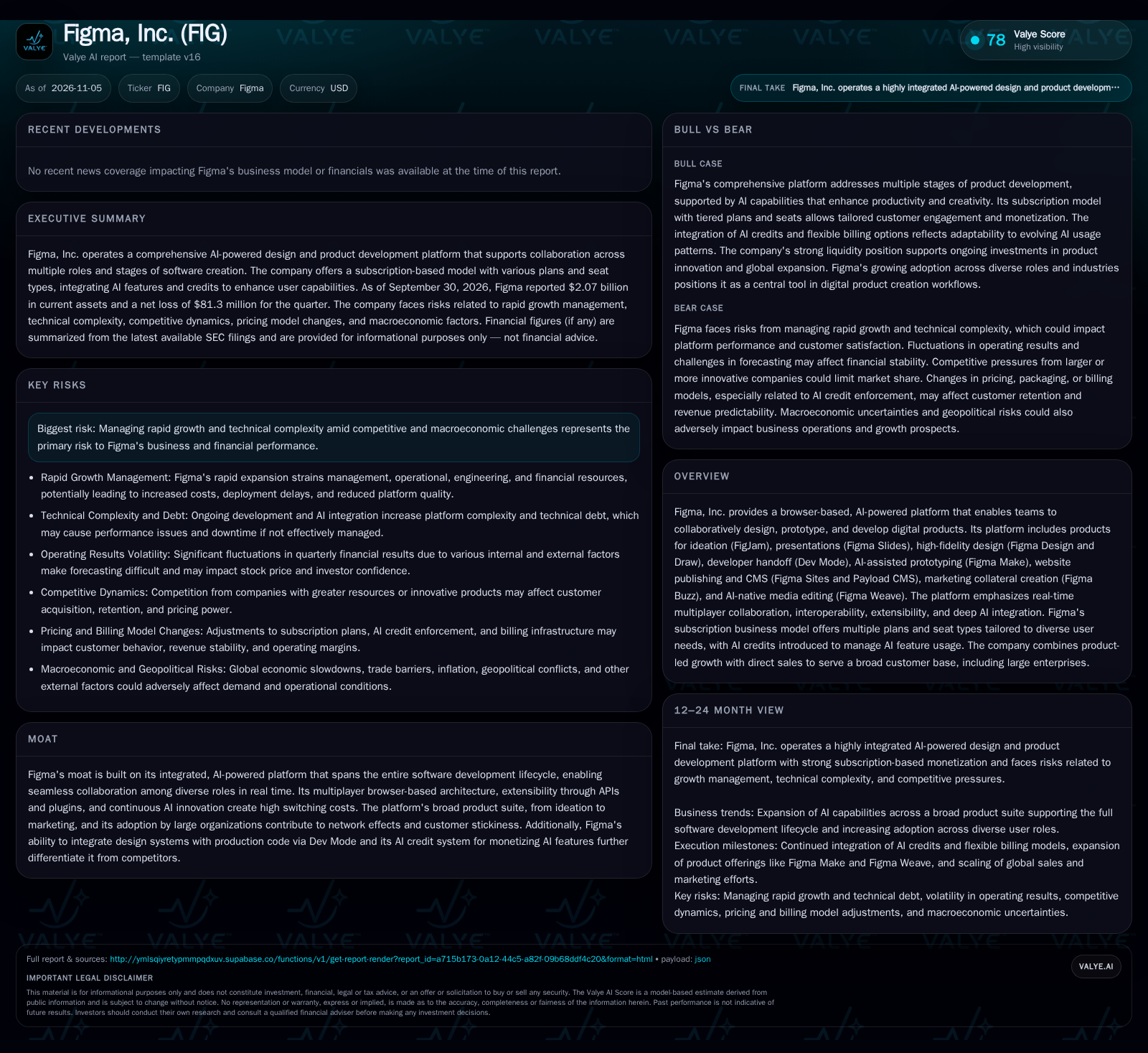
Figma’s platform now covers nearly the full spectrum of digital product creation, from ideation (FigJam) and high-fidelity design (Figma Design, Draw) to developer handoff (Dev Mode), AI-powered prototyping (Figma Make), website publishing (Sites, Payload CMS), and marketing collateral (Buzz, Weave) [S1]. The introduction and enforcement of AI credit limits on all seat types in 2025–2026, with options for additional purchases or pay-as-you-go billing, marks a significant shift in how advanced AI features are monetized [S1]. As of September 30, 2026, Figma holds $508 million in cash and equivalents and $1.21 billion in short-term investments, with current assets of $2.07 billion versus $844 million in current liabilities—a current ratio of 2.45 [S2]. The company posted a net loss of $81.3 million for the quarter, underscoring the ongoing cost of rapid product and sales expansion [S2]. These developments are central to Figma’s thesis: the breadth of its platform, its evolving monetization model, and its capacity to fund aggressive innovation in a competitive market.
How Figma Makes—and Could Lose—Money: Subscription Mechanics, AI Monetization, and Cost Leverage
Figma’s revenue is primarily driven by a subscription model with tiered plans (Starter, Professional, Organization, Enterprise) and differentiated seat types, allowing price segmentation by user role and organizational size [S1]. AI credits, first introduced in 2025 and strictly enforced in 2026, create an additional axis for monetization: users exceeding their included AI usage must purchase extra credits or opt for pay-as-you-go billing [S1]. This introduces variable revenue potential, especially as AI-powered features become integral to workflows. However, it also introduces cost management complexity, as generative AI infrastructure can be expensive and unpredictable in usage patterns.
Operating leverage is plausible if Figma can scale its platform without proportional increases in support, R&D, and sales costs, but rapid product expansion and deep AI integration may keep fixed costs elevated. The browser-based architecture and real-time multiplayer features are likely to require ongoing infrastructure investment. Capital intensity is relatively low compared to hardware-centric SaaS peers, but technical debt from integrating multiple new AI and workflow products could strain engineering resources and impact gross margins if not managed carefully.
The company reported cash and liquidity metrics for the period; these figures do not by themselves establish operating runway, investment capacity, financial flexibility, or financing capacity. [S2]
Workflow Lock-In or Feature Parity? Figma’s Competitive Stakes in a Crowded SaaS Landscape
Figma’s competitive position is defined by the breadth and integration of its platform, real-time collaboration, and extensibility via APIs and plugins [S1]. Its main rivals include other design and prototyping platforms, developer handoff tools, and workflow suites—some backed by larger, resource-rich incumbents or fast-moving startups.
Potential advantages include high switching costs for organizations that embed Figma’s tools across multiple roles and workflows, network effects from multiplayer collaboration, and the modularity of its seat-based pricing. The integration of AI features—especially if Figma can develop proprietary models aligned to design and product workflows—could differentiate the offering if performance and usability beat off-the-shelf solutions.
Counterforces are material: competitors may quickly replicate core features, integrate with popular design systems, or undercut on price. The introduction of AI credits and enforced limits could prompt price-sensitive customers to explore alternatives, especially if AI usage becomes mission-critical. The ease of integrating Figma into broader SaaS ecosystems is a double-edged sword—while it drives adoption, it could also make switching to another integrated platform less painful if Figma’s value proposition slips.
From Design Tool to Workflow Standard: What a Figma ‘Winner-Take-Most’ Outcome Would Require
In the most favorable scenario, Figma’s platform becomes the default operating system for digital product teams, with AI-powered features driving both productivity and creativity. Strong adoption of new products (Figma Make, Weave, Buzz) and seamless integration of AI into daily workflows could justify higher seat penetration and premium pricing. If customers embrace the AI credit system—viewing it as valuable rather than punitive—Figma could unlock a recurring upsell engine, with usage-based revenue compounding on top of core subscriptions.
Confirmation of this scenario would require evidence of accelerating seat growth in enterprise plans, high renewal rates, and increasing average revenue per user (ARPU) driven by AI credit purchases. Product usage metrics showing deep engagement with newer AI features, coupled with positive feedback on platform reliability and extensibility, would further support the bull case.
Falsification would come from customer pushback on AI credit enforcement, stagnating adoption of new modules, or rising churn in key segments. If the value of AI features is not perceived as justifying incremental spend, or if technical issues undermine the platform’s reliability, Figma’s ability to extract premium value from its user base would be in doubt.
Platform Expansion Meets Growth Friction: The Most Likely Evolution for Figma
A plausible middle path is that Figma continues to expand its product suite and deepen AI integration, but revenue growth moderates as the company encounters the limits of seat expansion and faces pricing sensitivity around AI credits. New products may see adoption among existing customers, but AI usage patterns could prove uneven—some users may exhaust credits quickly, while others remain on base plans.
Financially, operating losses may persist or narrow gradually, depending on Figma’s discipline in managing R&D, infrastructure, and sales costs relative to topline growth. [S2]
Confirmation would come from stable or slightly improving net loss margins, ongoing product launches, and maintenance of a reported current ratio. Falsification would be indicated by a sharp rise in churn, declining ARPU, or evidence that new product launches fail to drive incremental seat adoption or AI usage.
When Complexity Outpaces Value: How Figma Could Lose Momentum
Figma’s rapid product expansion and deepening technical complexity carry the risk that platform reliability or usability suffers, leading to customer dissatisfaction and increased churn. If the introduction of AI credit enforcement is perceived as a stealth price hike—especially by customers who rely heavily on generative AI tools—there could be backlash, downgrades, or migration to simpler or cheaper alternatives.
Competitive encroachment is another threat: if rivals launch compelling, integrated AI design features or undercut Figma on price, organizations may reconsider platform loyalty—especially in a cost-conscious macro environment. Technical debt built up from integrating multiple new modules could lead to outages, performance issues, or slower feature delivery, reducing customer confidence.
Downside confirmation would include a spike in support tickets, negative sentiment in user communities, missed product delivery timelines, and a material deterioration in net retention or cash burn. If operating losses widen despite topline growth, it could indicate that Figma’s expansion is not translating into scalable, profitable economics.
Milestones and Metrics That Will Define Figma’s Next Chapter
Growth in enterprise seat adoption, particularly for new products like Figma Make, Weave, and Dev Mode, if disclosed, would signal the platform’s ability to expand wallet share.
Rate of AI credit purchases and pay-as-you-go AI revenue, if disclosed, will reveal whether customers view advanced AI features as indispensable or discretionary.
Net retention and churn rates by customer segment (SMB, enterprise) would help test the impact of pricing and product changes on customer loyalty.
Gross margin trends, especially as AI-powered features scale, would indicate whether usage-based monetization is boosting or eroding profitability.
Evidence of technical debt or platform reliability issues—such as increased downtime, performance lags, or delayed product rollouts—would test the thesis that Figma can scale innovation without sacrificing quality.
Sales and marketing expense as a percentage of revenue, if disclosed, will clarify whether global expansion is yielding efficient go-to-market leverage.
Customer and developer engagement with Figma’s API and plugin ecosystem would help gauge the strength of its extensibility moat and the likelihood of network effects.
Disclaimer: This is research-only, informational analysis and not investment advice. It may include AI-generated interpretation and general industry context. Always verify important details using primary sources.

Comments