
Liberty Latin America: Infrastructure Shocks, Market Breadth, and the Stakes of Telecom Resilience
Liberty Latin America’s broad network and multi-country platform provide scale and integration advantages, but recent hurricane-driven infrastructure losses and ongoing net losses highlight the sector’s vulnerability to external shocks and persistent margin pressures.
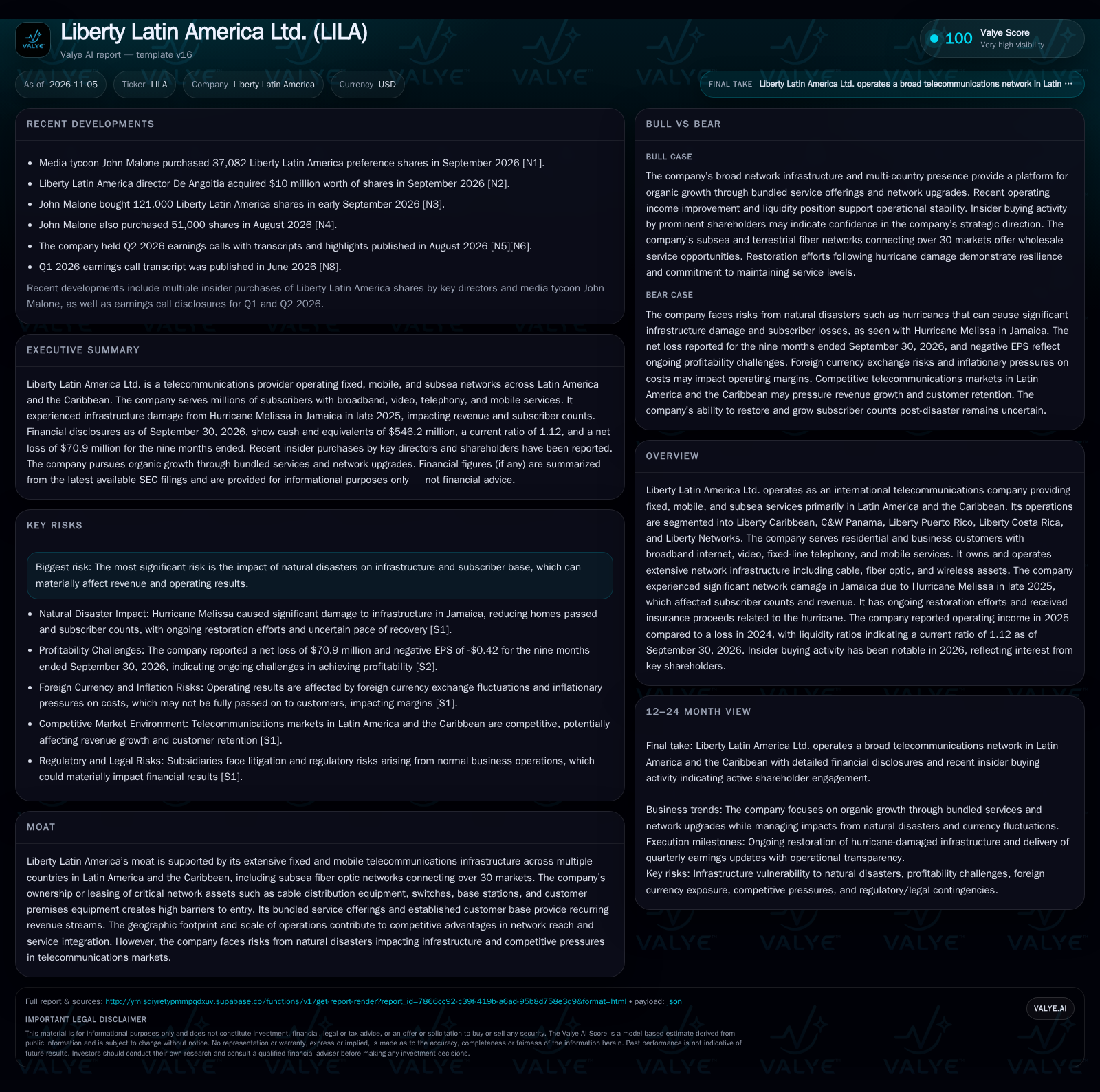
Liberty Latin America operates fixed, mobile, and subsea telecom networks across Latin America and the Caribbean, serving millions of residential and business customers. The company faces persistent profitability challenges, with a net loss of $70.9 million for the first nine months of 2026, and is still recovering from major infrastructure damage in Jamaica caused by Hurricane Melissa in late 2025. While its network scale and bundled service model offer growth potential, natural disaster risk, currency volatility, and stiff competition remain persistent headwinds. Insider share purchases by prominent investors in 2026 suggest confidence in the company’s long-term positioning, but the pace and cost of post-hurricane restoration—and the ability to return to sustainable profitability—remain critical variables for the investment case. [S1] [S2]
Liberty Latin America stands as one of the region’s most expansive telecom platforms, with operations stretching across over 20 countries and a portfolio that spans fixed, mobile, and subsea connectivity. Despite its scale and infrastructure reach, the company’s 2026 narrative is dominated by the aftershocks of Hurricane Melissa’s devastation in Jamaica—a stark reminder of the sector’s exposure to environmental risk. With profitability still elusive and restoration efforts ongoing, Liberty Latin America’s investment case hinges on its ability to leverage network breadth, restore disrupted service, and defend margins in the face of persistent competitive and macroeconomic pressures. Insider share purchases by major stakeholders add a layer of intrigue, but the core test remains: can the company convert operational scale into durable, disaster-resilient returns? [S1] [S2] [N1] [N2] [N3] [N4]
Hurricane Disruption, Ongoing Losses, and Restoration Efforts Define 2026
Liberty Latin America’s most pressing developments over the past year center on the severe impact of Hurricane Melissa in Jamaica in late 2025. The storm resulted in substantial infrastructure damage, leading to a reduction in homes passed and revenue-generating units (RGUs), as well as a direct hit to Q4 2025 revenue and Adjusted OIBDA. Restoration of disrupted networks remains ongoing, with the company incurring additional property and equipment costs, partially offset by $81 million in weather derivative proceeds. [S1]
For the nine months ended September 30, 2026, Liberty Latin America reported a net loss of $70.9 million, with EPS of -$0.42, despite having swung to operating income in full-year 2025—underscoring persistent profitability challenges and the lingering effect of the hurricane. The company reported cash and liquidity metrics for the period; these figures do not by themselves establish operating runway, investment capacity, financial flexibility, or financing capacity. [S2]
Notably, 2026 has seen a series of insider share purchases by major shareholders and directors, including John Malone and De Angoitia, signaling continued board-level engagement and potential confidence in the company’s long-term recovery or valuation. [N1] [N2] [N3] [N4]
How Bundling, Scale, and Asset Intensity Shape Profit Potential
Liberty Latin America’s economics are defined by the capital-intensive nature of telecom infrastructure and the pursuit of recurring revenue through bundled services. The company’s fixed and mobile networks—spanning cable, fiber, and subsea assets—enable it to offer multi-product bundles (broadband, video, telephony, mobile) to both residential and business customers. The bundled approach is designed to increase average revenue per user (ARPU), reduce churn, and leverage cross-selling across its customer base.
The company’s large installed asset base brings inherent operating leverage: incremental subscribers or upsold services can drive higher margins once fixed network costs are covered. However, this same asset intensity exposes the business to high maintenance and restoration costs—especially in the face of natural disasters, as seen in Jamaica. Restoration capex is not always offset by insurance or weather derivative proceeds, and the pace of subscriber recovery after disruption is a key variable for both top-line and margin trajectory.
The economics of Liberty’s subsea and terrestrial wholesale networks add a layer of complexity. While these assets can generate high-margin connectivity revenue by serving third-party carriers and enterprise customers, the market is competitive and pricing power can be limited by alternative routes and new entrants. The company’s ability to raise prices or pass through inflationary cost pressures is also constrained by regional competitive intensity and consumer price sensitivity.
Funding needs remain material. The company’s ongoing network upgrades, restoration projects, and potential expansion initiatives require sustained capital investment, which must be balanced against the pressure to return to sustainable free cash flow and reduce reliance on external financing.
Network Depth Versus Regional Competition and Environmental Exposure
Liberty Latin America’s competitive position is anchored by its extensive network infrastructure and presence across diverse geographies in Latin America and the Caribbean. Ownership or long-term control of fixed, mobile, and subsea assets gives the company significant barriers to entry—especially in smaller island markets or regions where building new infrastructure is prohibitively expensive.
However, the company faces intense competition from other established telecom operators, regional players, and, in some markets, government-backed incumbents. Mobile and fixed broadband markets are characterized by aggressive pricing, frequent promotional activity, and ongoing investments in network upgrades by peers. In some territories, over-the-top (OTT) content and alternative connectivity solutions (e.g., satellite broadband) represent growing substitutes, potentially pressuring ARPU and retention.
While scale and bundling can provide customer stickiness and some degree of recurring revenue, network resilience is increasingly a competitive differentiator. The impact of Hurricane Melissa exposed the vulnerability of even large-scale operators to environmental shocks. Companies that can rapidly restore service and communicate reliability may have an edge in customer retention and new customer acquisition post-disruption.
Liberty’s wholesale business, leveraging subsea and terrestrial fiber, offers some diversification, but faces pricing and utilization pressures as new capacity is added regionally. The company’s ability to maintain favorable terms and utilization on these routes is an ongoing challenge in a market where technological advances and new builds can erode legacy advantages.
Restoration Success and Bundled Upsell Could Unlock Margin Acceleration
A favorable outcome for Liberty Latin America would be driven by rapid and cost-effective restoration of hurricane-damaged infrastructure, enabling the company to recover lost RGUs and quickly reestablish revenue streams in Jamaica and any other affected territories. If restoration capex is contained and subscriber churn is reversed, the company could benefit from operating leverage as fixed costs are spread over a recovering base.
Success in upselling bundled services—such as converged broadband, video, and mobile plans—could lift ARPU and reduce churn, especially if Liberty leverages its network upgrades to differentiate on speed and reliability. Wholesale revenues from subsea and enterprise connectivity could add incremental margin if utilization increases and competitive pricing pressures abate.
Insider share purchases may be interpreted as a signal of management and board confidence in the company’s ability to execute on this recovery and growth strategy. Confirmation of this scenario would come from sequential RGU growth in the affected regions, improved ARPU trends, margin expansion in quarterly results, and a return to positive free cash flow.
This scenario would be undermined if restoration drags, churn persists, or competitive responses force further price concessions.
Gradual Recovery Amid Persistent Margin Pressure and Capex Demands
The most plausible near-term outcome is a slow but steady recovery from the effects of Hurricane Melissa, with network restoration in Jamaica progressing but at substantial cost. Subscriber counts may gradually return to pre-disaster levels, but ARPU and margin recovery could be offset by the need for ongoing promotional activity to win back customers and counter regional competition.
Operating leverage may be limited in the near term by the dual pressures of restoration-related capex and inflationary cost increases, which may not be fully passed through to customers. The company’s liquidity position—while sufficient for normal operations—does not eliminate the need for careful capital allocation, especially if further shocks occur.
Quarterly results could continue to show modest improvements in operating income but may remain volatile, with net profitability proving elusive absent a step-change in revenue growth or margin mix. Regulatory and currency risks remain persistent wildcards in the region.
Evidence for this scenario would be incremental quarterly improvement in RGUs and revenue, but with margin and free cash flow improvement lagging, and continued board-level share repurchases signaling patience rather than near-term inflection.
Prolonged Profitability Strain if Restoration Stalls or Competition Intensifies
A more adverse scenario for Liberty Latin America would see restoration efforts in Jamaica and any other affected regions hampered by logistical, regulatory, or financial constraints, delaying the return of lost RGUs and depressing revenue for several quarters. If churn in the wake of service disruptions is higher than anticipated, or if competitors aggressively target Liberty’s customer base with discounts or new offerings, subscriber recovery could stall or reverse.
Simultaneously, if inflationary and currency pressures drive up costs and the company is unable to pass these through to customers, margins could be further compressed. Additional natural disasters or regulatory shocks would exacerbate the strain, potentially forcing the company to delay network upgrades or seek external financing on less favorable terms.
Signs of this scenario would include persistent declines in RGU counts, stagnant or declining ARPU, rising capex with little visible improvement in revenue or margin, and negative trends in free cash flow. Board share repurchase activity would likely slow or cease, and management commentary would turn more defensive regarding liquidity and restoration timelines.
Thesis-Testing Developments for Liberty Latin America’s Recovery and Margin Trajectory
Quarterly changes in RGUs (fixed, broadband, video, mobile) in hurricane-impacted regions—sequential growth would indicate restoration success; persistent declines would challenge the recovery thesis.
Reported ARPU trends by segment and geography—stabilization or growth would support margin improvement; declines would suggest competitive or macro pressure.
Restoration-related capex and property/equipment additions—if disclosed, tracking these as a percentage of total capex would illuminate the cost and pace of recovery.
Gross and net churn rates—an uptick post-hurricane would indicate customer loss; normalization would support the upside scenario.
Quarterly margin trends (Adjusted OIBDA and operating income)—expansion would suggest operating leverage from restored scale; contraction would indicate ongoing cost or revenue pressure.
Free cash flow generation and net leverage metrics—if disclosed, these would test the company’s ability to self-fund restoration and growth.
Continued insider share purchases or board buyback activity—sustained buying could reinforce long-term confidence; a pause or reversal could signal increased concern.
External shocks: further natural disasters, regulatory changes, or material FX moves—each could rapidly alter the recovery and margin outlook.
Disclaimer: This is research-only, informational analysis and not investment advice. It may include AI-generated interpretation and general industry context. Always verify important details using primary sources.

Comments