
Orion S.A.: Carbon Black Cyclicality, Specialty Innovation, and the Stakes of Circular Expansion
Orion S.A. faces a volatile demand and cost environment in its core carbon black markets, but is investing in specialty products and circular manufacturing to offset cyclical pressures. The company’s ability to manage raw material risks and execute on innovation will shape its value proposition and resilience.
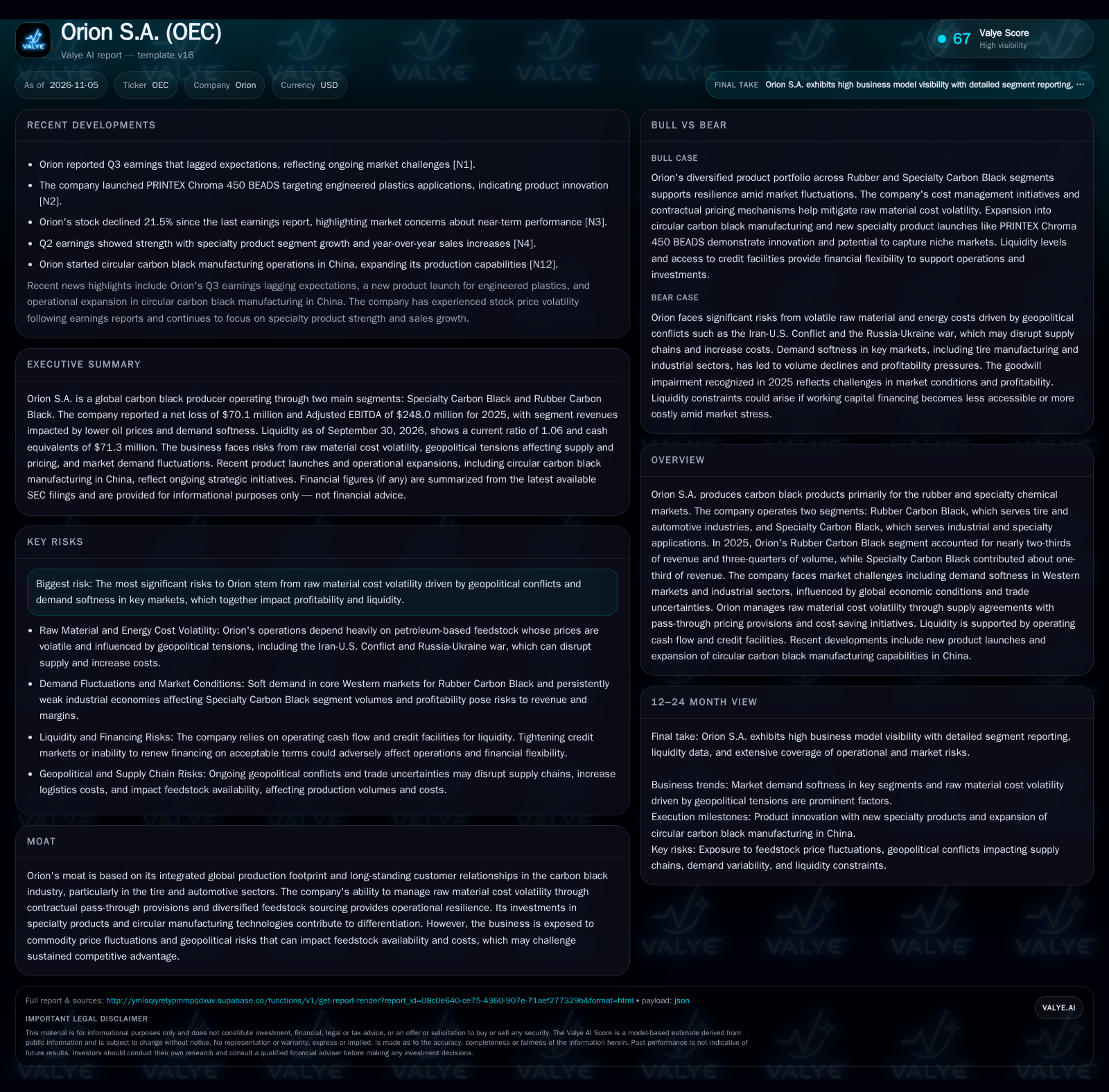
Orion S.A. reported a net loss of $70.1 million for 2025, with its Rubber Carbon Black segment accounting for the majority of revenue and volume. Despite demand softness and raw material cost volatility, Orion is expanding specialty product offerings and has launched circular carbon black manufacturing in China. The company’s resilience will depend on execution in specialty growth, supply chain agility, and its ability to maintain potential financial flexibility in a challenging macro environment. [S2] [N1] [N2]
Orion S.A. is at a crossroads as it navigates the cyclical volatility of its core carbon black business while pursuing specialty innovation and circular manufacturing. The company’s recent net loss and stock decline highlight the pressures from weak Western industrial demand and raw material price swings. However, Orion’s expansion in specialty products and new circular production in China position it to capture higher-value opportunities and respond to sustainability trends. The real test is whether these strategic moves can offset cyclical headwinds, stabilize margins, and deliver differentiated growth in a volatile global environment.
Recent Performance Reflects Cyclical Pressure and Strategic Shifts
Orion S.A. reported a net loss of $70.1 million for 2025, with Adjusted EBITDA of $248.0 million, reflecting the impact of lower oil prices and demand softness in its main end markets. The Rubber Carbon Black segment accounted for nearly two-thirds of revenue and three-quarters of volume, underscoring the company’s reliance on the automotive and tire sectors, both of which have faced persistent demand challenges in Western markets. Specialty Carbon Black, while smaller, contributed about one-third of revenue and has shown relative strength, especially in Q2 2026. The company reported cash and liquidity metrics for the period; these figures do not by themselves establish operating runway, investment capacity, financial flexibility, or financing capacity. Notably, Orion launched new specialty products and commenced circular carbon black manufacturing in China, signaling a strategic pivot toward higher-value and more sustainable offerings. [S2] [N1] [N2] [N4]
Segment Economics and the Dynamics of Margin Management
Orion’s revenue model is fundamentally split between high-volume, lower-margin Rubber Carbon Black and higher-margin, lower-volume Specialty Carbon Black. The Rubber segment’s economics are closely tied to the global tire and automotive industry, which is highly cyclical and sensitive to macroeconomic swings, especially in developed markets. Pricing in this segment is often governed by long-term supply agreements that include raw material pass-through clauses, allowing Orion to adjust prices in response to feedstock cost swings but also limiting margin expansion in periods of stable or declining input costs.
Specialty Carbon Black, serving industrial, plastics, and specialty chemical applications, offers higher value per ton and typically enjoys greater pricing power due to tailored formulations and customer-specific performance requirements. This segment has shown better resilience and growth, as evidenced by recent product launches and year-over-year sales increases in Q2 2026. However, volume is smaller and customer adoption cycles can be longer, requiring ongoing investment in R&D and application development.
Cost structure is characterized by significant exposure to petroleum-based feedstocks and energy inputs, with volatility driven by global commodity markets and geopolitical disruptions. While Orion’s pass-through mechanisms and diversified sourcing help mitigate input cost risk, they do not fully protect against margin compression during periods of rapid cost inflation or sudden demand drops. The capital intensity of manufacturing and the need for periodic plant upgrades, especially for circular and specialty capacity, reinforce the importance of stable cash flow and access to credit. [S2] [N2] [N4]
Differentiation Through Specialty Products and Circular Capabilities
Orion’s global production footprint and long-standing customer relationships in the tire and automotive sectors provide a defensive base, but these advantages are increasingly offset by the commoditization of standard rubber carbon black and the cyclical nature of automotive demand. The real opportunity for differentiation lies in Specialty Carbon Black, where Orion can leverage product innovation, application expertise, and tailored performance characteristics to secure higher-margin contracts and longer customer relationships.
The recent launch of PRINTEX Chroma 450 BEADS and the expansion of circular carbon black production in China highlight Orion’s efforts to move up the value chain and align with sustainability trends. Circular manufacturing, which uses recovered or recycled carbon black, has the potential to address regulatory and customer demands for lower-carbon materials, potentially creating switching costs for customers who value sustainability credentials.
Competitive threats remain significant. Major global carbon black producers, including both integrated chemical companies and regional specialists, compete on price, service, and technological innovation. Substitute materials—such as silica for certain tire and plastics applications—also pose a risk if they can match or exceed carbon black’s performance at competitive cost. In this context, Orion’s ability to commercialize specialty innovations and scale circular production will be critical to sustaining any moat.
Specialty Growth and Circular Expansion Unlock Margin and Resilience
If Orion successfully scales its specialty product pipeline and realizes commercial traction with new offerings like PRINTEX Chroma 450 BEADS, the revenue mix could shift toward higher-margin, less cyclical business. Adoption of circular carbon black, especially in China and other growth markets, would reinforce Orion’s positioning as a sustainability leader and create customer stickiness. Favorable macro conditions, such as a rebound in automotive production and stable raw material markets, would further support margin recovery.
This scenario would be confirmed by a sustained increase in Specialty segment revenue as a percentage of total sales, margin expansion even in periods of raw material volatility, and evidence of long-term contracts or repeat orders for circular products. Announcements of additional specialty launches, new customer wins in value-added applications, or major regulatory tailwinds for recycled materials would all validate this upside trajectory.
Mixed Cyclicality: Core Volatility with Incremental Specialty Gains
The most plausible outcome is that Orion continues to experience cyclical swings in its Rubber Carbon Black business, with demand and pricing closely tracking the broader automotive and industrial economy. Specialty Carbon Black provides incremental growth and some margin stability, but does not fundamentally transform the company’s risk profile in the near term. Circular manufacturing expansion in China builds optionality but may take several years to reach meaningful scale or profitability.
Confirmation of this scenario would include continued dominance of Rubber segment volumes and revenue, only modest growth in specialty and circular product sales, and EBITDA that remains exposed to raw material and demand shocks. Quarterly performance would likely show volatility in line with end-market conditions, with periodic cost savings or innovation-driven outperformance offset by macro or supply chain headwinds.
Sustained Demand Weakness and Input Cost Spikes Pressure Liquidity
In an adverse scenario, persistent demand softness in Western tire and industrial markets combines with renewed spikes in feedstock costs—driven by geopolitical events or supply chain disruptions—to compress margins and erode cash flow. Specialty segment growth stalls or fails to offset weakness in the core business, and circular manufacturing remains a niche contributor.
Evidence for this scenario would be ongoing net losses, declining cash balances, rising leverage or increased reliance on short-term credit, and a lack of meaningful growth in specialty or circular product adoption. Any tightening of credit markets or inability to renew working capital facilities on favorable terms could exacerbate liquidity risks and force cutbacks in investment or operations.
Milestones and Market Signals That Will Define Orion’s Strategic Trajectory
Specialty Carbon Black revenue growth rate and share of total revenue—if disclosed—will indicate whether the business mix is shifting toward higher-margin, less cyclical products.
Volume and margin trends in the Rubber Carbon Black segment, particularly relative to global tire and automotive production cycles, will test the resilience of the core business.
Updates on the scale, utilization, and customer adoption of circular carbon black manufacturing in China would help assess the commercial potential of this initiative.
Evidence of new or renewed long-term customer contracts, especially for specialty and circular products, would support the case for improved revenue visibility and customer stickiness.
Raw material cost pass-through effectiveness and any changes in contractual pricing mechanisms—if disclosed—will shape margin stability in volatile commodity markets.
Announcements of regulatory changes or major customer sustainability mandates affecting carbon black sourcing could accelerate or hinder adoption of circular products.
A useful metric would be R&D or capital expenditure allocation to specialty and circular initiatives, indicating management’s commitment to long-term transformation.
Disclaimer: This is research-only, informational analysis and not investment advice. It may include AI-generated interpretation and general industry context. Always verify important details using primary sources.

Comments