
Renasant’s Strategic Acquisition Push: Growth Ambitions, Integration Stakes, and the Path Forward
Renasant Corporation’s $142 million acquisition marks a major strategic gambit in a quarter where earnings lagged expectations.
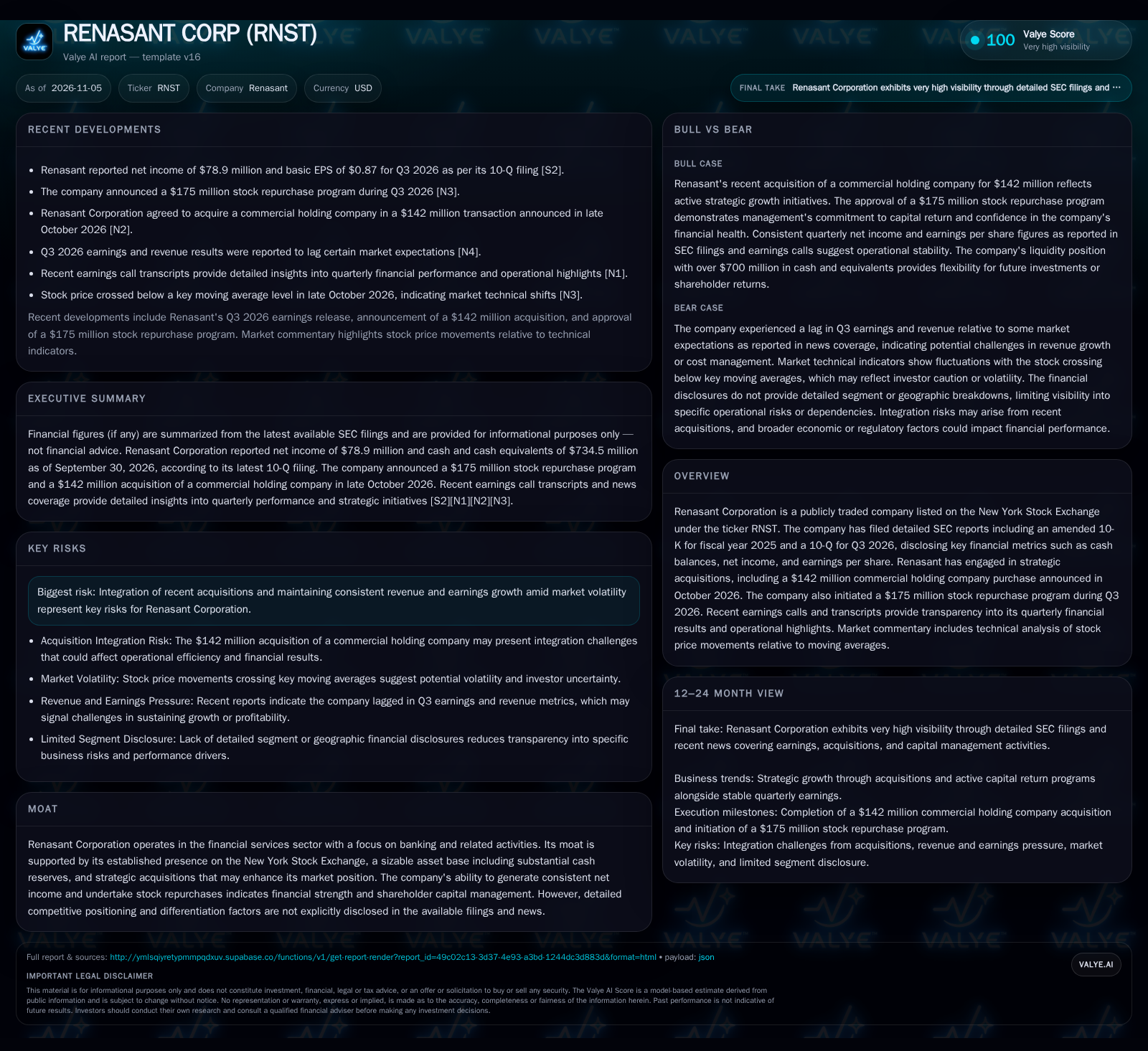
Renasant reported $78.9 million in Q3 2026 net income and holds $734.5 million in cash, but earnings trailed some forecasts. The recently announced $142 million acquisition signals a drive for inorganic growth. The company’s near-term trajectory will hinge on successful integration and its ability to mitigate margin pressures amid evolving market risks. [S2] [N2] [N4]
Renasant Corporation stands at a pivotal juncture, balancing the promise and risk of expansion through a $142 million acquisition even as its latest quarterly earnings lagged market expectations. The coming quarters will test Renasant’s ability to integrate new assets, sustain operational momentum, and defend its returns in a volatile banking landscape shaped by shifting investor sentiment and macroeconomic headwinds.
Recent Acquisition and Earnings Underscore a Transitional Moment
Renasant Corporation reported net income of $78.9 million and diluted EPS of $0.86 for the quarter ended September 30, 2026, supported by $734.5 million in cash and cash equivalents. These results reflect ongoing profitability and balance-sheet strength. However, the company’s Q3 earnings and revenue lagged some market expectations, indicating emerging performance pressures. Most notably, Renasant announced a $142 million acquisition of a commercial holding company in late October 2026, signaling a deliberate push for scale and diversification. This acquisition marks a material shift in corporate strategy and could reshape both the company’s risk profile and earnings trajectory in the near term. [S2] [N2] [N4]
How Renasant’s Profit Engine Could Shift Post-Acquisition
Historically, regional banks like Renasant generate revenue primarily through net interest income (the spread between interest earned on loans and paid on deposits), supplemented by fee-based services. The company’s ability to consistently post quarterly profits suggests reasonably efficient cost management and a stable loan/deposit franchise. The company reported cash and liquidity metrics for the period; these figures do not by themselves establish operating runway, investment capacity, financial flexibility, or financing capacity. [S2]
The $142 million acquisition could alter the company’s revenue mix, fixed-cost base, and capital requirements. If the acquired holding company brings in new commercial lending relationships or fee-generating businesses, this could boost non-interest income and diversify revenue streams. However, integration typically introduces elevated non-recurring costs, operational complexity, and potential credit risk if underwriting standards differ. Operating leverage may improve if the acquired assets are efficiently consolidated, but margin compression remains a risk if funding costs rise or if the acquisition fails to generate anticipated synergies.
In the current rate environment, regional banks face pressure from both sides: deposit costs are rising faster than loan yields in many markets, and credit losses could increase if macro conditions deteriorate. The company’s ability to offset these pressures through acquisition-driven scale or new fee businesses will be central to future earnings resilience.
Defending Share in a Crowded Regional Banking Market
Renasant operates in a fragmented regional banking landscape, competing against both large national banks and numerous local and regional peers. Its New York Stock Exchange listing provides credibility and capital access, but scale relative to national banks remains modest. The $142 million acquisition could enhance Renasant’s competitive position by expanding its customer base and product breadth, but integration risks and potential dilution of culture or underwriting discipline are real threats.
Competitive advantages in this sector often stem from local market knowledge, relationship banking, and the ability to cross-sell services. However, larger banks benefit from greater technology investment and lower funding costs, while fintech entrants are targeting profitable niches in payments, lending, and small business services. Renasant’s future moat may depend on its ability to leverage acquired assets for improved service differentiation or operational efficiency. The question is whether scale from acquisitions will translate into sustainable returns or simply add complexity and risk.
If Integration Succeeds, Renasant Could Unlock Scale-Driven Earnings Growth
The most favorable scenario is one in which Renasant efficiently integrates the newly acquired holding company, achieving both revenue and cost synergies. If the acquisition expands commercial lending and fee-based services, the company could see stronger top-line growth and a more diversified income stream. Successful integration would also allow the company to spread fixed costs over a larger asset base, potentially driving improved operating leverage and higher return on equity.
Confirmation of this scenario would come from sequential improvements in non-interest income, a stable or improving net interest margin, and evidence of cost discipline despite integration expenses. If Renasant can report above-peer loan growth, improved efficiency ratios, and sustained or rising EPS in the next several quarters, it would suggest the acquisition is delivering on its promise. Conversely, any signs of asset quality deterioration or a spike in one-time charges would undermine this upside thesis.
Incremental Progress as Integration and Market Headwinds Offset Each Other
A more likely outcome is that Renasant manages a smooth but unexceptional integration, with acquired assets contributing modestly to growth but not fundamentally altering the company’s risk/return profile. Earnings may remain steady, with any gains from the acquisition offset by industry-wide margin pressures and higher operating costs.
Evidence supporting this scenario would include stable EPS, manageable integration costs, and maintenance of key asset quality and efficiency metrics in line with historical norms. Disappointment on revenue growth or expense control, or any major credit event, would suggest a deviation from this middle path.
Integration Missteps or Macro Shocks Could Erode Franchise Value
The principal risk is that the acquisition proves difficult to integrate, resulting in elevated costs, operational disruption, or unexpected credit losses. If the acquired company’s assets underperform or reveal hidden risks, Renasant could face write-downs, regulatory scrutiny, or a deterioration in investor confidence. Broader macroeconomic shocks—such as a rapid increase in credit defaults or a liquidity squeeze—would compound these challenges, especially if the bank’s funding base proves less resilient than anticipated.
Indicators of this scenario would include rising non-performing loans, negative operating leverage (costs rising faster than revenues), and declining EPS or return on equity. A further drop in the stock price below technical support levels could also reflect market skepticism about management’s ability to deliver on its acquisition strategy.
What Will Determine Whether Renasant’s Expansion Delivers Value
Integration expense disclosure by management in upcoming filings and calls—if disclosed, this would help assess the true cost of the acquisition and inform expectations for synergy realization.
Trends in non-interest income and commercial lending growth, especially attributable to the newly acquired entity—these would indicate whether the acquisition is driving revenue diversification.
Net interest margin evolution in the wake of the acquisition, as this will reveal how well the company is managing funding costs versus loan yields.
Asset quality metrics, including non-performing loan ratios and charge-offs, which would signal any credit risk surfacing from the acquired portfolio.
Efficiency ratio trends (expenses as a percentage of revenue), as this will highlight whether Renasant is achieving operating leverage post-acquisition.
Management commentary regarding acquisition integration progress—details on timeline, systems consolidation, and customer retention would help test the integration thesis.
Stock price reaction relative to peer banks, as this may reflect investor confidence (or skepticism) regarding the acquisition and broader earnings outlook.
Disclaimer: This is research-only, informational analysis and not investment advice. It may include AI-generated interpretation and general industry context. Always verify important details using primary sources.

Comments