
TrueBlue’s Tech-Enabled Staffing Model Confronts Industry Cyclicality and Client Concentration
TrueBlue’s Q3 2026 performance highlights its diversified approach to workforce solutions, leveraging proprietary digital platforms across contingent labor, on-site management, and professional staffing. While solid profitability and a broad client base provide resilience, the company’s exposure to economic swings and concentrated clients raise critical questions about the sustainability of its competitive edge.
TrueBlue’s latest earnings beat underscores the potential of its technology-enhanced staffing model, which spans on-demand labor, managed services, and professional hiring across diverse industries. However, cyclical market exposure and reliance on a few large clients remain structural risks. The company’s ability to scale its digital platforms and deepen relationships in less cyclical, higher-margin segments will likely determine its future trajectory. [S1] [S2] [N1]
TrueBlue, Inc. stands at a strategic crossroads as it leverages proprietary digital platforms to deliver staffing and workforce management solutions across a broad client base. Its recent outperformance in Q3 2026 demonstrates the promise of its multi-segment approach and technology investments, yet cyclical demand patterns and dependence on a handful of large clients temper the story. The company’s ability to capture share in specialized, less cyclical niches—while navigating intense competition and evolving client needs—will shape its long-term economic trajectory.
TrueBlue’s Recent Results and Strategic Shifts
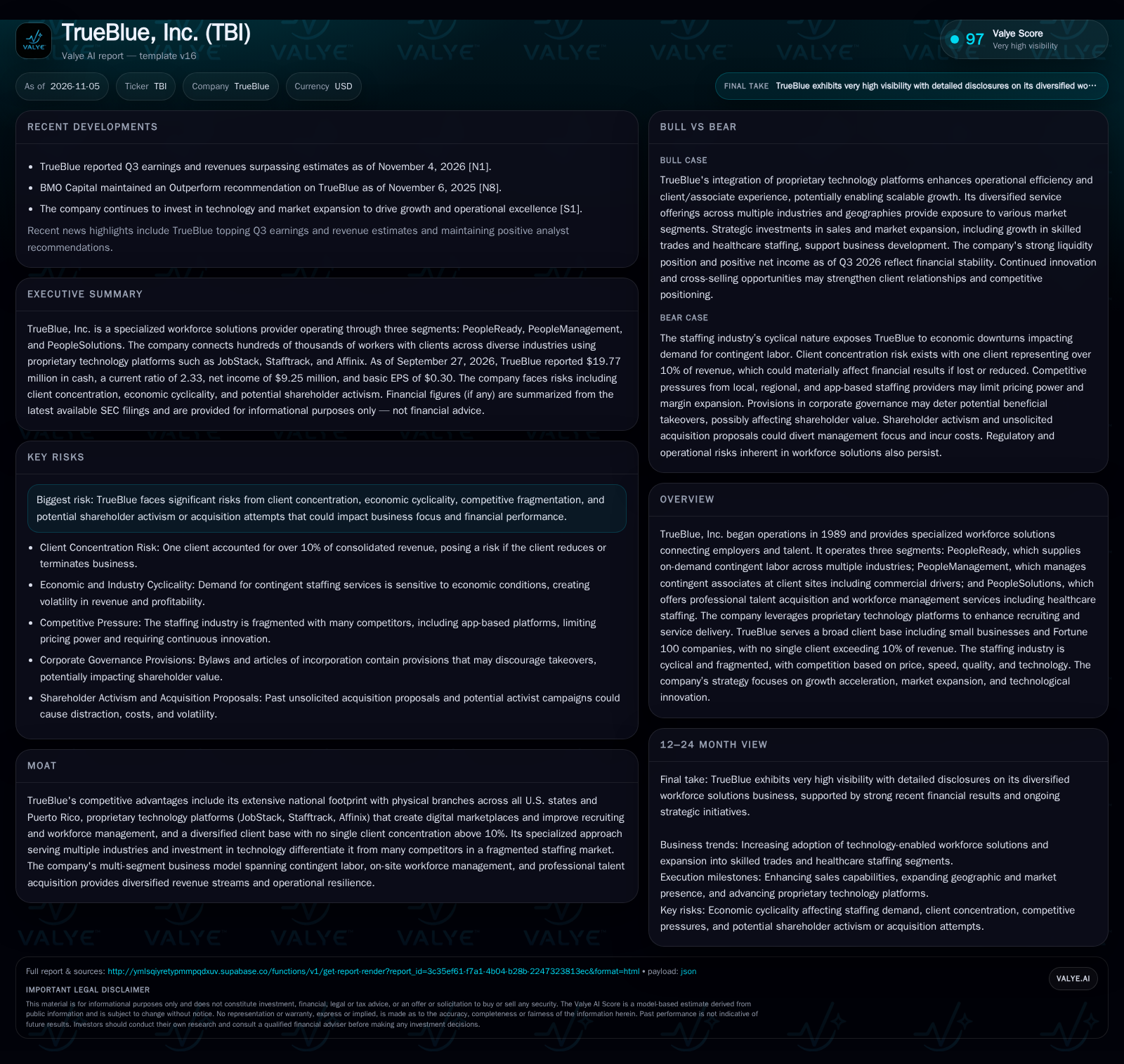
TrueBlue reported net income of $9.25 million for the quarter ending September 27, 2026, with basic EPS of $0.30 and diluted EPS of $0.28, surpassing analyst expectations for both earnings and revenue. This performance is noteworthy in the context of ongoing industry cyclicality and competitive pressure. [S2] [N1]
The company’s business is now organized across three major segments—PeopleReady (on-demand general and skilled labor), PeopleManagement (on-site managed services, including drivers), and PeopleSolutions (professional and healthcare staffing)—serving approximately 53,000 clients in fiscal 2025. Proprietary platforms such as JobStack, Stafftrack, Centerline mobile app, and Affinix underpin service delivery and are central to TrueBlue’s differentiation strategy. [S1]
While no single client exceeded 10% of revenue in fiscal 2025, TrueBlue still faces client concentration risk, as one client did cross that threshold, potentially exposing the company to abrupt revenue swings if that relationship weakens. [S1] [S2]
Revenue and Margin Dynamics Across TrueBlue’s Diverse Segments
TrueBlue’s economics are shaped by the interplay of volume-driven, transaction-based revenues and the potential for higher-margin, value-added services. In its PeopleReady segment, the company benefits from high transaction velocity and flexibility, but faces tight gross margins due to intense price competition and the commoditized nature of contingent labor. The digital JobStack platform may help reduce fulfillment costs and improve associate utilization, but the extent of margin impact depends on adoption scale and the company’s ability to pass through technology-driven efficiencies.
PeopleManagement provides on-site workforce management through multi-year client engagements, which can support more predictable revenue streams and operational leverage if contract terms are favorable. However, these contracts may come with lower per-associate margins due to volume discounts and embedded service costs.
PeopleSolutions, TrueBlue’s professional staffing and RPO/MSP segment, offers higher-margin opportunities, especially in specialized and healthcare staffing, where talent scarcity could support premium pricing. Affinix and other proprietary platforms could drive further margin expansion by automating sourcing, screening, and compliance, though these benefits hinge on successful client adoption and ongoing technology investment.
The company reported cash and liquidity metrics for the period; these figures do not by themselves establish operating runway, investment capacity, financial flexibility, or financing capacity. [S2] Funding needs will vary with acquisition ambitions, technology upgrades, and the cyclicality of receivables/payables in a contingent labor model.
Industry Fragmentation, Digital Change, and TrueBlue’s Competitive Edge
TrueBlue operates in one of the most fragmented industries globally, where traditional staffing firms compete with digital-first marketplaces, regional specialists, and gig-economy platforms. Its competitive advantages stem from a national footprint, longstanding client relationships, and proprietary technology such as JobStack, Stafftrack, and Affinix, which collectively facilitate speed, scale, and quality in talent matching. [S1]
However, technology is a double-edged sword: while digital tools can drive efficiency and client stickiness, they also lower entry barriers for new competitors and commoditize certain services. App-based staffing platforms can undercut traditional pricing and appeal to digital-native clients, particularly in commoditized, high-churn verticals.
TrueBlue’s multi-segment model—spanning general labor, on-site management, and professional recruiting—offers resilience against single-segment shocks. Its diversified client base further reduces vulnerability to individual industry downturns. Yet, the company’s ability to defend and grow margins will depend on sustaining differentiation in technology, breadth of service, and speed of fulfillment as competitors continue to invest in automation and data-driven matching.
Potential Gains from Accelerated Digital Adoption and Targeted Market Growth
The most favorable scenario for TrueBlue would see rapid adoption of its proprietary platforms—JobStack, Stafftrack, and Affinix—across both existing and new clients, driving cost efficiencies, higher associate utilization, and improved client retention. Successful expansion into less cyclical, higher-margin verticals such as healthcare, logistics, and specialized professional staffing could further diversify revenue and reduce earnings volatility.
Margin expansion may be realized if digital fulfillment reduces reliance on physical branch infrastructure and enables dynamic pricing or value-based billing. Cross-selling of services across segments and increased penetration in enterprise accounts would amplify operating leverage, especially if technology reduces client acquisition and service costs.
Confirmation would come from sustained revenue growth in PeopleSolutions and Healthcare Staffing Professionals, expanding gross and operating margins, and disclosure of rising digital platform usage rates (if disclosed). Falsification would occur if digital adoption stalls, gross margin remains flat, or revenue mix remains heavily weighted toward low-margin, highly cyclical segments.
Expected Performance Under Cyclical Pressures and Pricing Competition
A plausible middle path assumes TrueBlue maintains its current multi-segment structure, with technology investments supporting gradual improvements in fulfillment efficiency and client experience. Revenue would track macroeconomic cycles, with periods of growth during labor market tightness and contractions during downturns.
PeopleReady and PeopleManagement would continue to generate high volumes but face ongoing margin pressure from competitive pricing, while PeopleSolutions provides incremental margin uplift as professional and healthcare staffing expand. The company’s broad client base and absence of outsized single-client exposure (beyond the one client exceeding 10%) help buffer against sudden revenue shocks.
This scenario would be confirmed by stable or slightly improving operating margins, moderate revenue growth aligned with overall staffing industry trends, and continued investment in digital platforms. It would be falsified by sustained revenue or margin declines, loss of major clients, or evidence that technology is failing to deliver promised efficiencies.
Risks from Economic Downturns, Client Attrition, and Digital Disruption
In a negative scenario, a significant economic downturn sharply reduces demand for contingent labor, leading to revenue and margin contraction across all segments. The loss or downsizing of the client accounting for more than 10% of revenue would exacerbate the decline, given the lack of immediate replacement opportunities in a cyclical market.
Further downside could materialize if app-based competitors accelerate market share gains, compressing pricing and eroding TrueBlue’s branch-based and mid-market value proposition. Technology investments may fail to keep pace with industry innovation, leading to client attrition or increased cost per placement.
Confirmation would come from a steep drop in revenue and profitability, client disclosures indicating concentration risk materializing, or public evidence of major client defections. Falsification would require evidence of revenue stability through downturns, successful new client wins, or resilience in gross margin despite macro headwinds.
Assessing TrueBlue’s Capacity for Sustained Growth and Operational Strength
Growth rate and margin profile in PeopleSolutions and Healthcare Staffing Professionals—if disclosed—would indicate the company’s success in shifting toward higher-margin, less cyclical segments.
Adoption and utilization rates for proprietary technology platforms (JobStack, Stafftrack, Affinix), including metrics such as percentage of orders filled digitally or client/associate engagement levels.
Client concentration trends, specifically whether any client continues to exceed 10% of revenue or if the top-10 client revenue share increases or decreases over time.
Gross and operating margin trends across segments, reflecting the impact of digital transformation and competitive pricing dynamics.
Churn and retention rates among large enterprise clients and high-volume SMBs, particularly in the face of competitive encroachment and economic volatility.
Disclosure of cross-segment client wins or expanded multi-year contracts, which would support the thesis of operating leverage and integrated service delivery.
Capital allocation toward technology, M&A, or market expansion—if disclosed—clarifying management’s commitment to innovation and diversification.
Changes in regulatory or compliance landscape affecting contingent and healthcare staffing, as these could materially impact cost structure or service delivery models.
Disclaimer: This is research-only, informational analysis and not investment advice. It may include AI-generated interpretation and general industry context. Always verify important details using primary sources.

Comments