
NACCO Industries: Contract Layering, Resource Diversification, and the Stakes of Strategic Capital Allocation
NACCO Industries leverages a unique blend of long-term contract mining, minerals and royalties, and environmental mitigation services to generate stable cash flows and pursue new growth. As the company absorbs solar project curtailment costs and directs capital toward lithium, oil, gas, and restoration assets, the key question is whether its disciplined capital allocation can outpace regulatory, execution, and commodity headwinds.
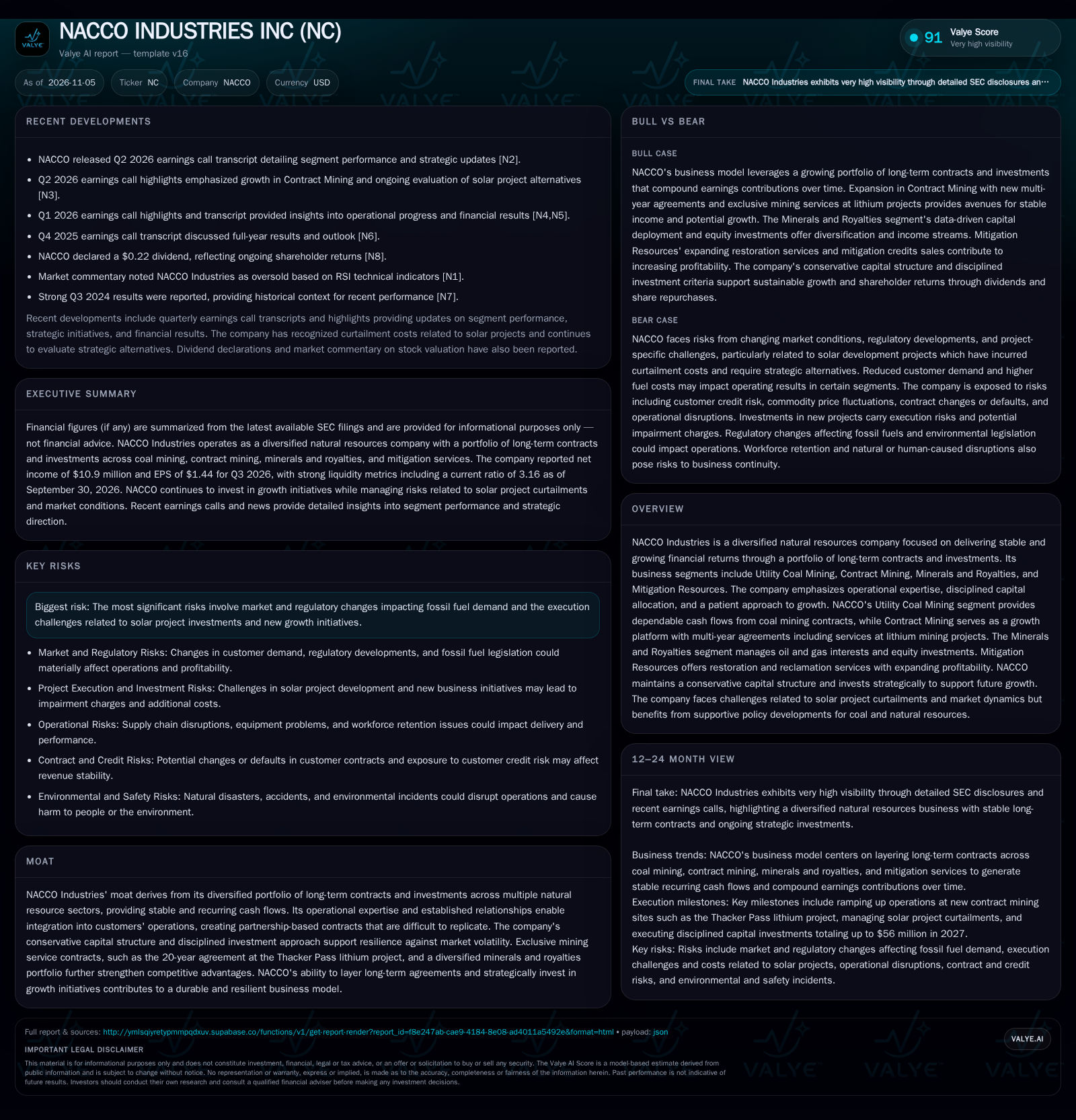
NACCO Industries reported Q3 2026 net income of $10.9 million and continues to prioritize long-term contract mining, minerals and royalties, and mitigation services. With $56.5 million in cash, a conservative capital structure, and planned investments in lithium and minerals, the company faces both the opportunity of compounding contractual returns and the risk of solar project write-downs and regulatory shifts [S2].
NACCO Industries stands apart from typical natural resource companies by layering a portfolio of long-term, mostly contracted cash flows across coal, lithium mining, oil and gas royalties, and environmental mitigation. While the company continues to generate steady earnings and manages a reported liquidity position, it is simultaneously contending with the financial fallout from underperforming solar investments. The strategic question for investors is whether NACCO’s deliberate capital allocation—particularly into lithium and minerals—can offset headwinds from regulatory uncertainty and shifting energy economics, positioning the company for durable, compounding returns.
Recent Earnings, Contract Wins, and Investment Priorities Shape the Outlook
NACCO Industries reported net income of $10.9 million and EPS of $1.44 for Q3 2026, with segment contributions reflecting the company's multi-pronged business model [S2]. This period also saw the recognition of $3.4 million in curtailment costs related to solar investments, highlighting ongoing challenges in renewable project execution and the company’s willingness to reassess underperforming assets [S2]. A major positive is the Sawtooth subsidiary’s 20-year exclusive mining contract at the Thacker Pass lithium project—a potential foundation for long-term, recurring cash flows in a fast-growing battery metals market [S2]. The company reported cash and liquidity metrics for the period; these figures do not by themselves establish operating runway, investment capacity, financial flexibility, or financing capacity. [S2] These facts underscore a business in transition—balancing legacy cash cows with new growth bets and absorbing the cost of strategic pivots.
How NACCO Layers Contractual Revenue Streams and Allocates Capital
NACCO’s business model is built on layering long-term contracts across multiple segments, aiming to generate stable cash flows and compound earnings over time. In Utility Coal Mining, the company benefits from multi-year, take-or-pay style contracts that reduce volume risk and create visibility into cash inflows. The Contract Mining segment—particularly through North American Mining and Sawtooth—extends this model to non-coal minerals, notably through the Thacker Pass lithium contract, which likely features minimum volume commitments, service fees, and cost recoverability over its 20-year term.
The Minerals and Royalties segment introduces asset-light economics, as royalty interests and equity stakes in oil and gas properties generate income with minimal direct operating costs—though these are exposed to commodity price volatility. Mitigation Resources, by providing restoration and reclamation services and selling mitigation credits, adds a countercyclical, potentially high-margin revenue stream that could mature into a more significant profit center as environmental demand grows.
Capital allocation is disciplined: planned investments are concentrated in minerals/royalties ($20 million per year) and in recoverable lithium-related assets ($16 million over five years) [S2]. This approach seeks to balance recurring contractual cash flows with selective exposure to higher-growth, higher-risk projects. However, the $3.4 million solar curtailment charge highlights the risk of capital missteps in emerging sectors, making project selection and risk assessment critical to future returns.
Where NACCO’s Structure Creates Advantages—and Faces Imitators or Substitutes
NACCO’s competitive edge derives from its ability to secure and operate long-term, often exclusive, contracts in sectors where operational reliability and regulatory compliance are at a premium. The 20-year Thacker Pass lithium contract is a rare example of early-mover advantage in a strategic mineral segment, while the company’s embeddedness in customer operations (especially in coal and contract mining) could increase switching friction and partnership stickiness.
However, these advantages are not insurmountable. Other contract miners and mineral royalty aggregators can compete for new contracts or acquire interests in emerging regions. In the coal segment, alternative fuels, renewables, and regulatory mandates pose substitution threats, though near-term policy support for grid reliability may delay this erosion [S2]. In environmental mitigation, barriers to entry are moderate—project execution and regulatory navigation matter, but the segment could attract new entrants as demand for credits grows.
The company’s asset-light minerals and royalties platform diversifies exposure but does not guarantee outperformance relative to larger, more specialized royalty companies with broader portfolios. Ultimately, NACCO’s moat depends on its ability to renew and layer contracts faster than legacy revenues decline and to execute new projects with discipline and scale.
Layering Growth Projects and Mitigation Maturity Could Drive Compounding Returns
The most favorable scenario sees NACCO successfully deploying capital into long-duration, high-visibility contracts—particularly in lithium, minerals, and environmental mitigation—while legacy coal cash flows persist longer than expected due to supportive grid policy. Sawtooth’s Thacker Pass contract could become a model for further lithium or battery metals deals, compounding contracted cash flow layers and potentially attracting premium valuations for the company’s mining services expertise.
Mitigation Resources could scale rapidly if regulatory or corporate demand for restoration credits accelerates, turning this segment into a material profit driver. The Minerals and Royalties segment might benefit from rising oil, gas, or lithium prices, while disciplined project selection prevents further solar-related write-downs.
Confirmation of this scenario would come from: new or expanded multi-year contracts in lithium or other minerals, visible growth in mitigation project backlog and credit sales, and evidence of stable or improving legacy segment cash flows despite sector headwinds.
Stable Cash Flows with Selective Growth amid Sectoral Transition
The most plausible trajectory is one in which NACCO’s legacy coal mining and contract mining segments continue to generate stable, albeit slowly declining, cash flows as long-term contracts roll off and are only partially replaced. The company steadily invests in minerals, royalties, and mitigation, with moderate success—some projects ramp up, but others (like solar) may underperform or require repositioning.
Earnings remain lumpy due to commodity price exposure in royalties and the timing of new contract wins.
Evidence for this scenario includes: gradual revenue mix shift toward minerals and mitigation, stable but not accelerating contract wins, and ongoing—but manageable—charges from legacy or experimental projects.
Execution Missteps and Regulatory Shifts Could Undermine the Model
Downside risk centers on regulatory or market changes that accelerate coal contract attrition, combined with execution failures in new segments. Should policy support for coal weaken or customers exit contracts early, legacy cash flows could erode faster than new projects ramp up. If the company misallocates capital—such as further solar write-downs or failed lithium ventures—returns on investment could materially lag expectations.
Commodity price collapses would further impair Minerals and Royalties segment income, while Mitigation Resources could face project delays or regulatory bottlenecks. The highly contracted nature of NACCO’s business reduces near-term volatility but increases the risk of step-function declines if contracts are not renewed or replaced.
This scenario would be confirmed by: unexpected contract losses or terminations, further material asset impairments, widening losses in new initiatives, and evidence that new investment fails to generate targeted returns.
Testing NACCO’s Thesis: What Will Separate Compounders from Value Traps
Growth in contracted backlog or new multi-year agreements in lithium, minerals, or environmental mitigation—if disclosed—would signal the company’s ability to layer future cash flows.
Revenue and margin contribution from Mitigation Resources should be tracked for inflection points as projects mature; a useful metric would be segment-level operating income and backlog.
Renewal rates and remaining durations for legacy coal and contract mining agreements—if disclosed—would clarify the risk of cash flow cliffs.
Additional asset impairments or curtailment costs, particularly outside solar, would indicate ongoing execution risk.
Deployment pace and realized returns on minerals and royalties investments, including any new equity stakes or royalty acquisitions.
Capital expenditure cadence and the proportion allocated to recoverable, contracted projects versus speculative initiatives.
Impact of regulatory developments on coal demand, lithium mining permitting, or environmental mitigation requirements.
Disclaimer: This is research-only, informational analysis and not investment advice. It may include AI-generated interpretation and general industry context. Always verify important details using primary sources.

Comments