
Deep Fission’s Gravity Reactor: Subsurface Nuclear Innovation and the Stakes of Commercialization
Deep Fission, Inc. is advancing a novel small modular reactor (SMR) leveraging deep borehole emplacement and proven pressurized water reactor (PWR) technology, targeting a 2027 pilot in Kansas and a 2028 commercial rollout. With reported liquidity position and a customer pipeline reportedly reaching 18.5 GW, the company faces a high-stakes journey through technical, regulatory, and capital hurdles to validate its approach and achieve market relevance.
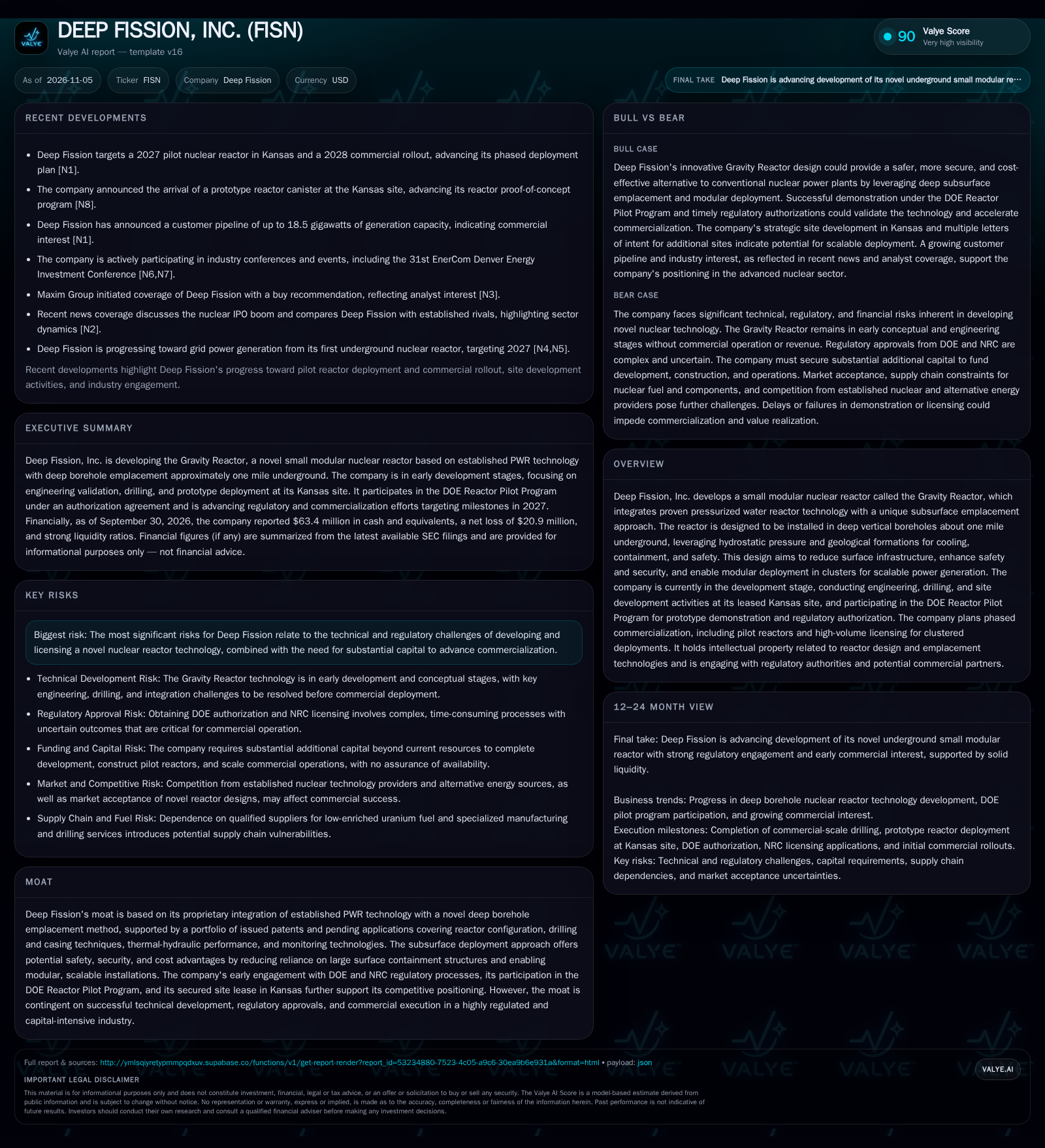
Deep Fission is developing an underground SMR using PWR technology, aiming for a Kansas pilot in 2027 and commercial rollout in 2028. [S1] [S2] [N1] [N8]
Deep Fission, Inc. is positioning itself at the intersection of nuclear innovation and energy infrastructure transformation. Its Gravity Reactor—a small modular reactor (SMR) designed for emplacement in deep boreholes—aims to address safety, cost, and deployment challenges that have historically limited the growth of nuclear power. With engineering validation and a 2027 pilot as near-term milestones, the company’s approach could reshape both the economics and the risk profile of new nuclear projects. However, Deep Fission remains pre-revenue and faces a demanding regulatory path, significant capital needs, and the technical complexity inherent in commercializing new nuclear technology.
Advancing Toward Demonstration: Where Deep Fission Stands Today
Deep Fission is in the early stages of developing its Gravity Reactor, a small modular nuclear reactor based on proven PWR technology but deployed in deep boreholes approximately one mile underground. As of November 2026, the company is conducting engineering and field development at its Kansas site, with a prototype reactor canister delivered and a data acquisition well drilled to 6,000 feet [S1] [N8]. The company's pilot reactor is targeted for 2027, with commercial rollout planned for 2028 [N1]. Financially, Deep Fission reported $63.4 million in cash and equivalents and a current ratio of 8.83 as of September 30, 2026, reflecting reported liquidity position but a net loss of $20.9 million and no operating revenue to date [S2]. The company claims a customer pipeline of up to 18.5 GW of potential generation capacity, though these are based on non-binding letters of intent [N1]. These milestones underscore early commercial and industry interest but also highlight the company’s pre-revenue, high-investment status and the critical importance of upcoming technical and regulatory achievements.
How Deep Fission’s Model Could Generate Value—If It Scales
Deep Fission’s business model is predicated on deploying and servicing clusters of Gravity Reactors for utility-scale and distributed power customers. Each reactor is designed to generate up to 15 MWe, with the possibility of deploying multiple units for aggregate output in the hundreds or thousands of MWe [S1]. The company’s value proposition rests on several economic levers: 1) reduced surface infrastructure and site preparation costs due to deep subsurface emplacement; 2) modularity, enabling phased capital spending and more flexible financing; and 3) leveraging standardized PWR-based components for manufacturability and supply chain access.
However, the economics are not yet proven. Capital intensity remains high, especially in early phases—drilling deep boreholes, custom engineering, and regulatory compliance all require substantial upfront investment. Fixed costs are front-loaded, but the model could see operating leverage if multi-unit deployments are realized and standardized manufacturing is achieved. Ongoing revenues could plausibly derive from reactor sales, installation services, long-term operations and maintenance contracts, and possibly fuel cycle or waste management services, though the company’s commercial mechanics are not yet established [S1]. The need for substantial additional capital before revenue generation introduces financing risk and shareholder dilution potential. If the company can demonstrate low overnight capital cost, high reliability, and streamlined regulatory approval, its model could undercut both conventional nuclear and some renewable alternatives on a levelized cost of energy basis.
Subsurface SMRs: Potential Edge and the Reality of Nuclear Competition
Deep Fission’s competitive positioning is built on its integration of established PWR technology with a proprietary deep borehole emplacement approach. This design could confer advantages in safety (geological shielding, physical separation), security (reduced surface exposure), and cost (less surface containment) [S1]. The company’s patent portfolio covers reactor configuration, drilling techniques, and monitoring technologies, potentially providing some defensibility if the technology proves viable.
However, the nuclear market remains crowded with both legacy vendors (traditional large-scale PWRs, boiling water reactors) and a wave of SMR startups pursuing alternative reactor designs (including sodium-cooled, molten salt, and microreactor technologies). Deep Fission’s borehole concept is novel, but it competes with companies offering factory-built SMRs with established supply chains and regulatory pathways. Substitution risk also comes from renewables-plus-storage, hydrogen, and advanced gas turbines, which are increasingly competitive in grid and distributed applications.
A key differentiator could be Deep Fission’s ability to offer a safer, more deployable solution for markets with limited surface space or heightened security concerns. Early regulatory engagement and site development may provide a first-mover advantage, but this is contingent on technical validation and regulatory approval. The company’s announced pipeline suggests early interest, but market share will ultimately hinge on cost, reliability, and the speed at which it can move from demonstration to commercial deployment.
If Borehole Deployment Is Proven: A Path to Accelerated Adoption
The bullish scenario for Deep Fission hinges on successfully demonstrating the safety, reliability, and cost-effectiveness of the Gravity Reactor in a real-world pilot, followed by timely regulatory approval. If the Kansas pilot achieves its technical and regulatory milestones in 2027, and if the first commercial deployments follow in 2028 as planned, Deep Fission could rapidly convert its pipeline of non-binding LOIs into commercial contracts [N1]. Early entrants—such as utilities, industrials, or government agencies—could validate the technology and de-risk future adoption, triggering multi-unit orders and, potentially, clustered deployments at industrial parks, remote communities, or data centers.
Confirmation of this scenario would require clear evidence of successful pilot operation, positive safety and performance reviews from the DOE and NRC, and signed commercial agreements with credible offtakers. Additional signals would include new capital inflows from strategic investors, supply agreements for LEU fuel, and expansion of the company’s project pipeline. Falsification would come from technical setbacks, regulatory delays, or customer attrition.
Commercialization: The Most Likely Sequence of Hurdles and Progress
The most plausible trajectory for Deep Fission is a multi-year process characterized by incremental technical progress, ongoing regulatory engagement, and staged capital raises. The company is likely to complete initial engineering and field validation at its Kansas site, but may encounter delays in pilot reactor construction, regulatory reviews, or fuel logistics. Commercial contracts could materialize gradually, with first revenues potentially arriving in the late 2020s, contingent on successful demonstration and licensing.
Evidence to the contrary would include persistent technical challenges, cost overruns, or inability to meet regulatory requirements, resulting in delays or dilution of first-mover advantage.
Where the Thesis Breaks: Technical, Regulatory, or Funding Failure
The bearish scenario is driven by one or more of the following: failure to resolve key engineering challenges (such as borehole stability, heat transfer, or reactor reliability), inability to obtain timely regulatory authorization, or exhaustion of capital before pilot completion. Any of these could stall or terminate the program, erode customer confidence, and result in loss of early partnerships or LOIs.
Downside confirmation would come from missed milestones (such as delays in prototype deployment or regulatory filings), cost overruns that deplete liquidity, or withdrawal of commercial interest. If Deep Fission cannot demonstrate a clear safety and cost advantage, it risks being outcompeted by established SMR vendors or alternative energy technologies, relegating its IP to niche or licensing status rather than full-scale operations.
What Will Determine Whether Deep Fission’s Gravity Reactor Becomes a Commercial Reality
Progress on Kansas pilot milestones: drilling of commercial-scale boreholes, installation of prototype reactor, and completion of initial commissioning if disclosed.
Regulatory engagement outcomes: DOE Reactor Pilot Program reviews, NRC licensing submissions, and public safety/environmental assessments.
Conversion of non-binding LOIs to signed, revenue-generating contracts, particularly with utilities or large industrial customers (if disclosed).
Capital raises and funding announcements: size, timing, and terms of new equity or strategic investments required to fund the next development phases.
Technical validation data: demonstration of safe, reliable, and efficient operation from prototype or pilot reactors, including thermal-hydraulic performance and containment integrity (if disclosed).
Fuel supply arrangements: securing qualified LEU fuel suppliers and addressing any supply chain bottlenecks or price shocks (if disclosed).
Cost and schedule adherence: tracking actual versus projected spend, timeline for pilot deployment, and any deviations from plan.
Customer pipeline updates: expansion, contraction, or attrition of the announced 18.5 GW pipeline, and the nature of customer commitments (if disclosed).
Disclaimer: This is research-only, informational analysis and not investment advice. It may include AI-generated interpretation and general industry context. Always verify important details using primary sources.

Comments