
GXO Logistics: Technology, Scale, and the Stakes of Execution in a Fragmented Global Logistics Market
GXO Logistics leverages proprietary warehouse automation, predictive analytics, and a diversified blue-chip customer base to lead the global contract logistics sector.
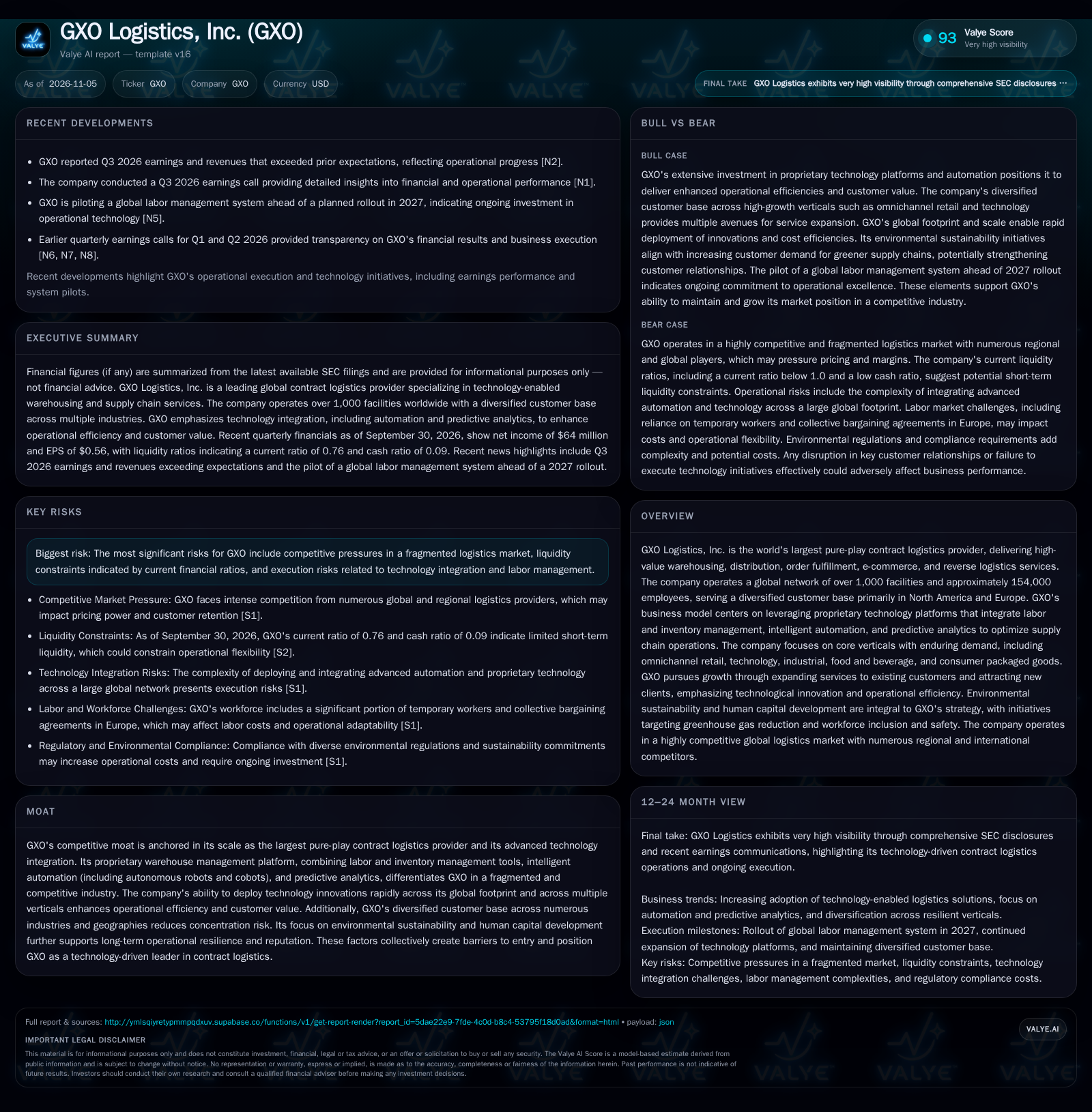
GXO Logistics remains the world’s largest pure-play contract logistics provider, blending proprietary technology platforms with scale to serve over a thousand customers across major verticals. Recent quarterly performance exceeded expectations and the company is piloting a global labor management system ahead of a 2027 rollout. The core question is whether GXO’s technology investments can translate into durable margin and retention advantages before capital constraints or integration risks undermine momentum. [S1] [S2] [N2] [N5]
GXO Logistics stands at the intersection of technology-driven logistics and global scale, operating more than 1,000 sites for a blue-chip customer roster spanning omnichannel retail, tech, and industrial sectors. Its strategic edge is built on proprietary automation and predictive analytics, delivering not only speed and efficiency but also the flexibility demanded by today’s supply chain challenges. Yet, as Q3 2026 results outpace expectations, the company’s below-par liquidity ratios and the daunting task of rolling out advanced systems globally spotlight the tension between ambition and execution. The next phase for GXO will test whether its tech-forward model can drive sustained margin expansion—or whether capital intensity and operational complexity become constraints. [S1] [S2] [N2] [N5]
Recent Performance, Technology Initiatives, and Near-Term Financial Constraints
GXO reported net income of $64 million and EPS of $0.56 for the quarter ending September 30, 2026, with both earnings and revenues beating analyst expectations. This performance reflects operational progress in a competitive environment. [S2] [N2]
The company is piloting a global labor management system, a precursor to a planned 2027 rollout, underscoring continued investment in technology to optimize labor productivity and cost. [N5]
GXO’s customer base remains diversified, with the top five customers accounting for 20% of revenue and no single customer exceeding 6%, reducing exposure to any one client’s volatility. [S1]
How GXO’s Technology-Enabled Model Drives Revenue and Cost Structure
GXO’s core economics center on multi-year logistics contracts for warehousing, fulfillment, and value-added supply chain services. Revenue is primarily driven by the volume of goods handled, transaction throughput, and the complexity of services provided. While the specific contract mechanics and pricing structures are not disclosed, logistics providers typically generate higher margins when deploying proprietary automation and data analytics, which can improve labor productivity, reduce error rates, and enable premium pricing for high-value verticals.
The company’s investments in goods-to-person robotics, automated guided vehicles, and predictive analytics suggest a shift toward higher fixed costs (technology, infrastructure) relative to more traditional labor-heavy models. This dynamic introduces operating leverage: incremental volumes—particularly from e-commerce and omnichannel retail—can drive outsized margin gains if overhead is already absorbed. Conversely, high fixed costs heighten downside risk during demand shocks or contract losses.
Capital needs for technology and automation remain significant. GXO’s ongoing rollout of new systems, coupled with its low current and cash ratios, highlights the importance of disciplined capital allocation and the risk of underinvestment if liquidity tightens further. The company’s global scale theoretically enables cost efficiencies and rapid deployment of innovations, but also increases the complexity and cost of technology integration across diverse regulatory and labor environments.
Technology as Differentiator Amidst Intense Global Competition
GXO operates in a highly fragmented global logistics industry, competing with both large multinationals (such as DHL Group, Kuehne + Nagel, and DSV) and strong regional players. Barriers to entry in basic contract logistics are modest, but the company’s proprietary warehouse management platforms and integration of robotics and predictive analytics create potential switching costs for customers seeking advanced solutions.
Customer incentives revolve around efficiency, reliability, and increasingly, sustainability—areas where GXO’s investments in automation and ESG initiatives may confer advantage. However, many competitors are also investing heavily in automation and digitalization, narrowing the technology gap and putting pressure on pricing. GXO’s scale and global presence enable cross-border solutions and rapid innovation deployment, but the risk is that technology becomes table stakes rather than a source of durable margin.
Switching friction exists primarily for customers with complex, highly integrated supply chains; for more commoditized or transactional business, price and service remain paramount. The question is whether GXO’s tech-enabled offerings can deliver measurable, persistent customer value that justifies premium pricing and stickiness.
If Automation and Analytics Unlock Sustained Margin Expansion
The bull case for GXO is that proprietary technology and automation deliver a step-change in operational efficiency, labor productivity, and error reduction, enabling the company to capture share in high-growth verticals such as e-commerce, omnichannel retail, and technology. As the global labor management system rolls out in 2027, GXO could see improved workforce utilization and cost control, further strengthening margins.
Customer adoption of advanced supply chain solutions—driven by demand for visibility, speed, and sustainability—could deepen relationships and support multi-year contract renewals or expansions. If GXO can demonstrate clear ROI to its blue-chip clients, pricing power and retention may improve, reducing churn and enabling cross-selling of value-added services.
Evidence confirming this scenario would include sustained above-peer margin expansion, growing share of revenue from technology-enabled contracts, increased average contract duration, and visible customer wins in automation-centric verticals. A material improvement in liquidity—whether from improved cash conversion, working capital discipline, or asset-light expansion—would further support the case.
Operational Progress Balanced by Capital Intensity and Market Competition
The most plausible scenario is that GXO continues to grow in line with global supply chain outsourcing trends, leveraging technology to drive incremental efficiency gains and customer retention, but facing ongoing pressure from capital intensity, labor cost volatility, and aggressive competition.
Margins may improve modestly as automation initiatives scale, but offsetting factors—including pricing pressure from global and regional rivals, elevated investment needs, and the complexity of integrating new systems across geographies—limit the upside. Liquidity constraints could force GXO to prioritize high-return investments and potentially slow the pace of technology rollout, particularly if macro or customer demand weakens.
This scenario would be confirmed by steady, but not dramatic, margin improvement, continued customer diversification, and incremental gains in technology adoption. Conversely, evidence of stalled automation rollouts, persistent liquidity stress, or loss of major contracts would point toward downside risk.
Liquidity Constraints and Execution Risks Undermine Competitive Position
In the bear case, GXO’s below-par liquidity ratios and high fixed costs from automation investments become acute vulnerabilities. An adverse demand shock, unexpected customer loss, or operational disruption (such as technology integration failures) could force the company to curtail investment, delay key technology rollouts, or even restructure operations.
Competitors with stronger balance sheets could undercut pricing or invest more aggressively in automation, eroding GXO’s market share and compressing margins. Labor market disruptions—particularly in Europe, where collective bargaining and temporary staffing are significant—could further inflate costs and reduce flexibility.
Downside confirmation would come from deteriorating liquidity metrics, delays or cancellations of technology initiatives (such as postponing the labor management system rollout), rising customer churn, or margin compression relative to peers. Regulatory or environmental compliance costs could also weigh on performance if not offset by operational efficiencies.
Milestones and Metrics That Will Shape GXO’s Margin and Technology Trajectory
Progress and timeline of the global labor management system rollout, including pilot results and any delays into 2027. [N5]
Trends in contract renewal rates and average contract duration, especially in technology-enabled and automation-centric service lines (if disclosed).
Operating margin trajectory versus global logistics peers as automation and analytics scale (would help test the thesis).
Liquidity evolution: changes in current and cash ratios, cash flow from operations, and any new financing or working capital initiatives. [S2]
Customer concentration and churn—watch for shifts in top customer revenue share or loss of large accounts. [S1]
Capital expenditure levels and allocation—whether GXO maintains, increases, or curtails technology investment in response to liquidity or macro conditions (if disclosed).
Labor cost trends and workforce flexibility, particularly in key European markets where collective bargaining and temporary staffing are prevalent (if disclosed).
Environmental compliance and sustainability initiatives: actual cost savings or customer wins tied to ESG capabilities (would help test competitive differentiation).
Disclaimer: This is research-only, informational analysis and not investment advice. It may include AI-generated interpretation and general industry context. Always verify important details using primary sources.

Comments