
NexPoint Residential Trust: Navigating Dispositions, Fee Dynamics, and Multifamily Headwinds
NexPoint Residential Trust’s recent losses and revenue declines reflect a pause in property sales and operational pressures, even as fee waivers and yield recognition highlight levers for cost control and investor appeal. The company’s short-term lease structure and multifamily sector exposure create both flexibility and vulnerability as it confronts higher interest expense and shifting rental demand.
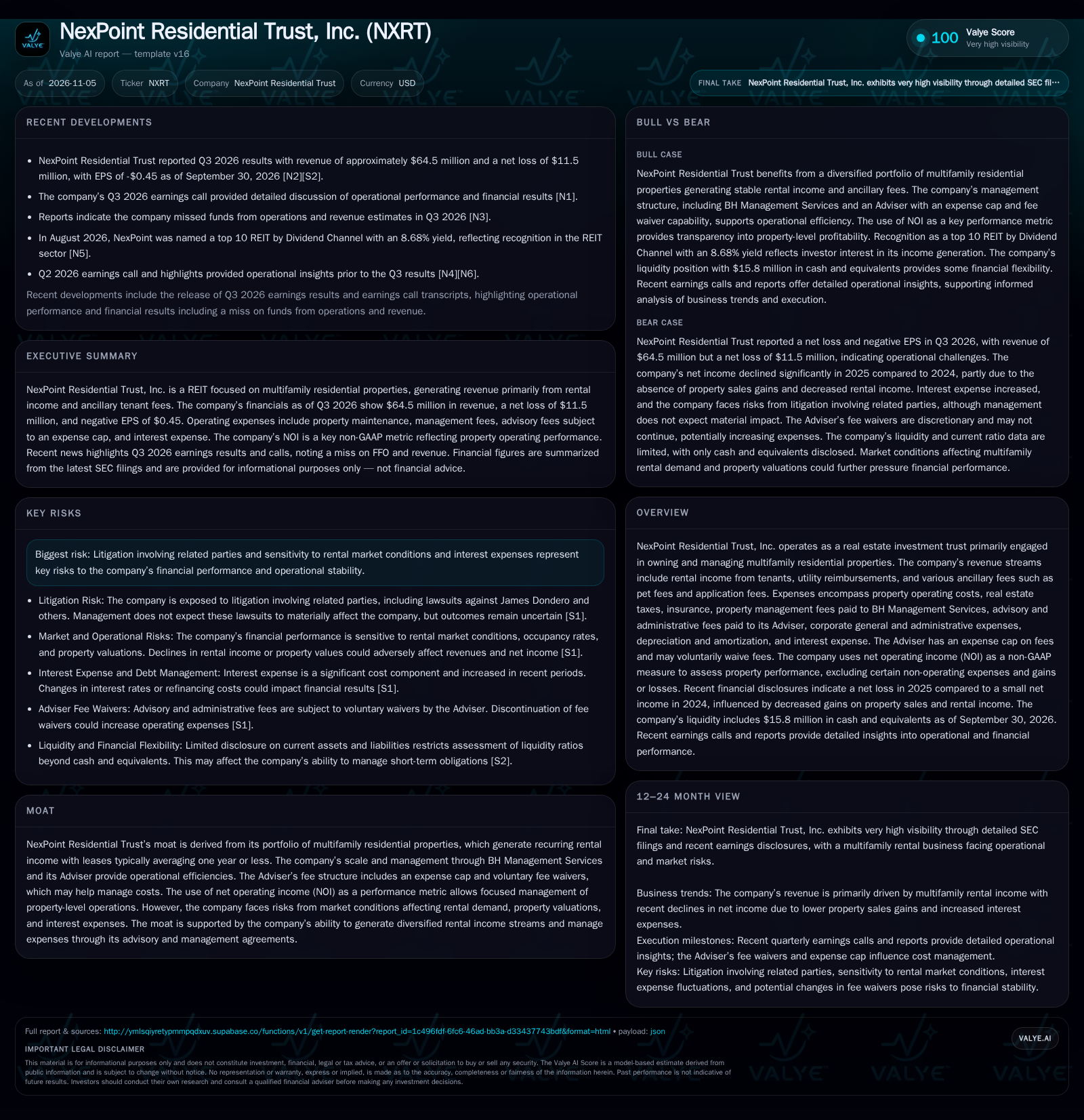
NexPoint Residential Trust (NXRT) reported a Q3 2026 net loss amid lower annual revenues and no property sales, with fee waivers partially offsetting cost pressures. The company’s focus on multifamily rentals with short-term leases provides income diversification but increases exposure to market and rate volatility. Key watchpoints include rent growth, occupancy, interest expense, and the sustainability of cost controls and dividends in a more challenging operating environment. [N2] [S2]
NexPoint Residential Trust, Inc. enters late 2026 facing the aftereffects of a sharp pivot in its multifamily real estate strategy. The company’s Q3 net loss and negative EPS are the most conspicuous signals of a business model in transition: property sales—a prior profit driver—have stalled, exposing underlying pressures from softening rental income, rising interest expense, and the variable nature of its short-term lease portfolio. While the Adviser’s voluntary fee waivers and a sector-leading dividend yield offer some ballast, they raise fresh questions about sustainability if operating headwinds persist or capital market conditions tighten further.
Recent Losses, Revenue Compression, and Yield Recognition Shape Near-Term Outlook
NexPoint Residential Trust reported Q3 2026 revenue of $64.5 million and a net loss of $11.5 million, with EPS at -$0.45. This follows a broader trend: 2025 annual revenues fell to $251.3 million from $259.7 million the prior year, mainly due to a halt in property sales that had previously generated $54.2 million in gains in 2024. Interest expense continued to climb, while the Adviser’s voluntary fee waivers—totaling $21 million—helped cap administrative costs. The cited source reports dividend-related activity; that disclosure alone does not establish dividend-policy continuity, management confidence, or a material constraint on capital flexibility. [N2] [S2] [S1] [N5]
The interplay between revenue compression and fee waivers is critical in understanding NexPoint’s near-term financial health. While fee waivers provide immediate cost relief, they also represent a discretionary lever that may be adjusted based on evolving profitability and capital needs. This creates a scenario where the company’s headline operating costs might not fully reflect underlying expense pressures, potentially masking structural challenges. Moreover, the absence of property sales removes a key source of episodic income that has historically supplemented core rental revenues, exposing the firm to greater reliance on operational performance and external financing conditions.
Short-Term Lease Structure and Fee Dynamics Influence Earnings Volatility
NexPoint’s core revenue stream is rental income from multifamily properties, supplemented by ancillary fees such as utilities, applications, and pet-related charges. Most leases are one year or less, which allows for rapid repricing in strong markets but exposes the company to quick downturns if demand weakens or supply rises. Property operating expenses, real estate taxes, insurance, and management fees are largely variable and scale with property count and occupancy. The Adviser’s expense cap and voluntary waivers play a significant role in managing overhead, but these waivers are discretionary and could be withdrawn, increasing fixed costs if profitability does not recover. Interest expense, while only modestly higher in 2025, remains a major outflow, especially as credit costs rise across the REIT sector. Capital needs are influenced by acquisition/disposition activity, but with no property sales in 2025, the company’s ability to recycle capital and recognize gains was constrained. Operating leverage in this model is limited unless top-line growth outpaces expense inflation and interest burden.
The short-term lease model amplifies earnings volatility by tethering revenue closely to market rental dynamics on a near-immediate basis. In rising rate environments, this can compress net operating income if rental increases fail to keep pace with higher financing costs. Additionally, the variable nature of many operating expenses means that occupancy declines can have a double negative impact, reducing revenue while leaving certain fixed or semi-fixed costs unchanged. The discretionary nature of adviser fee waivers introduces another layer of uncertainty; if waived fees are reinstated during periods of operational weakness, the company’s fixed cost base could rise sharply, exacerbating losses and limiting potential financial flexibility.
How Multifamily REITs Compete: Property Quality, Management, and Local Demand
NexPoint competes in the highly localized and competitive multifamily REIT space, where returns are shaped by property location, asset quality, and operational efficiency. Its partnership with BH Management Services and the Adviser’s cost oversight provide some scale advantages and cost controls. However, the short-term lease structure reduces switching frictions for tenants, limiting pricing power compared to sectors with longer-term contracts. Substitutes include other REITs, private landlords, and alternative housing options, all of which compete for similar tenant demographics. Economic downturns or oversupply in key markets can quickly erode occupancy and rent growth, while rising rates put incremental pressure on both asset values and financing costs. NexPoint’s ability to maintain a high dividend yield may attract income-focused investors, but also amplifies scrutiny if cash flows weaken or leverage rises.
If Rental Demand Recovers and Fee Controls Hold, Operating Leverage Could Return
A constructive scenario for NexPoint would involve a rebound in multifamily rental demand—driven by demographic trends, limited new supply, or regional economic strength—enabling higher occupancy and above-inflation rent increases. If property-level NOI expands, and the Adviser continues (or increases) fee waivers, operating leverage could improve despite higher interest expense. The resumption of selective property sales at favorable cap rates could also generate capital gains, boosting net income. Confirmation would require evidence of sequential rent growth, improving occupancy, stable or declining operating expense ratios, and continued fee waivers.
Stable but Pressured: Limited Rent Growth, Cost Controls Tested, and Dividend Scrutiny
The most plausible near-term trajectory is one of stabilization with modest improvement: rental income remains flat or grows slightly, offsetting inflationary pressures on costs but not fully restoring prior profitability. Adviser fee waivers may persist but could be trimmed as the company seeks to align incentives or preserve advisory economics. Property sales may resume selectively, but gains are likely lower than in previous cycles given current valuations and rate environments. Interest expense remains elevated, but refinancing risk is managed through staggered maturities. Dividend payouts persist, but coverage ratios remain thin, leading to heightened investor scrutiny. Evidence for this scenario would include steady NOI, limited property turnover, and continued—though possibly reduced—fee relief from the Adviser.
Adverse Rental Markets and Fee Reversal Could Force Dividend Cuts or Asset Sales
Should rental market conditions deteriorate—due to oversupply, local job losses, or affordability pressures—NexPoint could see declining occupancy, rent concessions, and compressing NOI. If the Adviser reduces or eliminates fee waivers, operating expenses could climb just as revenue weakens, leading to deeper net losses. Higher-for-longer interest rates would further erode cash flows and could jeopardize debt covenants or refinancing plans. In this scenario, the company might be forced to cut its dividend, accelerate asset sales at less favorable prices, or seek external capital on dilutive terms.
What Will Determine NexPoint’s Resilience in Multifamily Real Estate?
Sequential rent growth and occupancy rates, if disclosed, to gauge underlying demand and pricing power.
Net operating income (NOI) trends relative to operating expenses, as a measure of property-level profitability.
Continuity and size of Adviser fee waivers, since reductions could materially increase overhead.
Interest expense trajectory and debt refinancing terms, especially in a rising rate environment.
Evidence of resumed property sales and realized gains/losses, indicating ability to recycle capital and recognize value.
Legal or regulatory developments related to ongoing litigation, as any material impact could alter the risk profile.
Management guidance or commentary on portfolio strategy, acquisition/disposition plans, and capital allocation priorities.
Disclaimer: This is research-only, informational analysis and not investment advice. It may include AI-generated interpretation and general industry context. Always verify important details using primary sources.

Comments