
Seacoast Banking: Risk Management Discipline and the Levers of Regional Bank Performance
Seacoast Banking Corp of Florida posts robust Q3 2026 earnings, underlining its commitment to prudent risk management and transparency. The bank’s capital mix, credit loss methodology, and interest rate risk controls shape its resilience—but the path forward will hinge on economic conditions, regulatory constraints, and the sustainability of core profitability.
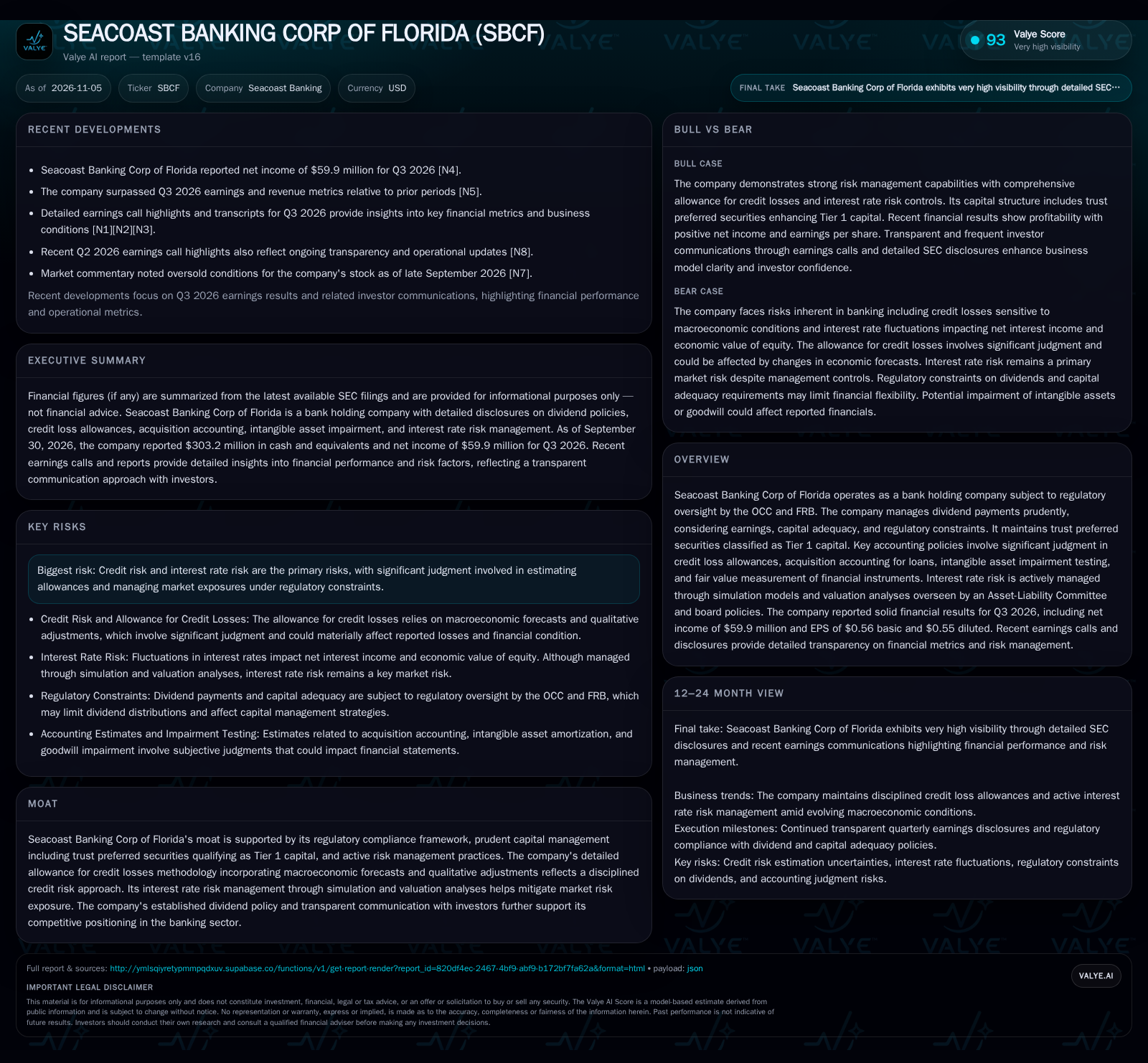
Seacoast Banking reported $59.9 million in Q3 2026 net income and exceeded prior-period earnings and revenue. Its disciplined approach to credit loss allowances and interest rate risk management, combined with strong capital structure and transparent communications, position it as a resilient regional player. However, its exposure to macroeconomic and regulatory forces will remain central to the long-term thesis. [S2] [N4] [N5]
Seacoast Banking Corp of Florida’s latest quarterly results underscore the company’s focus on disciplined risk management and transparent operations. With $59.9 million in Q3 2026 net income and outperformance versus prior periods, Seacoast demonstrates the earnings power needed to navigate a turbulent interest rate and regulatory environment. Yet, as with all regional banks, the interplay between macroeconomic headwinds, credit quality, and regulatory capital requirements will be decisive for long-term value creation and shareholder returns.
Recent Results Highlight Earnings Momentum and Capital Discipline
Seacoast Banking reported Q3 2026 net income of $59.9 million, with basic and diluted EPS of $0.56 and $0.55 respectively [S2] [N4]. These results surpassed prior-period earnings and revenue benchmarks, indicating operational momentum [N5]. The company held $303.2 million in cash and equivalents as of September 30, 2026 [S2]. This financial snapshot signals both profitability and liquidity at a time when many regional banks are contending with margin compression and credit challenges.
The cited source reports dividend-related activity; that disclosure alone does not establish dividend-policy continuity, management confidence, or a material constraint on capital flexibility. [S1] The use of trust preferred securities, included as Tier 1 capital, further strengthens its regulatory capital posture [S1]. Collectively, these facts point to a bank that is currently executing well, but whose future trajectory will be shaped by the durability of these trends and the broader economic environment.
How Seacoast Banking’s Profit Engine Works: Spread, Scale, and Sensitivity
Seacoast’s core profitability is driven by the spread between interest earned on loans and securities and interest paid on deposits and borrowings—a classic net interest margin (NIM) model. The company’s earnings are sensitive to both the volume and mix of loans, deposits, and securities, as well as to the pricing environment set by prevailing interest rates. Operating leverage is achieved as fixed costs (including branch infrastructure and corporate overhead) are spread over a larger asset base, but this leverage can cut both ways if credit losses or funding costs rise.
Allowance for credit losses is determined using a combination of Moody’s macroeconomic forecasts and qualitative credit assessments, introducing both rigor and managerial discretion to loss provisioning [S1]. This methodology can smooth earnings volatility in benign environments but could lead to sudden reserve buildups if economic conditions deteriorate. Acquisition accounting for purchased loans and intangibles can create step-ups in asset values, but these are amortized over the loan life, affecting future income recognition and potentially creating non-cash charges in the event of impairment.
The company reported cash and liquidity metrics for the period; these figures do not by themselves establish operating runway, investment capacity, financial flexibility, or financing capacity. [S1]
Regulatory Discipline, Risk Controls, and the Regional Bank Arena
Seacoast Banking’s competitive position is built on regulatory compliance, prudent capital management, and a disciplined approach to credit and interest rate risk. Its inclusion of trust preferred securities as Tier 1 capital under Basel III enhances its regulatory capital adequacy, potentially allowing for greater lending and dividend flexibility than less-well-capitalized peers [S1]. The company’s risk management infrastructure—anchored by simulation modeling, board-approved policies, and an active Asset-Liability Committee—provides a framework for navigating interest rate volatility and credit cycles.
However, the regional banking sector remains intensely competitive, with larger banks able to leverage scale for better technology, lower funding costs, and broader product suites. Community banks and fintech lenders, meanwhile, can undercut on service or niche offerings. While Seacoast’s transparency and communication help build trust with investors and regulators, the ultimate test will be the bank’s ability to maintain credit quality, manage deposit costs, and adapt to evolving customer needs amid a shifting macroeconomic and regulatory landscape.
What Could Drive Outperformance: Benign Credit, Rising Rates, and Disciplined Growth
In a favorable scenario, Seacoast benefits from a stable or improving macroeconomic environment, leading to low credit losses and steady or expanding net interest margins. If the bank’s loan book grows—either organically or through well-executed acquisitions—without a commensurate rise in nonperforming assets, operating leverage could drive higher returns on equity. An upward-sloping yield curve, with rising long-term rates and contained deposit costs, would further expand NIM and profitability.
Confirmation of this scenario would come from continued net income growth, stable or declining provision expenses, sustained or improving asset quality metrics (such as nonperforming loans and charge-offs, if disclosed), and positive operating leverage. Evidence of successful acquisition integration—reflected in expense synergies and accretive earnings contributions—would also support the upside thesis. Conversely, a reversal in these trends, such as rising credit losses or deposit runoff, would falsify the case for durable outperformance.
Sustained Profitability Amidst Macro and Regulatory Crosscurrents
The most plausible trajectory for Seacoast is one of continued profitability, but with periodic earnings volatility tied to credit and interest rate cycles. The bank is likely to maintain rigorous risk management, prudent capital policies, and transparent investor communications. Net interest income may face pressure if deposit costs rise faster than loan yields, or if the yield curve inverts. Credit provisioning is expected to remain disciplined, but could fluctuate with changes in Moody’s macro forecasts or local economic conditions.
Quarterly results may show modest growth or occasional setbacks, but the company’s capital structure and risk controls provide a buffer against severe shocks. Confirmation of this scenario would include steady EPS, stable regulatory capital ratios, and absence of material impairment charges. Signs of deteriorating credit metrics, regulatory intervention, or a sharp spike in funding costs would challenge this base case.
Adverse Credit Cycle or Rate Shock: How the Thesis Could Unravel
A negative scenario centers on a worsening economic environment that drives up credit losses and pressures net interest margins. If Moody’s forecasts deteriorate or local market conditions worsen, Seacoast could be forced to increase its allowance for credit losses sharply, leading to lower reported earnings and potentially eroding capital. A rapid rise in deposit costs—or a loss of deposit funding to higher-yield alternatives—could compress margins and strain liquidity.
Additional risks include regulatory restrictions on dividends or capital returns, goodwill or intangible asset impairments, and failed acquisition integrations. If Seacoast’s risk management tools fail to anticipate or mitigate these shocks, the downside could be both swift and severe.
Milestones and Metrics That Will Shape Seacoast’s Long-Term Value
Quarterly trends in net interest margin (NIM) and their sensitivity to changes in interest rates—especially if disclosed in simulation analyses—will be critical to gauging profitability resilience.
Allowance for credit losses as a percentage of loans, along with any disclosed internal or external credit quality indicators, would help assess the adequacy of loss reserves.
Nonperforming assets and charge-off rates, if disclosed, would provide early warning signals of credit deterioration.
Deposit growth and cost of funds trends—especially in the context of competitive market dynamics—will indicate Seacoast’s ability to retain and price funding.
Changes in regulatory capital ratios, particularly Tier 1 capital (including trust preferred securities), will be important for dividend-paying capacity and balance sheet flexibility.
Updates on acquisition activity, integration costs, and realized synergies, if provided, would clarify the impact of M&A on earnings and risk.
Any management commentary on macroeconomic assumptions used in credit loss modeling would help investors gauge the risk of future provision swings.
Sustained transparency in earnings calls and SEC filings will be essential for maintaining investor confidence and tracking execution against stated risk management objectives.
Disclaimer: This is research-only, informational analysis and not investment advice. It may include AI-generated interpretation and general industry context. Always verify important details using primary sources.

Comments