
BillionToOne’s Molecular Diagnostics Model: Proprietary Technology, Expanding Clinical Utility, and the Tests of Scale
BillionToOne, Inc. has established itself as a commercial-stage innovator in molecular diagnostics, leveraging its single molecule next-generation sequencing (smNGS) platform to deliver highly sensitive prenatal and oncology tests.
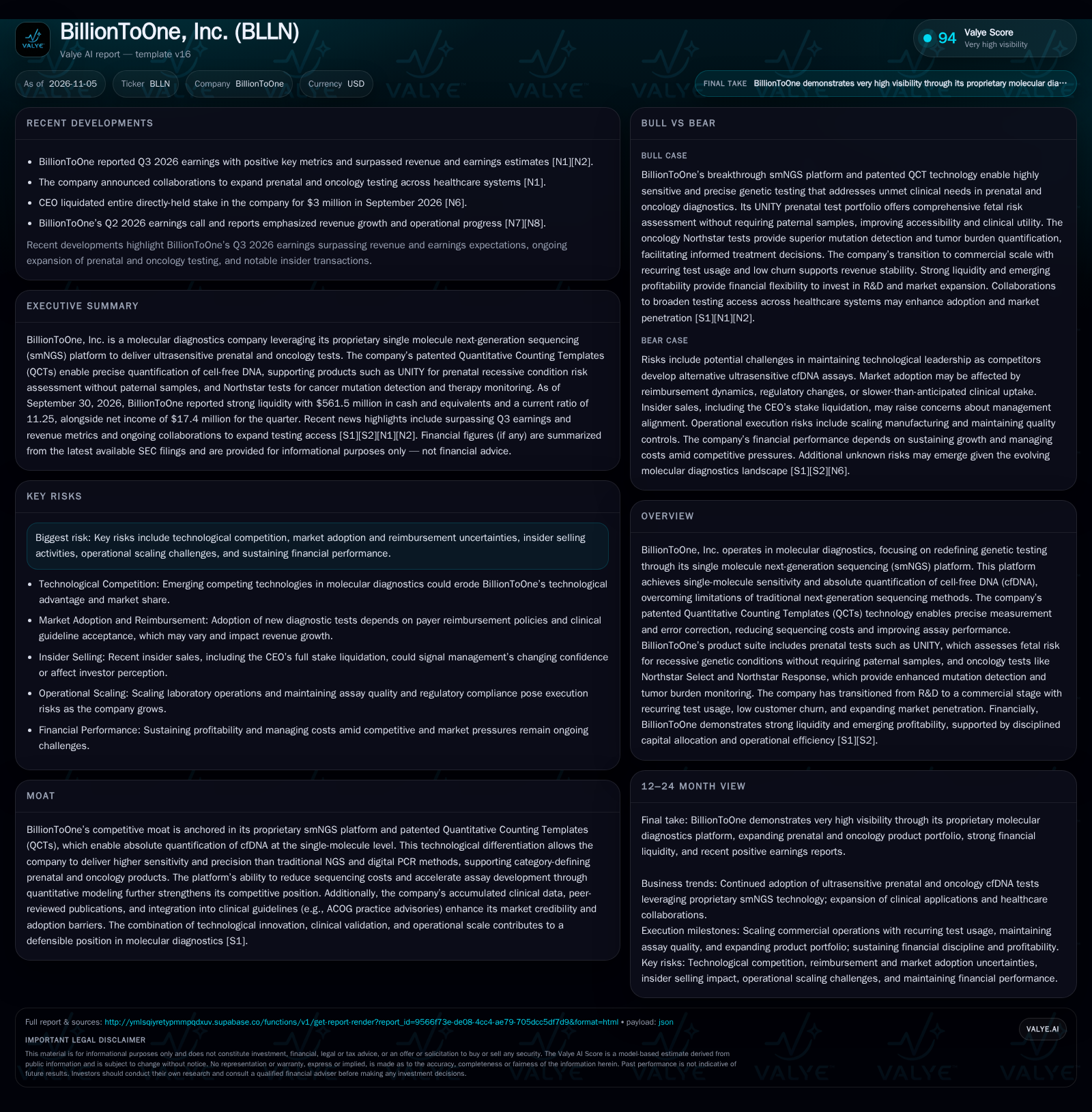
BillionToOne’s patented smNGS and Quantitative Counting Templates (QCTs) technology underpin a growing portfolio of prenatal and oncology liquid biopsy tests. However, the CEO’s recent full stake liquidation, combined with sectoral risks around technological competition and reimbursement, raise questions about long-term leadership and margin durability. Execution on scaling, payer adoption, and further clinical integration will be pivotal.
BillionToOne, Inc. has transitioned from a research-driven startup to a commercial-stage molecular diagnostics player, using its proprietary smNGS and QCTs technology to deliver highly accurate prenatal and oncology tests. Its UNITY and Northstar product lines target critical needs in non-invasive prenatal screening and oncology liquid biopsy, respectively, with clinical claims of higher sensitivity and broader patient applicability.
Recent Performance and Strategic Developments Shape BillionToOne’s Trajectory
BillionToOne reported net income of $17.4 million for Q3 2026, with basic and diluted EPS of $0.37 and $0.32, respectively, and a reported cash position of $561.5 million as of September 30, 2026 [S2]. Additionally, the company expanded its UNITY prenatal test menu to 14 conditions by May 2025, broadening clinical reach [S1]. The Northstar oncology portfolio continues to address advanced liquid biopsy markets, with claims of superior mutation detection and real-time treatment monitoring [S1]. However, management alignment is now under scrutiny after the CEO liquidated his entire directly-held stake for $3 million in September 2026 [N6]. Recent collaborations to expand access and recurring test usage with low churn further underscore commercial momentum [N1] [N2].
Commercial Model and Cost Structure: How BillionToOne Seeks to Monetize Innovation
BillionToOne’s revenue model is built around proprietary, high-value molecular diagnostics tests that command premium pricing relative to traditional screening methods. The key driver is the smNGS platform, which, paired with QCTs, allows for single-molecule quantification and error correction—enabling higher sensitivity and broader clinical applicability. This technological edge may allow the company to capture greater share of reimbursement in both prenatal (NIPT) and oncology liquid biopsy markets if clinical utility and payer coverage are validated.
Fixed costs are significant due to R&D, regulatory, and laboratory infrastructure requirements, but as test volumes scale, operating leverage can improve—particularly if throughput and automation efficiencies are realized. Variable costs are influenced by assay consumables and sample processing, but QCTs are designed to reduce sequencing costs per test, potentially enhancing gross margins as volume grows. Recurring revenue is plausible given the clinical workflow, but ultimate retention, pricing power, and margin durability depend on payer acceptance and competitive responses.
The scalability of BillionToOne’s business model hinges critically on its ability to optimize the balance between fixed and variable costs. Given the capital-intensive nature of molecular diagnostics, especially the initial investments in laboratory automation and regulatory compliance, achieving meaningful economies of scale is essential to improve profitability. If the company can successfully increase test volumes without proportionally increasing overhead, the incremental contribution margin per test could rise substantially. However, this is contingent on maintaining assay accuracy and throughput, as any compromise in quality could trigger costly recalls or reimbursement challenges, thereby undermining the model’s financial sustainability.
Another important dimension is the pricing strategy relative to payer reimbursement frameworks. While premium pricing may be justified by enhanced clinical utility, sustained reimbursement depends on demonstrating cost-effectiveness and improved patient outcomes compared to incumbent technologies. If payers adopt value-based contracting models, BillionToOne will need robust real-world evidence linking its tests to downstream cost savings or clinical benefits. Failure to provide such data or shifts in payer policies could compress margins or limit coverage, constraining revenue growth despite technological superiority. Therefore, investment in health economics and outcomes research is a strategic imperative to support long-term monetization.
Defensible Technology Versus Sector Headwinds: Where BillionToOne Stands
BillionToOne’s moat is anchored in its proprietary smNGS and QCTs technology, which enables higher sensitivity and quantitative precision than conventional NGS or digital PCR methods [S1]. This differentiation is particularly valuable in non-invasive prenatal testing (where UNITY obviates the need for paternal samples and expands the spectrum of detectable conditions) and in oncology, where Northstar’s mutation detection and therapy monitoring set a high bar for clinical utility. However, the molecular diagnostics sector is characterized by rapid innovation cycles, with both established players and well-funded startups racing to develop alternative cfDNA and liquid biopsy platforms.
Competitive threats include advances in sequencing chemistry, AI-driven assay interpretation, and integrated diagnostic platforms that could erode the company’s lead. Reimbursement policy shifts and evolving clinical guidelines also shape adoption rates and pricing power. The company’s accumulating clinical data and integration into practice advisories help build credibility and switching frictions, but sustained leadership will require ongoing innovation, evidence generation, and execution on cost and quality.
If Adoption Accelerates: The Path to Category Leadership
The most favorable scenario would see BillionToOne’s UNITY and Northstar tests become widely adopted as reference standards in their respective markets. This would require continued demonstration of superior clinical utility, further integration into clinical guidelines, and broad payer reimbursement—unlocking expanding addressable markets and recurring, high-margin revenue. Operating leverage would increase as fixed infrastructure costs are spread over higher volumes, and improved gross margins from QCT-enabled cost reductions would enhance profitability.
Evidence for this scenario would include sustained volume growth in both prenatal and oncology segments, rapid expansion of collaborations with large health systems, positive updates on payer coverage and reimbursement rates, and new clinical validations or peer-reviewed studies reinforcing test superiority. Additionally, further expansion of the test menu and successful entry into adjacent indications would validate the platform’s extensibility.
Steady Growth Amid Sectoral Pressures and Execution Challenges
A more tempered scenario envisions BillionToOne maintaining commercial momentum, but with growth rates moderating as competitive offerings enter the market and payer scrutiny intensifies. The company continues to expand its customer base, but faces periodic pricing pressure and must invest in ongoing clinical validation to defend reimbursement rates. Gross margins improve modestly as volumes rise, but incremental margin expansion is offset by increased SG&A and R&D spend required to sustain innovation and market access.
Confirmation of this scenario would come from stable or gradually increasing test volumes, maintenance of positive net income, and incremental product enhancements. Signs of payer pushback, slower-than-expected adoption in new health systems, or increased customer churn would suggest the need for tactical adjustments.
Losing the Innovation Edge: Risks to Margin and Market Share
In a negative scenario, BillionToOne’s technological lead is eroded by faster-moving competitors or disruptive new assay platforms, leading to price competition and market share loss. If clinical or payer adoption stalls—due to shifting reimbursement, regulatory headwinds, or less compelling evidence compared to rivals—revenue growth could decelerate sharply. The fixed cost base, built for scale, would become a burden, compressing margins and potentially requiring cost cuts or fresh capital.
Evidence for this scenario would include a flattening or decline in test volumes, negative trends in net income, loss of key collaborations, or unfavorable reimbursement updates. Persistent insider selling, such as the CEO’s recent divestiture, could compound concerns about strategic direction or internal confidence.
Milestones That Will Clarify BillionToOne’s True Commercial Trajectory
Rate of volume growth for UNITY and Northstar tests across prenatal and oncology segments—if disclosed.
Updates on payer reimbursement decisions, including coverage expansions, denials, or pricing adjustments.
Gross margin trends and evidence of cost-per-test reductions from QCTs and operational scale.
Expansion and renewal of collaborations with major healthcare systems; new partnership announcements.
Churn rates and customer retention metrics—data on recurring usage would help test the stickiness thesis.
Pipeline progress: new test launches, menu expansions, or entry into adjacent disease areas.
Management and insider trading activity, especially in the wake of the CEO’s full stake sale.
Regulatory developments or clinical guideline updates that impact adoption or competitive positioning.
Disclaimer: This is research-only, informational analysis and not investment advice. It may include AI-generated interpretation and general industry context. Always verify important details using primary sources.

Comments