
Timken’s Industrial Strategy: Aftermarket Growth, Acquisition Execution, and Operational Efficiency
Timken’s recent momentum reflects a blend of organic demand recovery, disciplined pricing, and strategic expansion in industrial motion segments. The company’s ability to convert top-line gains into sustainable margin improvement hinges on integrating acquisitions, managing cost headwinds, and capitalizing on the aftermarket’s recurring potential.
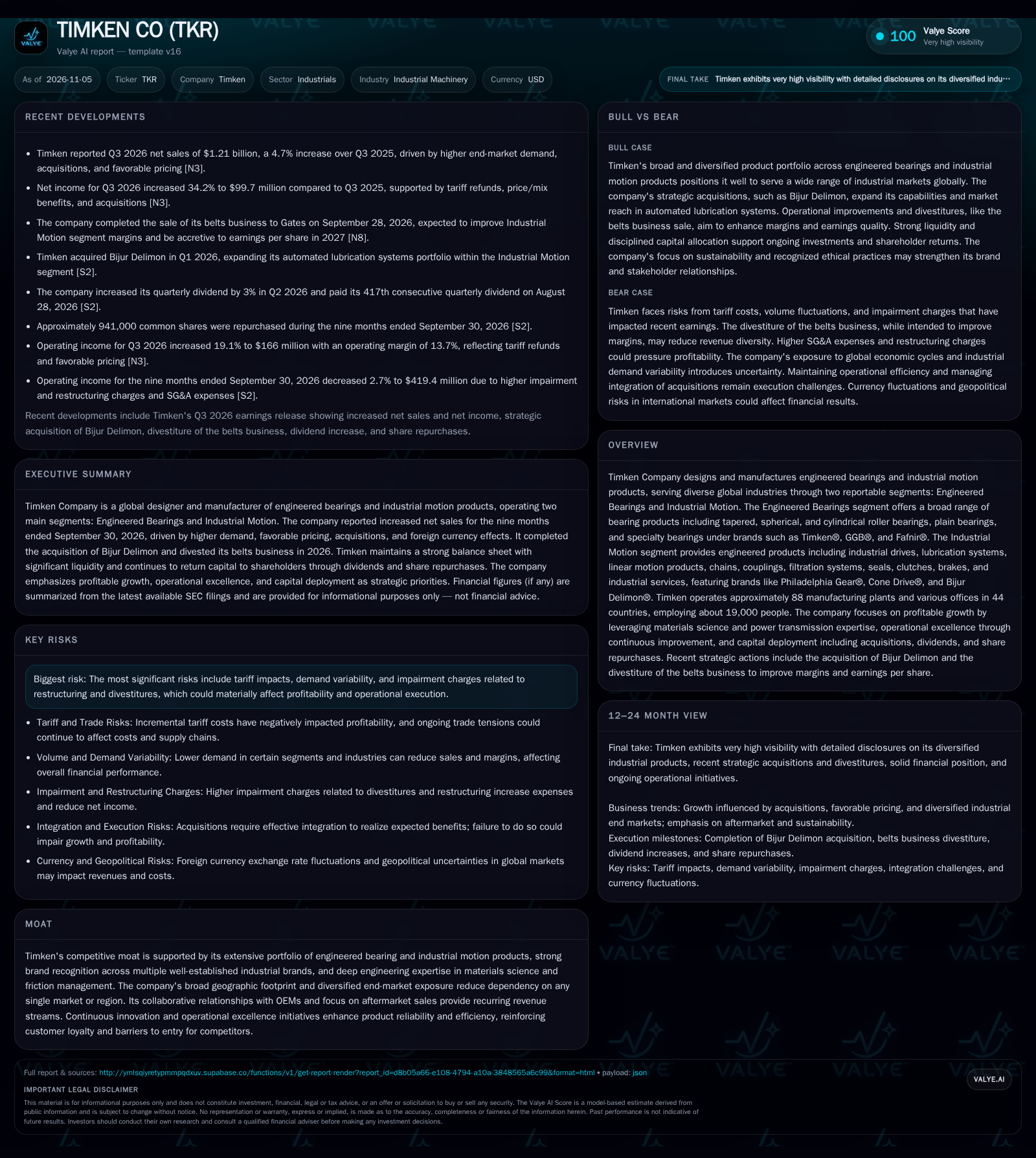
Timken’s Q3 2026 results underscore a business benefiting from broad industrial recovery, favorable pricing, and portfolio expansion through acquisitions. Operating margin gains have been aided by tariff refunds and mix, but full-year profitability remains pressured by restructuring and integration costs. The company’s path forward will be defined by its success in extracting value from recent deals, driving operational efficiency, and navigating cyclical and geopolitical risks in global industrial demand. [N3] [S2]
Timken enters late 2026 as a diversified industrial supplier blending engineered bearings expertise with a growing portfolio in motion products and services. Recent results reflect a business capturing both cyclical demand recovery and strategic expansion via acquisitions like Bijur Delimon. While short-term margin gains benefited from tariff refunds and favorable pricing, sustained value creation will depend on integrating new assets, extracting aftermarket revenue, and managing the volatility inherent to global industrial cycles. The challenge now is to convert scale and breadth into durable margin and cash flow, particularly as restructuring and integration costs weigh on the base.
Margin Recovery, Strategic Moves, and Portfolio Adjustments in Recent Quarters
Timken’s Q3 2026 net sales increased 4.7% year-over-year to $1.21 billion, a period that also saw operating income jump 19.1% to $166 million and operating margin rise to 13.7%. This margin rebound was supported by tariff refunds and positive price/mix effects, counterbalancing input cost pressures and providing a temporary lift to profitability. The company’s acquisition of Bijur Delimon in Q1 2026 strengthened its Industrial Motion segment, specifically in automated lubrication systems, signaling continued portfolio diversification. However, for the first nine months of 2026, operating income declined 2.7% to $419.4 million, with margin compression linked to higher impairment and restructuring charges, including costs associated with divestitures and integration. Timken’s capital return strategy remains active, as evidenced by a 3% dividend hike and nearly one million shares repurchased year-to-date. The company reported cash and liquidity metrics for the period; these figures do not by themselves establish operating runway, investment capacity, financial flexibility, or financing capacity. [N3] [S2]
Revenue Drivers: Volume Trends, Value Creation, and Aftermarket Services Impact
Timken’s revenue model is anchored in supplying engineered bearings and industrial motion products to a diversified set of end markets—ranging from wind energy to automotive, food, mining, and logistics. The company operates two segments: Engineered Bearings and Industrial Motion. The former is primarily a specification-driven, OEM-focused business that relies on technical selling, product quality, and customer relationships. The latter, encompassing products like drives, lubrication, and linear motion systems, is increasingly service-oriented and leverages recurring aftermarket opportunities.
Pricing power is evident in recent quarters, with favorable price/mix cited as a driver of margin expansion. However, Timken’s ability to pass through cost increases is partially offset by exposure to global supply chain volatility, tariffs, and input inflation. The company’s fixed cost base—given its 88 manufacturing plants worldwide—provides operating leverage in upcycles, but also introduces earnings sensitivity to volume swings and underutilization.
Acquisitions play a central role in Timken’s growth and margin strategy, both broadening the product set and increasing addressable aftermarket revenue. Integration costs, however, have weighed on recent profitability, as evidenced by higher SG&A and restructuring charges. Capital allocation is balanced between reinvesting in the core business, M&A, dividends, and share repurchases.
Maintaining Competitive Edge Through Engineering Expertise and Brand Diversity
Timken’s competitive moat is built on several durable features: a deep portfolio of engineered products, strong brands (Timken, GGB, Fafnir, Philadelphia Gear, and others), and a global manufacturing and distribution footprint. Its technical expertise in friction management and materials science underpins customer relationships, particularly with OEMs seeking performance and reliability.
The company’s exposure to highly fragmented industrial markets, including automation, rail, construction, and renewables, provides both opportunity and risk. Fragmentation allows Timken to gain share through targeted acquisitions and technical selling, but also exposes it to nimble niche competitors and price-focused rivals. The increasing focus on aftermarket and services can provide some recurring revenue and switching-cost advantages, but these effects are not automatic; aftermarket retention depends on channel execution and product reliability.
Substitution risk is present, especially as customers in sectors like energy and automotive seek alternatives to traditional bearing and motion technologies. Digitalization, predictive maintenance, and broader industrial automation trends could shift value toward system integrators or data-driven service providers. Timken’s ability to innovate and embed itself in OEM and aftermarket ecosystems will be key to sustaining its competitive edge.
Potential Gains from Successful Integration and Expanded Aftermarket Reach
The most favorable scenario for Timken is one in which recent acquisitions like Bijur Delimon are rapidly and efficiently integrated, expanding the company’s share in automated lubrication and value-added motion systems. If Timken can leverage its broad distribution network and technical sales force to drive deeper aftermarket penetration, especially in high-service, fragmented end markets, the company could achieve higher recurring revenue and margin resilience.
Margin expansion would be further supported by continued operational excellence—lowering manufacturing costs, reducing waste, and improving working capital turns. Evidence of this scenario would include sustained improvement in adjusted EBITDA margins across both segments, rising aftermarket revenue mix, and a reduction in integration- and restructuring-related charges relative to sales. Accelerating cash generation and incremental dividend or buyback increases would strengthen the case that Timken is converting scale and breadth into durable shareholder value.
Expected Outcomes Reflecting Cyclical Trends and Portfolio Refinement
The most plausible outlook is that Timken continues to grow modestly by capturing organic demand recovery, selectively integrating acquisitions, and maintaining pricing discipline. Operating margins may remain in a mid-teens range, with periodic volatility driven by input costs, currency swings, and integration expenses. Aftermarket and service penetration should gradually improve, but not enough to fully insulate the business from broader industrial cycles or regional slowdowns.
Falsifying evidence would be prolonged margin compression, repeated integration missteps, or a material decline in aftermarket retention rates. The base case assumes Timken’s diversified end-market exposure smooths out the most severe cyclical shocks, but does not eliminate them.
Risks from Integration Challenges and Market Volatility Affecting Margins
A more adverse scenario would see Timken struggle to realize expected synergies from recent acquisitions, with integration costs and cultural friction eroding profitability. Simultaneously, a downturn in industrial demand—whether from macroeconomic shocks, regional instability, or sector-specific weakness—could lead to underutilized capacity, price competition, and working capital strain.
This scenario would likely manifest in declining operating margins, rising restructuring and impairment charges, and muted cash returns to shareholders. Early warning signs would include a spike in SG&A or restructuring costs as a percentage of sales, negative free cash flow, and management guidance cuts. Should aftermarket sales underperform or customer retention wane, Timken’s intended buffer against cyclicality could prove less robust than anticipated.
Factors Influencing Timken’s Margin and Integration Outlook Post-2026
The pace and cost of integrating Bijur Delimon and other recent acquisitions—timely synergy realization versus ongoing SG&A drag.
Adjusted EBITDA margin trends by segment, especially the Industrial Motion segment where recent portfolio shifts are most pronounced.
Aftermarket revenue mix and retention rates, if disclosed, to gauge recurring revenue strength and customer loyalty.
Operating cash flow and free cash flow conversion, particularly as working capital needs fluctuate with industrial cycles.
Restructuring and impairment charges as a proportion of sales, signaling the degree of portfolio adjustment pain.
Organic sales growth versus acquisition-driven growth, separating underlying demand from deal-dependent expansion.
Foreign exchange and tariff cost disclosures, given ongoing exposure to global supply chain and trade dynamics.
Disclaimer: This is research-only, informational analysis and not investment advice. It may include AI-generated interpretation and general industry context. Always verify important details using primary sources.

Comments