
International Paper: Structural Transformation, Integration Pressures, and the Stakes of EMEA Separation
International Paper’s acquisition of DS Smith and the planned separation of its EMEA packaging business mark a period of deep operational and financial transformation.
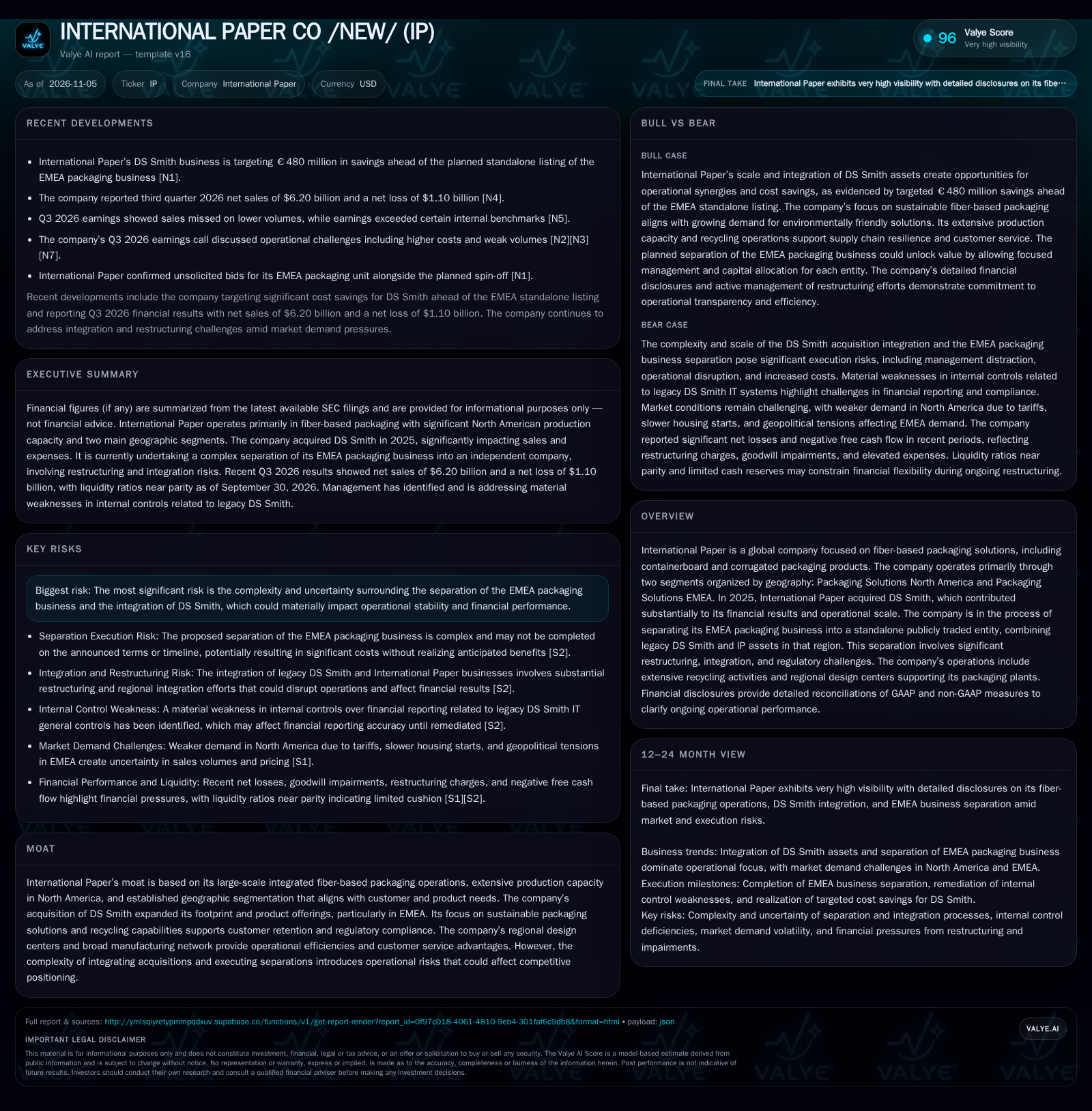
International Paper is navigating a high-stakes integration of DS Smith and the complex spin-off of its EMEA packaging business. The company targets €480 million in DS Smith-related savings but faces net losses, restructuring charges, and internal control weaknesses. Market headwinds and liquidity near parity amplify the importance of execution during this transition phase. Success depends on realizing operational synergies, stabilizing controls, and managing through weak demand in North America and EMEA.
International Paper stands at a pivotal juncture as it integrates DS Smith’s operations and prepares to separate its EMEA packaging business into a standalone public entity. These moves fundamentally reshape the company’s scale, cost base, and geographic focus, but introduce substantial operational and financial risks. Net losses, restructuring charges, and a thin liquidity cushion underscore the urgency of executing on targeted cost savings and restoring financial discipline. With market demand soft in both North America and EMEA, International Paper’s ability to manage integration, unlock synergies, and stabilize controls will determine whether this transformation ultimately creates or destroys shareholder value.
Recent Performance Reflects Heavy Restructuring and Integration Strain
International Paper reported Q3 2026 net sales of $6.20 billion, but the quarter was marked by a net loss of $1.10 billion, driven by restructuring charges, goodwill impairments, and integration costs associated with the DS Smith acquisition [N4] [S2]. Liquidity ratios are near parity: as of September 30, 2026, the company's current assets ($8.71 billion) barely cover its current liabilities ($8.83 billion), and cash on hand stands at $815 million, yielding a cash ratio of just 0.09 [S2]. Management has identified a material weakness in internal controls over financial reporting, specifically tied to legacy DS Smith IT systems. This is being actively remediated but remains unresolved [S2]. On the strategic front, International Paper is targeting €480 million in cost savings from DS Smith operations ahead of the planned spin-off of its EMEA packaging business—a process that itself is complex and subject to execution and regulatory risks [N1] [S2].
How Restructuring and Integration Shape Profitability Levers
International Paper’s core business model rests on converting low-cost fiber into containerboard and corrugated packaging, with scale, vertical integration, and asset utilization historically underpinning margins. The DS Smith acquisition expands the company’s production footprint and customer base, particularly in EMEA, but introduces new cost structures and integration risks. The company’s targeted €480 million in DS Smith-related savings suggests a focus on fixed cost reduction, procurement, and operational synergies—yet achieving these savings depends on successful integration and rationalization of overlapping facilities and supply chains [N1].
The planned EMEA separation is likely to alter the company’s capital allocation and fixed cost absorption, potentially leading to stranded costs or dis-economies of scale in both the remaining North American business and the new EMEA entity. The company faces elevated restructuring charges, with recent periods also showing negative free cash flow as capital expenditures have exceeded cash from operations [S2]. Significant non-cash charges, including goodwill impairments, further complicate the picture and may mask underlying operating trends. If integration and restructuring succeed, the business could see improved operating leverage; if not, persistent losses could erode capital and constrain future investment.
Scale and Network vs. Disruption: Where International Paper Stands
International Paper’s enduring advantage has been its vast North American production capacity (approximately 11 million tons annually as of 2025) and its ability to serve major consumer and industrial customers through an integrated supply chain. The DS Smith acquisition was intended to deepen the company’s EMEA presence and broaden its product and customer mix. However, the integration process and planned EMEA spin-off introduce uncertainty about whether these scale advantages can be preserved or even enhanced.
The company faces competition from other large, integrated packaging producers as well as regional players, with customer switching costs generally low in commoditized packaging segments. While International Paper’s recycling operations and sustainability focus may help retain customers concerned about environmental impact, pricing remains cyclical and sensitive to input costs and demand. The complexity of separating EMEA operations could temporarily distract management, create operational redundancies, or provide openings for competitors to capture share—especially if service or cost disruptions emerge during the transition. Post-separation, both International Paper and the new EMEA entity will need to reestablish their value propositions in their respective markets.
Synergy Realization and EMEA Spin-off Unlock Shareholder Value
A favorable outcome for International Paper would see management delivering on the targeted €480 million in DS Smith cost savings, efficiently integrating operations, and completing the EMEA packaging spin-off with minimal disruption [N1]. If internal control weaknesses are remediated on schedule and restructuring costs begin to subside, the company could transition from persistent net losses to positive operating leverage, especially if market conditions stabilize or improve.
Additional upside could emerge if the spin-off catalyzes a rerating of both International Paper and the new EMEA entity, allowing for more focused capital allocation and improved returns on invested capital. Evidence of this scenario would include sequential improvement in adjusted EBITDA margins, declining restructuring and impairment charges, successful regulatory approval of the spin-off, and early signs of commercial stability in both segments post-separation. Confirmation would also come from management guidance reaffirming synergy delivery and market share retention in both geographies.
Transition Period Defined by Execution Risks and Muted Growth
The most plausible path is a multi-quarter period marked by elevated restructuring costs, operational noise, and only gradual realization of synergies. The EMEA separation process is likely to consume management bandwidth and maintain a high risk of operational disruption. While cost savings from DS Smith could begin to materialize, ongoing market headwinds in North America and EMEA—such as weak demand, tariff impacts, and geopolitical pressures—are likely to limit volume and pricing power.
Financial performance may remain under pressure, with periodic net losses and negative free cash flow as restructuring and integration costs persist. The company’s thin liquidity cushion could constrain flexibility, though asset sales or refinancing could provide temporary relief if needed. Evidence for this scenario would be continued reporting of special items, moderate sequential improvement in core operating metrics, and management commentary focused on execution milestones rather than transformational growth.
Execution Missteps Compound Market Weakness, Threatening Balance Sheet
A negative outcome could unfold if the integration of DS Smith and the separation of EMEA packaging are delayed, disrupted, or prove more costly than anticipated. Failure to remediate internal control weaknesses could trigger compliance issues or erode investor confidence, while further restructuring charges or impairment write-downs could deepen net losses.
If market demand in North America and EMEA deteriorates further—due to recession, escalating tariffs, or geopolitical shocks—International Paper could face declining volumes and underutilized assets, amplifying fixed-cost absorption issues. In this scenario, the company’s near-parity liquidity ratios and reported cash balance would heighten vulnerability to covenant breaches or forced asset sales. Confirmation would include missed synergy targets, repeated downward revisions to earnings guidance, and negative commentary on customer retention or operational stability.
Milestones and Metrics That Will Reveal If Transformation Succeeds
Progress toward the €480 million DS Smith cost savings target—quarterly updates on synergy realization would be critical to validate operational improvement [N1].
Remediation status of the material weakness in internal controls over financial reporting—timely resolution would reduce compliance and reputational risk [S2].
Completion and regulatory approval of the EMEA packaging business separation—delays or adverse terms would signal elevated execution risk [S2].
Trends in adjusted EBITDA margins and operating cash flow—improvement would reflect underlying business health, while continued weakness would indicate persistent operational strain (if disclosed).
Volume and pricing trends in North American and EMEA packaging—stabilization or growth would suggest demand recovery; further declines would point to market headwinds (a useful metric would be segment-level volume growth).
Magnitude and frequency of restructuring charges and impairment write-downs—declining charges would indicate transition progress; persistent special items would signal ongoing disruption [S2].
Liquidity evolution—movement in the current and cash ratios, as well as access to external financing, would help assess potential financial flexibility (if disclosed).
Customer retention and new business wins during and after the EMEA spin-off—a shift in major customer relationships would be an early sign of competitive repositioning (if disclosed).
Disclaimer: This is research-only, informational analysis and not investment advice. It may include AI-generated interpretation and general industry context. Always verify important details using primary sources.

Comments