
PROCEPT BioRobotics: Expanding Aquablation Adoption and the Economics of Surgical Robotics in Urology
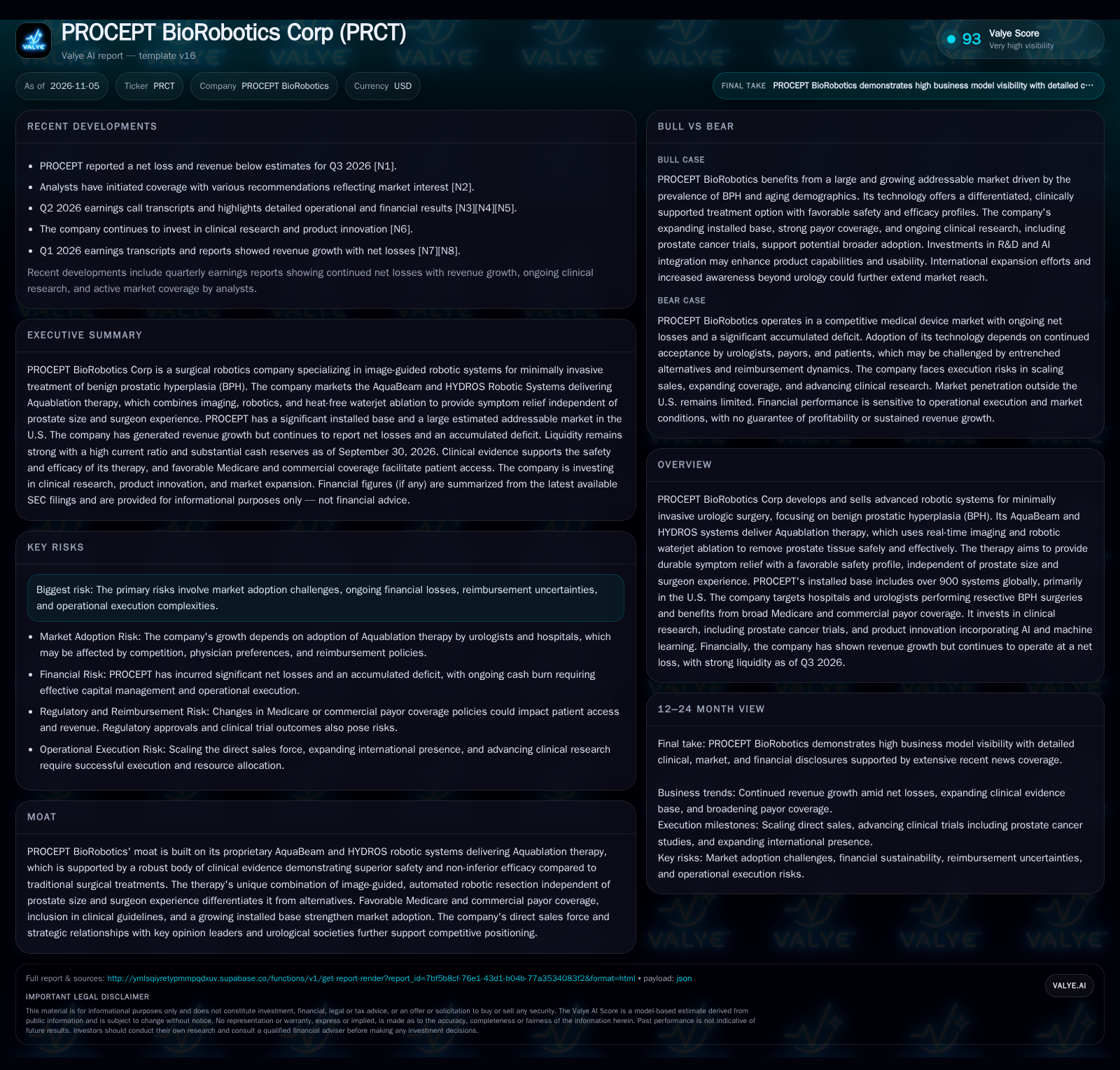
PROCEPT BioRobotics is scaling its installed base of robotic systems for minimally invasive BPH surgery, leveraging favorable payor coverage and robust clinical evidence. While revenue growth persists, sustained net losses highlight the challenges of capital-intensive medtech adoption and the need for greater system utilization and market penetration.
PROCEPT BioRobotics continues to grow its installed base and revenue in the urologic surgical robotics market, supported by broad U.S. payor coverage and strong clinical data. Despite this, the company remains unprofitable, reflecting the capital intensity and adoption hurdles in medtech. Key questions are whether increased system utilization and international expansion can drive operating leverage and move the business toward profitability.
PROCEPT BioRobotics stands at the intersection of surgical robotics innovation and the realities of medtech commercialization. With its AquaBeam and HYDROS systems targeting benign prostatic hyperplasia (BPH), PROCEPT has built a meaningful installed base in the U.S. and established broad reimbursement coverage. However, the company continues to operate at a loss, reflecting the capital requirements, adoption curve, and utilization hurdles typical of disruptive medical device platforms. The core question is whether PROCEPT can drive sufficient procedure volume and expand internationally to achieve the scale and utilization needed for sustained profitability.
Recent Growth Anchored by Installed Base Expansion and Broad Coverage
As of year-end 2025, PROCEPT BioRobotics had deployed 912 robotic systems globally, including 718 in the United States, demonstrating meaningful penetration among hospitals performing resective BPH procedures [S1]. The company reported revenue growth to $308.1 million in 2025 (up from $224.5 million in 2024), yet continued to incur significant net losses ($95.6 million in 2025 and $26.5 million in the first nine months of 2026) [S1] [S2]. Notably, PROCEPT secured favorable Medicare coverage in all 50 states and estimates its U.S. commercial payor access at approximately 95% of eligible men, a critical enabler for therapy adoption [S1]. These developments matter because they establish a foundation for further system utilization and procedure growth, but persistent operating losses highlight the challenges of scaling capital-intensive medtech platforms.
Beyond the installed base and reimbursement landscape, a critical factor influencing PROCEPT's growth trajectory is the rate at which hospitals and physicians integrate Aquablation into their procedural mix. Adoption is not solely a function of coverage but also depends on clinical workflow integration, training requirements, and institutional willingness to shift from established surgical methods. The capital expenditure decision for hospitals involves balancing the upfront cost of robotic systems against anticipated procedural volume and reimbursement rates. Therefore, understanding the dynamics of hospital budgeting cycles and physician referral patterns is essential to assessing how quickly installed systems translate into meaningful procedure volumes.
How Procedure Volume and Utilization Drive the Robotic Platform Model
PROCEPT’s business model is built on the sale and ongoing use of high-value robotic systems, with economic performance hinging on both initial placements and recurring procedure-driven revenue streams (such as disposables, service contracts, and upgrades). The capital-intensive nature of robotic system sales typically results in high gross margins once installed bases are sufficiently utilized, but also requires substantial upfront investment in direct sales, clinical support, and R&D. The company’s revenue growth tracks with system placements, but persistent net losses reflect high fixed costs and the long payback period associated with hospital capital equipment adoption [S1].
Operating leverage in this model emerges only as procedure volume per system increases: higher utilization means more recurring revenue per installed system, spreading fixed costs across a larger revenue base. However, if utilization lags (whether due to slow physician adoption or patient flow), the business can remain loss-making even with a growing installed base. Additionally, ongoing investment in clinical trials, new indications (such as prostate cancer), and international expansion adds to capital requirements, prolonging the path to profitability.
The economics of PROCEPT’s platform also hinge on the durability and scalability of recurring revenue streams. Disposable components and service contracts typically offer higher margin contributions relative to system sales, but their growth depends on consistent procedure volumes and customer retention. Additionally, the timing of revenue recognition can be uneven, with system sales generating upfront revenue but recurring revenues accruing over time. This mismatch necessitates careful capital planning to sustain operations during early growth phases. Furthermore, the competitive landscape influences pricing power for disposables and services; if competitors introduce lower-cost alternatives or bundled pricing models, margin expansion could be constrained.
Differentiation Versus Incumbents and Substitutes in Urologic Surgery
PROCEPT’s primary differentiation lies in its Aquablation therapy, which combines real-time imaging, robotic precision, and a heat-free waterjet ablation technique. This approach is supported by robust clinical data—nine studies and over 150 peer-reviewed publications—demonstrating superior safety and non-inferior efficacy to traditional transurethral resection of the prostate (TURP), with low retreatment rates [S1]. The ability to treat prostates independent of size and surgeon experience further strengthens its appeal.
However, the company faces competition from both established surgical techniques (TURP, laser therapies, and other minimally invasive devices) and emerging robotic or image-guided platforms. Entrenched physician preferences, capital budgeting cycles, and the need for workflow integration can slow adoption. While favorable payor coverage and inclusion in clinical guidelines are competitive advantages, future substitutes or incremental innovations by larger surgical robotics firms could compress PROCEPT’s differentiation if not offset by further product innovation and evidence generation.
In evaluating PROCEPT’s differentiation, it is important to consider the potential impact of evolving surgical robotics trends and technology convergence. Larger surgical robotics companies may leverage their broader platforms and installed bases to bundle offerings or integrate multi-indication capabilities, potentially diluting PROCEPT’s niche advantage. Moreover, advancements in imaging, artificial intelligence, and automation could raise the bar for clinical outcomes and cost-effectiveness, requiring continuous innovation. The company’s ability to maintain a competitive moat will depend on sustaining clinical evidence superiority, enhancing ease of use, and demonstrating cost-benefit advantages to both providers and payors amid intensifying competition.
Widespread Utilization and International Expansion Unlock Operating Leverage
The most favorable scenario for PROCEPT involves accelerating system utilization in the U.S.—converting a greater share of resective BPH procedures to Aquablation and expanding awareness among both urologists and primary care physicians. This would drive recurring revenue from disposables and services, improving margins and generating operating leverage. Expansion into new indications (notably prostate cancer), if supported by positive clinical trial outcomes, could meaningfully increase the addressable market. International growth, particularly in underpenetrated geographies, would further amplify the revenue base and reduce reliance on U.S. sales.
Evidence confirming this scenario would include sustained double-digit revenue growth, rising procedure volumes per installed system (if disclosed), successful launches in new markets, and narrowing operating losses or a clear path to profitability. Additional clinical guideline endorsements and expanded payor coverage for new indications would further support this trajectory.
Incremental Adoption in BPH Drives Gradual Margin Improvement
A more moderate outcome assumes continued but gradual adoption of Aquablation therapy within the existing U.S. hospital base, with incremental gains in system utilization and slow expansion into international markets. Revenue grows in line with system placements and increased procedure penetration, but operating losses persist as fixed costs remain high and investments in R&D and clinical trials continue. Margin improvement is achieved through better utilization and some operational efficiencies, but breakeven remains several years away.
This scenario would be confirmed by steady, but not accelerating, revenue growth, persistently negative net income, and ongoing investment in sales infrastructure and clinical research. Utilization metrics that show only modest improvement, and limited international contribution to revenue, would reinforce this middle path.
Sluggish Adoption, Utilization Stagnation, and Reimbursement Headwinds
The principal risk is that system utilization fails to ramp as expected—whether due to physician inertia, workflow disruption, or patient preference for established procedures. If hospitals limit purchases or underutilize installed systems, recurring revenue and gross margins will underperform, and fixed costs will remain burdensome. Any adverse changes to Medicare or commercial payor coverage, or setbacks in new clinical indications, could further dampen growth and threaten profitability [S1].
Confirmation of this scenario would include stagnating revenue growth, flat or declining procedure volumes per system, widening net losses, or negative reimbursement developments. Delays or failures in clinical trials for new indications, or competitive responses from incumbents, would reinforce the downside.
Milestones That Will Shape the PROCEPT BioRobotics Investment Thesis
Trends in procedure volume per installed system (if disclosed) to assess whether utilization is increasing and driving recurring revenue.
Rate of new system placements in the U.S. and internationally, indicating ongoing market penetration and adoption.
Gross margin evolution, particularly as recurring revenue from disposables and services grows relative to system sales.
Updates on clinical trial progress and outcomes, especially for prostate cancer and other new indications.
Changes in Medicare and commercial payor coverage policies that could affect patient access and reimbursement rates.
Expansion of clinical guideline endorsements for Aquablation therapy, which may influence physician adoption.
Evidence of operational leverage, such as narrowing operating losses or positive operating cash flow, as the business scales.
Market entry or competitive product launches from larger surgical robotics firms, which could pressure pricing or share.
Disclaimer: This is research-only, informational analysis and not investment advice. It may include AI-generated interpretation and general industry context. Always verify important details using primary sources.

Comments