
Wintrust’s Community Banking Model, Specialty Finance Engine, and the Stakes of Regional Scale
Wintrust Financial leans on its multi-charter, community-first banking model and a robust specialty finance engine to drive earnings in the Midwest. The challenge: balancing operational complexity, credit risk, and geographic concentration as it seeks to sustain differentiated growth.
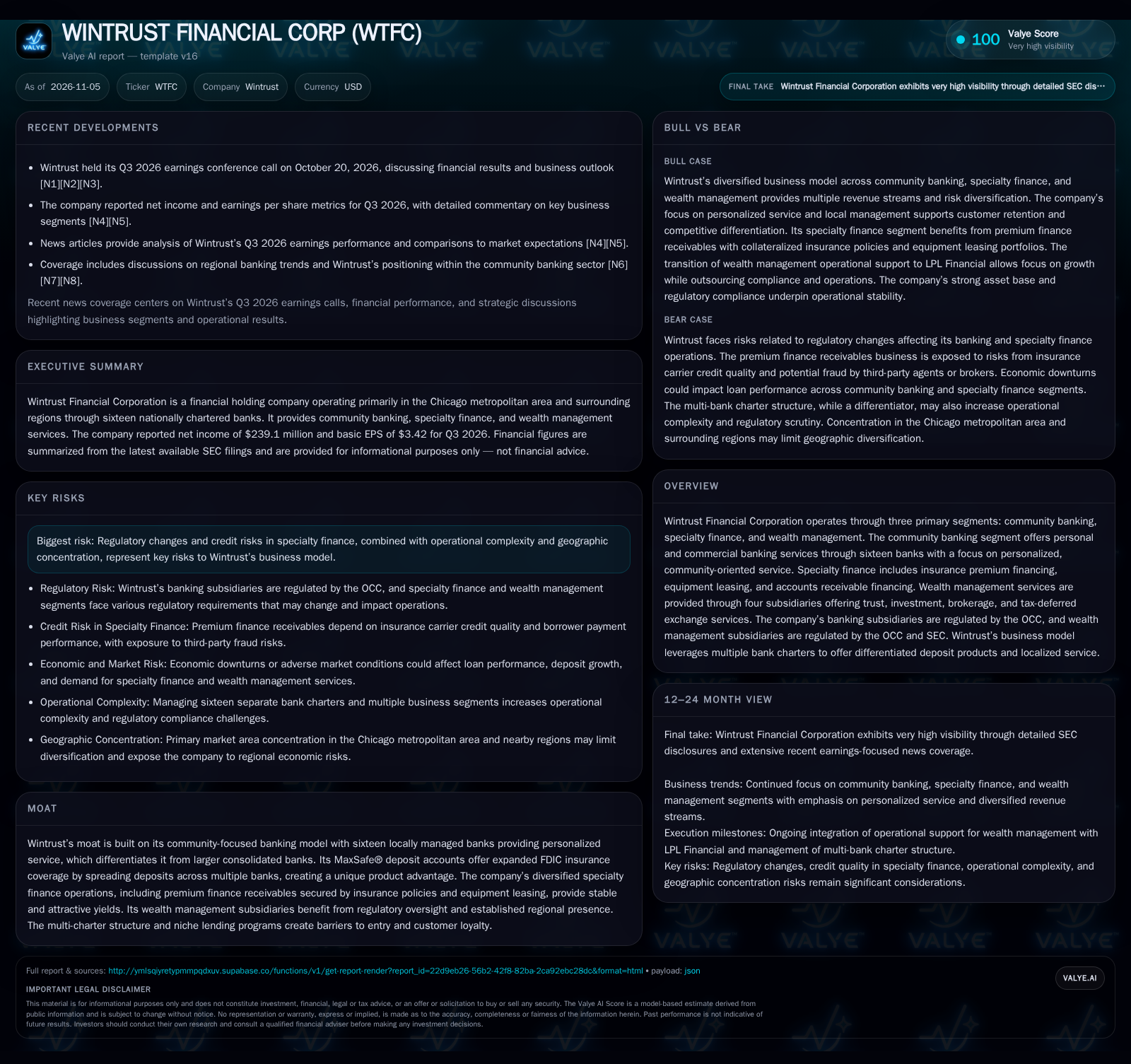
Wintrust Financial reported $239.1 million in net income for Q3 2026, with its community banking segment contributing nearly three-quarters of 2025 revenues and specialty finance delivering $509 million in net revenue for the year. Its 16-bank, multi-charter structure underpins a unique MaxSafe® deposit product, but also raises operational complexity and regulatory scrutiny. Geographic focus in the Chicago region remains both a differentiator and a concentration risk. The company’s ability to manage credit risk in premium finance and execute on outsourced wealth management operations will shape its forward trajectory. [S2] [N4] [N5]
Wintrust Financial stands out among regional banks for its multi-bank charter model, which enables hyper-localized service and innovative products like MaxSafe® deposits. The company’s latest results show robust earnings, with community banking still the foundation but specialty finance—especially premium finance and equipment leasing—providing significant diversification and yield. However, this structure brings heightened operational complexity, and Wintrust’s heavy geographic concentration around Chicago means that risk management, credit quality, and regulatory adaptation are all under the microscope as it seeks sustainable growth.
Earnings Momentum and Segment Contributions Define the Current Landscape
Wintrust reported net income of $239.1 million and basic EPS of $3.42 for Q3 2026, underscoring continued earnings strength in a period of heightened scrutiny for regional banks. For 2025, its community banking segment generated $2.1 billion in net revenues (74.7% of the total), while specialty finance delivered $509.1 million (18.4%). This segment mix highlights the ongoing importance of both local banking relationships and specialized lending niches to the company’s revenue base. The $4.5 billion leasing portfolio as of year-end 2025 further anchors specialty finance as a meaningful earnings contributor. [S1] [S2] [N4] [N5]
How Wintrust’s Multi-Segment Model Drives Revenue and Risk
Wintrust’s core economics are built on three pillars: traditional spread-driven community banking, specialty finance with higher yields and risk-managed collateral, and fee-generating wealth management. Community banking provides relatively stable, if competitive, net interest margins, with the multi-charter structure supporting differentiated deposit products like MaxSafe® that target high-balance customers seeking expanded FDIC insurance. This can attract sticky, low-cost funding but may also increase compliance and operational costs.
Specialty finance—comprising insurance premium financing, equipment leasing, and accounts receivable lending—offers higher margins but also more complex credit risk. Premium finance receivables are generally collateralized by insurance policies, providing some risk mitigation, but are exposed to carrier credit quality and potential fraud. Equipment leasing introduces asset management and residual value risk but can generate attractive spreads when properly underwritten. The wealth management segment, freshly transitioned to operational support from LPL Financial, shifts much of the regulatory and back-office burden out of house, potentially improving efficiency but also relinquishing some control over client experience and integration.
Overall, Wintrust’s economics hinge on its ability to balance net interest income stability in community banking with higher-yield, higher-risk specialty finance and scalable, fee-based wealth management. This mix provides revenue diversification but also increases sensitivity to credit cycles, regulatory shifts, and operational execution.
Local Scale, Niche Lending, and the Challenge from Larger Banks
Wintrust’s competitive position is anchored in its community-first, multi-bank model, which enables deep local relationships and a high-touch service approach. This is a meaningful differentiator against larger, more centralized regional and national banks that may lack the same level of local market knowledge or flexibility. The unique MaxSafe® product, made possible by the multi-charter structure, further appeals to businesses and individuals with large deposits who are concerned about FDIC insurance limits.
In specialty finance, Wintrust faces competition from national specialty lenders and non-bank finance companies, particularly in premium finance and equipment leasing. Here, its advantages stem from risk management discipline and the ability to cross-sell to existing clients, but it does not have the scale or technology muscle of the largest specialty platforms. The transition of wealth management operations to LPL Financial is a double-edged sword: it may enhance platform breadth and compliance, but could weaken proprietary differentiation if not carefully managed.
A core counterforce remains the company’s geographic concentration, which exposes Wintrust to local economic downturns and limits its ability to spread risk across diverse markets. Larger banks with broader footprints, deeper technology investments, and national brand recognition are perennial threats, especially as digital banking erodes some of the traditional advantages of local branch density.
What It Would Take for Wintrust to Outperform: Cross-Segment Synergies and Asset Quality
An upside scenario for Wintrust involves continued outperformance in core community banking, with stable or expanding net interest margins and robust deposit growth, especially among high-balance clients who value MaxSafe®. If specialty finance continues to grow—through disciplined underwriting and asset-based lending—while maintaining low credit losses, the company could achieve above-peer returns without materially increasing risk.
Successful integration of the LPL Financial partnership in wealth management could also unlock new fee-based revenue streams and improve operating leverage by reducing fixed costs. If Wintrust can leverage its local relationships to cross-sell specialty finance and wealth management products, it may increase customer lifetime value and retention.
Confirmation of this scenario would come from sustained low net charge-off rates in specialty finance, above-market deposit growth, and evidence that wealth management fee income is growing post-outsourcing. Falsification would be signaled by rising credit losses, declining deposit share, or operational stumbles in the LPL transition.
Sustaining Growth Amidst Operational and Regulatory Complexity
The most plausible trajectory for Wintrust is steady, regionally focused growth, with community banking anchoring earnings and specialty finance providing incremental upside. The company is likely to experience continued margin pressure from competition and regulatory compliance costs, offset by selective expansion in premium finance and equipment leasing, assuming underwriting discipline is maintained.
Wealth management will likely remain a smaller but stable contributor, with the LPL Financial transition allowing Wintrust to focus on client acquisition and relationship management rather than back-office operations. While geographic concentration creates exposure to local economic cycles, the company’s diversified segment structure should provide some earnings resilience.
This scenario would be confirmed by continued positive net income trends, stable or improving efficiency ratios, and manageable credit losses. It would be challenged by a regional recession, regulatory changes that increase compliance burden or reduce fee income, or integration issues with the LPL partnership.
How Credit Deterioration or Regional Weakness Could Derail Wintrust
A downside scenario could unfold if economic conditions in the Chicago area deteriorate, leading to higher loan delinquencies and credit losses in both community banking and specialty finance. Premium finance receivables are particularly sensitive to insurance carrier failures or fraud, while equipment leasing portfolios could experience higher defaults and asset impairments in a downturn.
Operational complexity from managing sixteen bank charters could exacerbate risk management challenges, especially if regulatory scrutiny intensifies or compliance costs rise. The outsourcing of wealth management operations, if poorly executed, could result in client attrition or reputational damage.
Downside confirmation would come from a spike in non-performing assets, rising provision expenses, declining deposit balances, or negative earnings surprises. Early warning signs could include adverse regional economic data, insurance carrier downgrades, or operational incidents tied to the multi-charter structure.
Milestones That Will Test Wintrust’s Diversification and Risk Controls
Net charge-off and non-performing asset ratios in both community banking and specialty finance—if disclosed—would indicate credit risk and underwriting discipline.
Deposit growth rates, particularly for MaxSafe® accounts, would show whether Wintrust is successfully attracting and retaining high-value customers in a competitive environment.
Fee income trends in wealth management, especially after the LPL Financial transition, would help gauge the success of the partnership and client retention.
Expense ratios and efficiency metrics would reflect the company’s ability to manage operational complexity and realize cost savings from outsourcing.
Growth and performance of the equipment leasing portfolio, including delinquency and recovery rates, would clarify risk and earnings potential in specialty finance.
Regulatory or compliance developments affecting multi-bank charters and specialty finance would signal potential shifts in cost structure or operational risk.
Regional economic indicators for the Chicago metropolitan area—such as unemployment rates or commercial real estate trends—would provide early context for local credit cycle risks.
Insurance carrier ratings and defaults relevant to the premium finance business would directly impact collateral quality and credit exposure.
Disclaimer: This is research-only, informational analysis and not investment advice. It may include AI-generated interpretation and general industry context. Always verify important details using primary sources.

Comments