
United Community Banks: Margin Pressures and Competitive Dynamics Reshape Community Banking
Despite strong brand recognition and diversified financial services, United Community Banks reported negative revenue and net income in Q3 2026. The company’s ability to navigate intensified competition, margin compression, and operational challenges will determine whether its community-focused strategy delivers sustainable value.
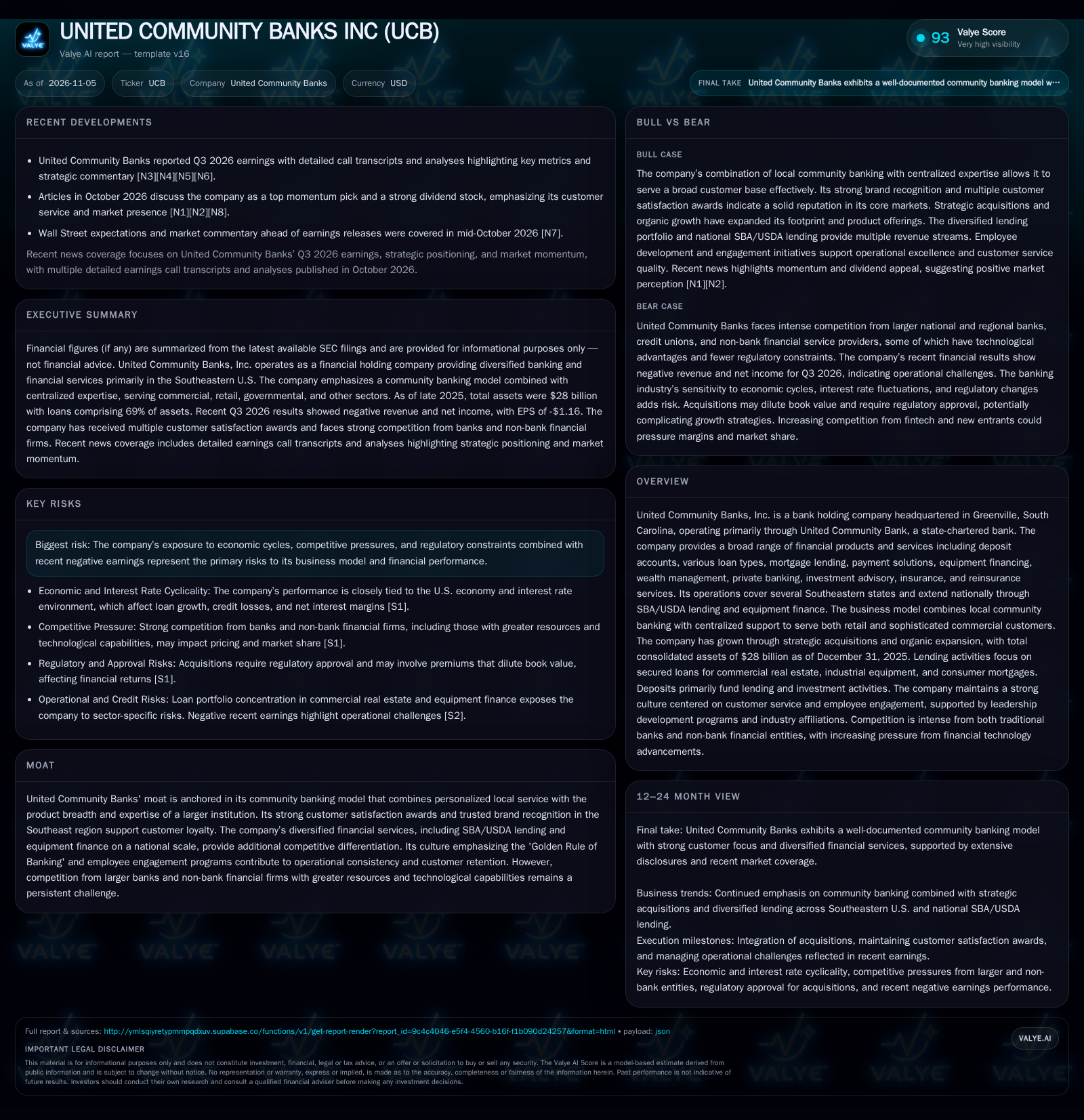
United Community Banks, Inc. operates a $28 billion-asset regional bank with a strong Southeastern U.S. presence, national specialty lending, and a reputation for customer satisfaction. However, Q3 2026 brought negative revenue and a net loss, highlighting operational and margin pressures. The durability of its community banking model will be tested by intensifying competition, technology shifts, and the need for disciplined risk management in a challenging macro environment. [S1] [S2]
United Community Banks, Inc. stands at a strategic crossroads after reporting negative revenue and a substantial net loss in Q3 2026. While the bank’s $28 billion asset base, deep Southeastern roots, and national specialty lending businesses provide breadth, these strengths are being tested by margin compression, competitive encroachment from both traditional and digital challengers, and the operational complexity of a diversified financial platform. The coming quarters will reveal whether UCB’s community-focused approach and customer loyalty can offset macro headwinds and deliver consistent returns.
Strategic Impact of Recent Losses at United Community Banks
United Community Banks reported negative revenue of $11.97 million and a net loss of $139.75 million for Q3 2026, with basic and diluted EPS at -$1.16 per share [S2]. This marked a significant operational setback for an institution that has historically emphasized steady, community-driven growth. As of December 31, 2025, loans comprised 69% of its $28.0 billion in assets, highlighting a business model rooted in lending, particularly secured commercial and real estate loans [S1]. The bank continues to earn customer satisfaction accolades, such as J.D. Power’s best consumer bank in the Southeast and recognition from Forbes [S1]. However, the negative financial results underscore mounting pressures on spreads, credit quality, and possibly cost structure. These developments place a spotlight on UCB's ability to protect its franchise value amid adverse economic and competitive dynamics.
Community Banking Economics: Loan Mix and Margin Trends
United Community Banks generates revenue primarily through the spread between interest earned on loans and investments and interest paid on deposits. With 69% of assets in loans and a deposit-funded balance sheet, net interest margin (NIM) is the principal profit driver [S1]. In the current environment, rising funding costs and competitive loan pricing may have compressed NIMs, contributing to the reported negative revenue in Q3 2026 [S2]. The bank’s loan book is heavily weighted toward secured commercial real estate, equipment finance, and residential mortgages, which can provide stability but also expose the institution to sector-specific credit risks if economic conditions deteriorate. Non-interest income streams—such as mortgage origination, wealth management, insurance, and payment processing—offer diversification, but these businesses often carry higher variable costs and are sensitive to volume swings and fee pressure from fintech competitors. The company’s community banking model, with centralized support, implies some fixed-cost leverage, but scale advantages are limited compared to national peers. Capital requirements remain high due to regulatory standards, and the need to maintain reserves against loan losses can further constrain profitability if credit quality deteriorates.
Rising Competition from Traditional Banks and Fintech Innovators
United Community Banks faces multi-front competition: from large national and regional banks with greater scale and technology budgets, from community banks with local ties, and increasingly from digital-first fintechs and non-bank lenders [S1]. The bank’s customer satisfaction awards and regional brand strength provide some insulation, but these advantages are eroding as digital banking expectations rise and new entrants target high-value segments with lower-cost, tech-enabled offerings. Notably, fintechs and non-traditional banks can often sidestep legacy infrastructure and regulatory burdens, enabling them to undercut fees or deliver more personalized digital experiences. In this landscape, UCB’s efforts to combine local service with centralized expertise are necessary but may not be sufficient to sustain pricing power or defend market share if digital adoption accelerates. The national SBA/USDA and equipment finance businesses offer geographic and product diversification but attract specialized competitors and introduce additional underwriting complexity. The sustainability of UCB’s competitive position will hinge on its ability to innovate, manage risk, and continue delivering a differentiated customer experience.
Potential for Earnings Recovery Through Operational Improvements and Loyalty
A favorable outcome for United Community Banks would see stabilization and recovery in net interest margins, supported by moderating deposit costs and improved loan pricing. If the bank can maintain low credit losses across its secured loan portfolio, particularly in commercial real estate and equipment finance, margin expansion could follow. Continued strength in customer satisfaction, as evidenced by repeat industry awards, would help retain and grow deposit relationships, keeping funding costs competitive. Successful execution in fee-based businesses—such as mortgage origination, wealth management, and payment processing—could provide additional non-interest income buffers. Evidence supporting this scenario would include a return to positive revenue and net income, a rebound in NIM, and stable or improving credit quality metrics. Confirmation would also come from sustained or improved customer satisfaction rankings and retention of key commercial and retail clients.
Managing Credit Risk and Growth Amid Margin Challenges
The most plausible near-term scenario is one in which United Community Banks faces continued margin pressure due to elevated funding costs and competitive loan pricing, offset by gradual improvements in operational efficiency and risk management. Credit quality may remain stable but will require ongoing vigilance, especially given the large exposure to secured commercial loans. Non-interest income streams may provide only modest relief, as fee-based revenues are subject to cyclical swings and competitive pricing. Organic growth in core Southeastern markets could slow as competition intensifies, and national specialty lending may deliver only incremental gains. Evidence confirming this path would include modest improvement in revenue and profitability, stable asset quality metrics, and continued customer satisfaction recognition—but without a dramatic turnaround in earnings. Falsification would come from either a sharp deterioration in credit metrics or a sustained inability to generate positive net income.
Risks of Credit Losses and Cost Inefficiencies Threatening Performance
In a negative scenario, United Community Banks could face rising credit losses, particularly in commercial real estate or equipment finance as economic headwinds persist or worsen. If deposit competition continues to drive up funding costs while loan yields remain compressed, net interest margins could stay negative or decline further. Non-interest income might not be able to offset these pressures if mortgage origination volumes fall or if fee-based businesses are squeezed by fintech competitors. Additionally, fixed operating costs and integration expenses from prior acquisitions could limit the bank’s flexibility to adjust quickly. Evidence supporting this scenario would include further quarters of negative revenue or net income, rising non-performing loan ratios, and potential downgrades in customer satisfaction or brand perception. Regulatory scrutiny or capital adequacy concerns could also emerge if losses persist.
Indicators of Sustainability for United Community Banks’ Business Model
Quarterly trends in net interest margin (NIM) and their drivers—particularly the spread between loan yields and deposit costs—will be essential to monitor.
Credit quality indicators such as non-performing asset ratios, charge-offs, and loan loss provisions, especially in commercial real estate and equipment finance, if disclosed.
Quarterly loan growth or contraction by segment, indicating whether the bank is gaining or losing share in core and specialty lending.
Deposit retention and composition—shifts in demand, savings, and time deposits, and any evidence of rising funding costs.
Non-interest income performance, particularly in mortgage origination, wealth management, and payment processing businesses.
Customer satisfaction and retention metrics, including continued recognition from J.D. Power or other industry benchmarks.
Operating expense trends and any disclosures about cost restructuring, efficiency initiatives, or integration costs from recent acquisitions.
Disclaimer: This is research-only, informational analysis and not investment advice. It may include AI-generated interpretation and general industry context. Always verify important details using primary sources.

Comments