
Hamilton Beach: Tariff Impacts, Operational Scale, and Product Mix Shape Market Position
Recent profitability improvements at Hamilton Beach Brands stem from both tariff refunds and operational execution, but sustained performance will depend on the company’s ability to manage cost pressures, defend its brand position, and adapt to shifting consumer and commercial demand patterns.
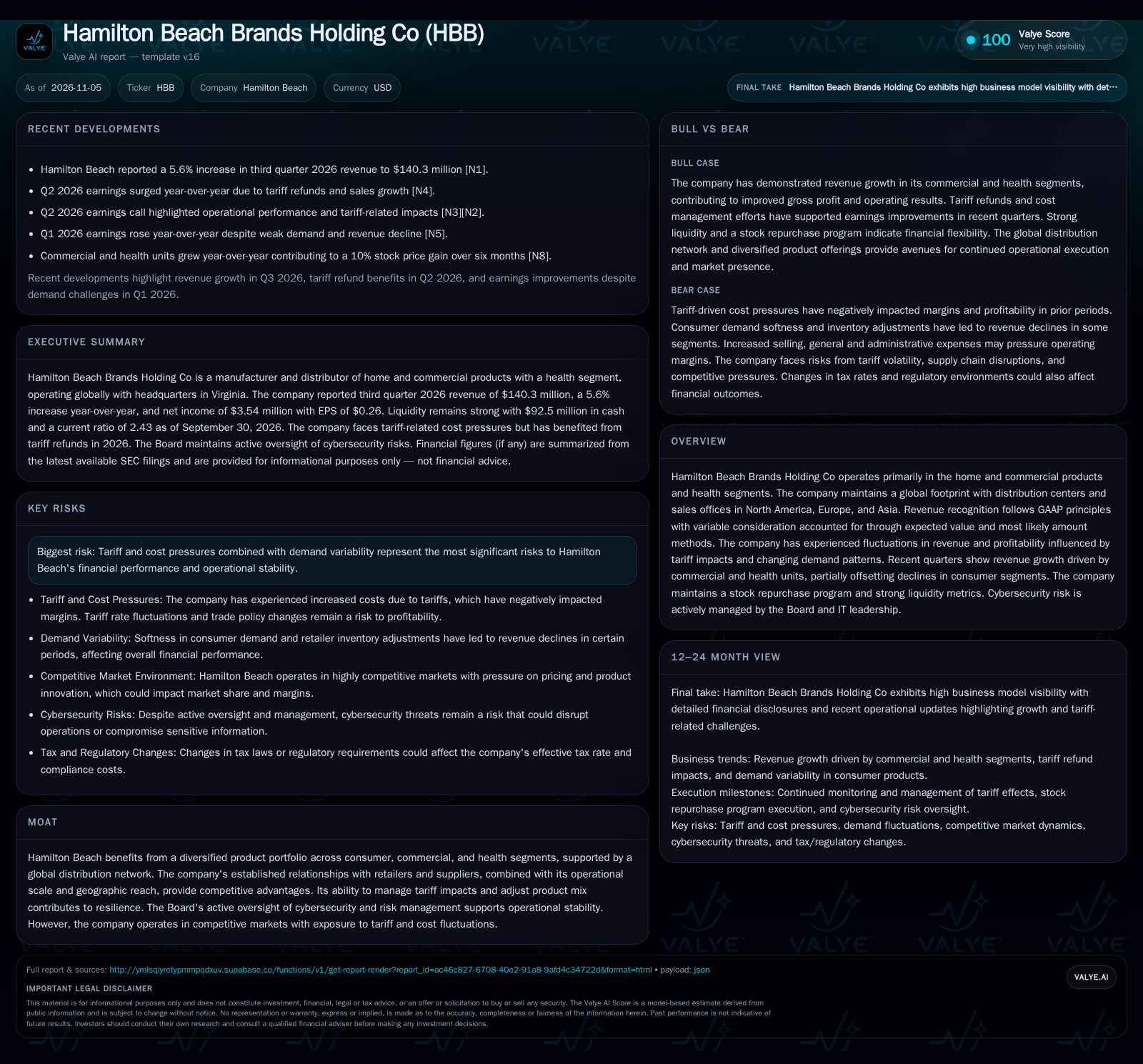
Hamilton Beach Brands reported a 5.6% revenue increase in Q3 2026 and improved gross profit for the first nine months, aided by tariff refunds and contributions from commercial and health segments. However, higher selling and administrative expenses, ongoing tariff risk, and intense competition create uncertainty for future margin expansion and demand stability. [S2] [N1] [N4] [N8]
Hamilton Beach Brands has demonstrated resilience in 2026, posting revenue and gross profit gains despite persistent tariff pressures and demand fluctuations. The company’s diversified portfolio—spanning home, commercial, and health products—and global distribution infrastructure have enabled it to capture pockets of growth, particularly in its commercial and health segments. However, escalating operating expenses, ongoing exposure to trade policy shifts, and a fiercely competitive landscape mean that recent financial improvements may not be fully indicative of future profitability. The strategic question for investors is whether Hamilton Beach can sustain margin expansion and defend its market position as external headwinds and internal cost pressures persist.
2026 Revenue Growth and Margin Recovery Explained
Hamilton Beach reported third quarter 2026 revenue of $140.3 million, up 5.6% year-over-year, and gross profit for the first nine months of $152.2 million compared to $95.9 million in the prior period, signaling a substantial improvement in profitability [N1] [S2]. Earnings for Q2 2026 were buoyed by tariff refunds, and the company’s commercial and health units were cited as key contributors to recent top-line expansion [N4] [N8]. However, selling, general, and administrative expenses rose in 2026, reflecting either investment in growth or higher underlying costs [S2]. Cash and cash equivalents stood at $92.5 million with a current ratio of 2.43 as of September 30, 2026 [S2]. The company also initiated a new $25 million stock repurchase program effective through 2027 [S1]. These developments matter because they reflect both tactical wins (tariff relief, segment growth) and ongoing structural challenges (cost inflation, competitive intensity) that will shape future outcomes.
Hamilton Beach’s Earnings Structure: Fixed Costs, Variable Factors, and Capital Use
Hamilton Beach’s business model relies on manufacturing and distributing a broad range of home and commercial appliances, with revenues recognized upon transfer of goods and variable consideration (such as returns and price concessions) factored into the accounting [S1]. The company’s cost structure typically features a mix of fixed overhead (manufacturing, distribution, IT, and management) and variable input costs (materials, logistics, tariffs). Operating leverage is evident: when volume rises or tariff relief occurs, incremental gross profit can expand meaningfully, as seen in the sharp year-over-year gross profit jump for 2026 [S2].
However, the recent increase in SG&A expenses suggests that either cost inflation or investments in sales, marketing, or digital infrastructure are offsetting some operational gains [S2]. The company reported cash and liquidity metrics for the period; these figures do not by themselves establish operating runway, investment capacity, financial flexibility, or financing capacity. Capital is not especially burdensome for a consumer appliance business, but supply chain disruptions or prolonged tariff escalation could alter working capital needs and compress margins. The degree to which Hamilton Beach can pass through cost increases or optimize product mix will determine future profitability.
Assessing the Strength of Hamilton Beach’s Competitive Edge in Appliances
Hamilton Beach operates in highly competitive consumer and commercial appliance categories, facing rivals ranging from global conglomerates to specialized upstarts. Its competitive advantages historically include a broad product portfolio across home, commercial, and health segments, established retail relationships, global sourcing and distribution, and a recognized brand. The company’s geographic reach—spanning North America, Europe, and Asia—offers some insulation from single-market volatility and supports sourcing flexibility [S1].
However, these advantages are countered by pricing pressure, the commoditization of many product categories, and the risk that retailers or end customers trade down to lower-cost alternatives during periods of economic uncertainty. Tariff volatility is a structural threat, as it can quickly erode gross margins if not offset through price actions or supply chain adjustments. There is also the risk of technology substitution (e.g., smart appliances or IoT-enabled devices) shifting demand away from traditional offerings. The company’s ability to defend shelf space, maintain retailer mindshare, and innovate in response to evolving consumer preferences will be tested as industry dynamics evolve.
Potential for Margin Growth and Market Share Gains to Boost Valuation
The most favorable scenario for Hamilton Beach involves a sustained easing of tariff pressures, continued strong performance in the commercial and health segments, and successful cost discipline—allowing gross and operating margins to expand. If the company can leverage its scale to negotiate better input pricing or further automate its supply chain, incremental volume growth could drive outsized profit gains due to operating leverage. Accelerated growth in health or commercial product lines, where competition may be less intense or where the company can offer differentiated solutions, would also support premium pricing and higher margins.
Confirmation of this scenario would require evidence of continued gross margin improvement even if tariffs normalize, stable or declining SG&A as a percentage of revenue, and clear signs that new products or categories are gaining traction over commoditized legacy offerings. Additionally, if the company can demonstrate recurring revenue streams—perhaps through service contracts, consumables, or digital offerings in the health or commercial space—this would further strengthen the bull case.
Performance Outlook Amid Tariff Changes and Demand Variability
A more probable scenario is that Hamilton Beach continues to experience moderate revenue growth, but with margins fluctuating in response to the external environment. Tariff relief may not be permanent, and the company could face renewed cost inflation or supply chain bottlenecks. Top-line growth could be driven by periodic strength in commercial and health segments, offset by cyclical or structural softness in core consumer appliances as customers adjust to economic conditions.
Operating expenses are likely to remain elevated as the company invests in digital transformation, cybersecurity, and product development. Confirmation of this scenario would include stable (but not expanding) gross margins, continued investment in SG&A, and revenue growth tracking in the low- to mid-single digits. Falsification would occur if either cost pressures escalate without offsetting price increases, or if demand in key segments deteriorates more rapidly than anticipated.
Risks of Margin Pressure from Tariff Renewals and Consumer Slowdown
The adverse scenario for Hamilton Beach involves a resurgence of tariff-related costs, significant supply chain disruptions, or a pronounced decline in consumer and retailer demand. If the company is unable to pass through higher input costs or if SG&A continues to rise out of proportion to revenue, operating margins could contract sharply. Retailers may further rationalize inventory, push for price concessions, or shift shelf space to private label or lower-cost competitors—undermining both revenue and profitability.
Further, if technological shifts or changes in consumer preferences accelerate away from Hamilton Beach’s core categories, the company could lose relevance or be forced into costly reinvestment cycles. This scenario would be confirmed by declining gross and operating margins, negative operating cash flow, or evidence of inventory build-up and working capital strain. A persistent drop in commercial and health segment growth would also signal the thesis is breaking down.
Operational and Strategic Developments Defining Hamilton Beach’s Trajectory
Track quarterly gross margin trends to determine whether cost improvements or tariff relief are sustainable, especially as tariff environments evolve.
Monitor SG&A expenses relative to revenue; persistent increases without clear ROI would suggest cost discipline issues or margin risk.
Segment-level revenue and margin disclosures (if provided), particularly for commercial and health, would clarify the drivers of growth and resilience.
Watch the cadence and magnitude of stock repurchases under the new $25 million program as an indicator of management’s capital allocation priorities.
Regularly assess inventory and working capital levels for signs of supply chain disruption or demand misalignment—a spike could presage margin compression.
Follow new product launches, digital initiatives, or moves into recurring revenue models, as these would help test the company’s ability to innovate beyond commoditized categories.
Evaluate external signals of retailer or customer concentration risk, such as changes in major retail relationships or shifts in shelf space allocation, if disclosed.
Monitor management commentary and board actions on cybersecurity oversight, given the increasing operational and reputational risks in this area.
Disclaimer: This is research-only, informational analysis and not investment advice. It may include AI-generated interpretation and general industry context. Always verify important details using primary sources.

Comments