
Energy Fuels: Strategic Expansion in Uranium and Rare Earths Faces Execution and Environmental Hurdles
Energy Fuels Inc. leverages its unique White Mesa Mill to pursue a leading role in U.S. uranium and rare earth element supply. While recent acquisitions and planned processing enhancements aim to capture clean energy tailwinds, the company must navigate environmental remediation liabilities, campaign-based operations, and volatile markets to realize sustainable profitability.
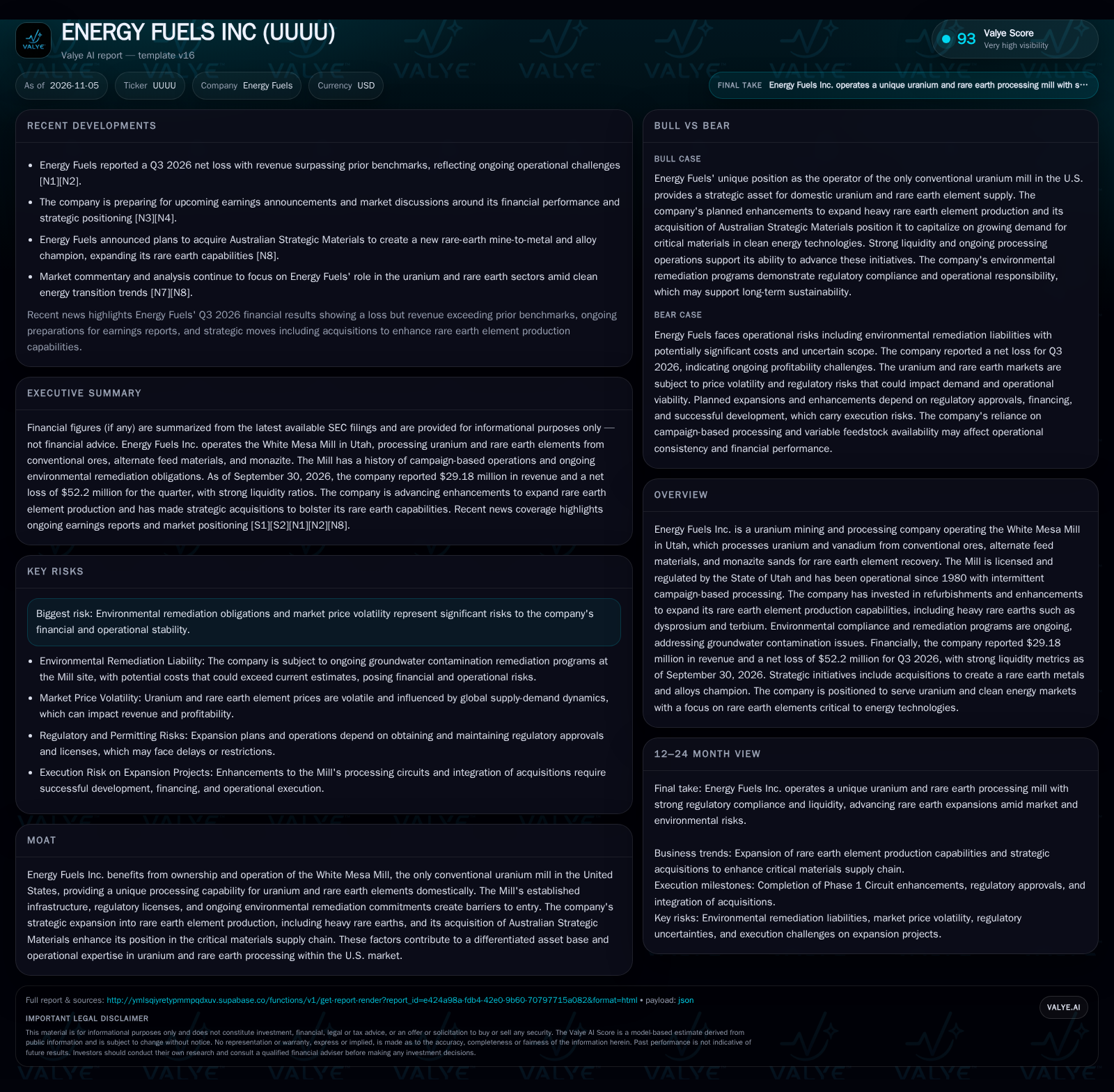
Energy Fuels operates the only conventional uranium mill in the U.S., with expanding rare earth capabilities and reported liquidity position. Strategic moves—including the planned acquisition of Australian Strategic Materials and upgrades to the White Mesa Mill—position the company to serve critical material supply chains. However, operational losses, environmental remediation costs, and campaign-based processing highlight the execution and market risks ahead. [S1] [S2] [N1] [N2] [N8]
Energy Fuels Inc. stands at a crossroads between legacy uranium processing and an ambitious bid to become a North American leader in rare earth elements (REEs)—both crucial for the clean energy transition. Its White Mesa Mill in Utah is a strategic asset, uniquely licensed and equipped to process uranium, vanadium, and monazite sands for REE recovery. The next phase of execution, including the integration of a major Australian acquisition and the expansion of heavy REE output, will likely determine whether Energy Fuels can translate its asset base into durable economic returns.
Recent Results Highlight Strategic Initiatives and Persistent Profitability Challenges
Energy Fuels reported $29.18 million in revenue and a net loss of $52.2 million for Q3 2026, with basic and diluted EPS of -$0.20. The company ended September 2026 with $76.4 million in cash and equivalents, current assets of $980 million, and current liabilities of $47.8 million, yielding a current ratio of 20.49 and a cash ratio of 1.64. This snapshot underscores the company’s reported liquidity position. [S2]
Operationally, Energy Fuels continues to run the White Mesa Mill on a campaign basis, recovering approximately 1,015,000 pounds of U3O8 in 2025 from alternate feeds and conventional ore. The Mill is also being upgraded to expand commercial-scale recovery of heavy rare earth elements, with plans to process up to 10,000 tonnes of monazite per year by 2027. [S1]
Strategically, the company announced the planned acquisition of Australian Strategic Materials to create a vertically integrated rare earth mine-to-metal and alloy champion, aiming to enhance its presence in the critical materials supply chain. [N8]
Environmental remediation remains an ongoing concern, with the Mill subject to a Groundwater Discharge Permit and active programs addressing chloroform and nitrate/chloride contamination. The costs and scope of these obligations could be significant. [S1]
How Energy Fuels’ Asset Base and Processing Model Influence Its Economics
Energy Fuels’ revenue comes primarily from processing uranium ores (conventional and alternate feeds) and, increasingly, monazite sands for rare earth element recovery. The White Mesa Mill is a capital-intensive asset with historically campaign-based (non-continuous) operations, leading to variable utilization rates and cost absorption. This structure can result in operating leverage during periods of strong throughput but exposes the company to under-absorption of fixed costs during lulls.
Uranium and rare earth elements are both subject to highly cyclical, price-sensitive markets. Uranium revenues are sensitive to long-term contracting cycles and spot price volatility, while rare earth revenues—particularly from NdPr and heavy REEs—depend on both volume ramp and successful separation/purification at commercial scale. The mix between uranium, vanadium, and REEs in any period affects margin profile, as each has distinct processing costs and market pricing.
The planned expansion to process up to 10,000 tonnes of monazite per year (targeting 2027) could provide volume leverage in rare earths, but requires successful capital deployment, technical execution, and downstream market access. The acquisition of Australian Strategic Materials, if completed and integrated, could enhance vertical integration, potentially improving margins and supply chain control but also increasing capital requirements and integration risk. [N8]
Environmental remediation obligations are a persistent and material cost center, with ongoing groundwater cleanup programs that may impact cash flows and future capital allocation. [S1] [S2]
Unique U.S. Processing Footprint, but Facing Global and Domestic Counterforces
Energy Fuels’ primary competitive advantage is its ownership and operation of the White Mesa Mill—the only conventional uranium mill in the United States. This confers unique value in a market where domestic processing capacity is scarce and energy security concerns are rising. The Mill’s regulatory licenses, operational history, and ability to process both uranium and REEs create barriers to entry for would-be competitors. [S1]
The strategic move into rare earths—especially heavy REEs like Dy, Tb, Sm, Eu, and Gd—positions Energy Fuels to address U.S. supply chain vulnerabilities. However, global competitors in China and emerging projects in Australia and Canada possess scale, technical expertise, and established customer relationships, which may limit pricing power and market share gains unless Energy Fuels can demonstrate reliable, high-purity output at scale.
Domestically, Energy Fuels faces competition from other uranium miners, advanced nuclear fuel cycle projects, and alternative REE developers. While its vertical integration ambitions (post-Australian Strategic Materials acquisition) could differentiate its offering, success will depend on execution, cost competitiveness, and the ability to meet evolving regulatory and customer standards.
Environmental liabilities and the intermittent nature of campaign-based processing could be sources of relative disadvantage, particularly if remediation costs escalate or operational consistency lags peers.
Capturing Clean Energy Tailwinds Through Rare Earth Expansion and Vertical Integration
A favorable outcome for Energy Fuels would see the company successfully ramping up heavy rare earth element (REE) production at the White Mesa Mill, achieving commercial-scale throughput of up to 10,000 tonnes of monazite annually by 2027. If the acquisition of Australian Strategic Materials is completed and integrated smoothly, Energy Fuels could become a vertically integrated mine-to-metal and alloy supplier, capturing more margin along the value chain and offering customers a domestic, secure source of critical materials. [N8]
This scenario would likely be enabled by: (1) sustained or rising demand for uranium and REEs driven by clean energy deployment (e.g., nuclear power, electric vehicles, wind turbines); (2) successful environmental management keeping remediation costs contained; (3) stable or improving operating margins as throughput increases and fixed costs are spread over greater volumes.
Evidence that would confirm this scenario includes: sustained sequential growth in rare earth production volumes, successful commissioning of the upgraded Phase 1 Circuit, margin improvement in reported results, and customer or offtake agreements with major U.S. or allied manufacturers. Additional confirmation would come from regulatory approvals for expansion and positive integration milestones with the Australian acquisition.
Operating Between Opportunity and Constraint: Variable Throughput, Gradual REE Ramp, and Ongoing Remediation
The most plausible path for Energy Fuels is one of gradual progress, with campaign-based uranium and vanadium processing continuing to provide intermittent revenue, while rare earth element enhancements are brought online in phases. Regulatory, technical, and market hurdles slow—but do not derail—the ramp of REE production, with initial heavy REE output achieved but commercial scale and margin expansion proving slower than projected.
Environmental remediation costs remain a recurring drag on free cash flow, and campaign-based processing leads to quarter-to-quarter variability in financial results.
This scenario would be confirmed by continued quarterly losses (albeit narrowing over time), modest growth in REE output, and steady but unspectacular progress on expansion milestones and integration of new assets. Evidence that would challenge this scenario includes either a sudden, sustained improvement in rare earth margins and volumes, or a material escalation in remediation costs or regulatory setbacks.
Execution Shortfalls and Environmental Liabilities Undermine Expansion Ambitions
The adverse scenario sees Energy Fuels struggling to deliver on its rare earth expansion plans. Technical setbacks in processing or integration, delays in regulatory approvals, or cost overruns in upgrading the White Mesa Mill could limit throughput and erode intended margin gains. If the acquisition of Australian Strategic Materials faces integration challenges or fails to deliver expected synergies, the company could face increased costs without offsetting revenue.
Escalating environmental remediation obligations—particularly if groundwater contamination proves more extensive or costly than projected—could consume cash, divert management attention, and constrain capital available for growth projects. Meanwhile, continued campaign-based processing could result in persistent under-utilization of fixed assets and operating losses.
This downside would be confirmed by: widening net losses, rising environmental provision expenses, delays in REE output ramp, missed expansion milestones, or a need to raise additional capital to fund operations or remediation. Regulatory or market shocks (e.g., sharp declines in uranium or REE prices) would amplify these pressures.
Milestones and Metrics That Will Define Energy Fuels’ Rare Earth and Uranium Trajectory
Quarterly rare earth element (REE) production volumes—especially heavy REEs (Dy, Tb, Sm, Eu, Gd)—will indicate success or challenges in the Mill’s expansion and process upgrades.
Progress toward processing up to 10,000 tonnes of monazite per year by 2027: announcements, engineering milestones, and regulatory filings would help test the path to scale.
Environmental remediation cash outflows and provisions: sustained or rising costs here could materially impact free cash flow and capital allocation.
Updates on the acquisition and integration of Australian Strategic Materials, including realized synergies, cost savings, and new customer agreements.
Securing long-term offtake contracts or supply agreements with U.S. or allied end-users for uranium and rare earths would indicate improved revenue visibility.
Margins and earnings trend: evidence of sustained improvement in operating margin or narrowing net losses would support a thesis of improving economics.
Any regulatory or permitting developments—positive or negative—impacting the White Mesa Mill’s operating or expansion status.
Disclaimer: This is research-only, informational analysis and not investment advice. It may include AI-generated interpretation and general industry context. Always verify important details using primary sources.

Comments