
ThredUp’s Resale Platform: Margin Expansion Ambitions, Regulatory Frictions, and the Stakes of Automation
ThredUp’s record quarterly results and automation focus signal operational progress, but persistent net losses, regulatory complexity, and exposure to payment fraud and asset impairments anchor the company’s risk profile. The core challenge remains: can a scale-driven, tech-enabled resale platform deliver durable profitability in a highly regulated, price-sensitive market?
Regulatory risks, exposure to payment fraud, and asset impairments complicate the path to sustainable profitability. The central question is whether scale and operational enhancements can overcome these structural headwinds and deliver lasting margin expansion. [S2] [N3]
ThredUp Inc. stands at a crossroads between operational momentum and persistent structural challenges. The company’s latest quarter delivered record revenues and signaled progress in automating and refining its logistics-heavy apparel resale platform. Yet, net losses continue, liquidity is tight, and the regulatory environment remains complex and unpredictable. With increasing price sensitivity among consumers and mounting compliance burdens, ThredUp’s ability to translate scale and technology investments into sustainable margin gains will determine its long-term viability.
Recent Results Reveal Both Momentum and Structural Constraints
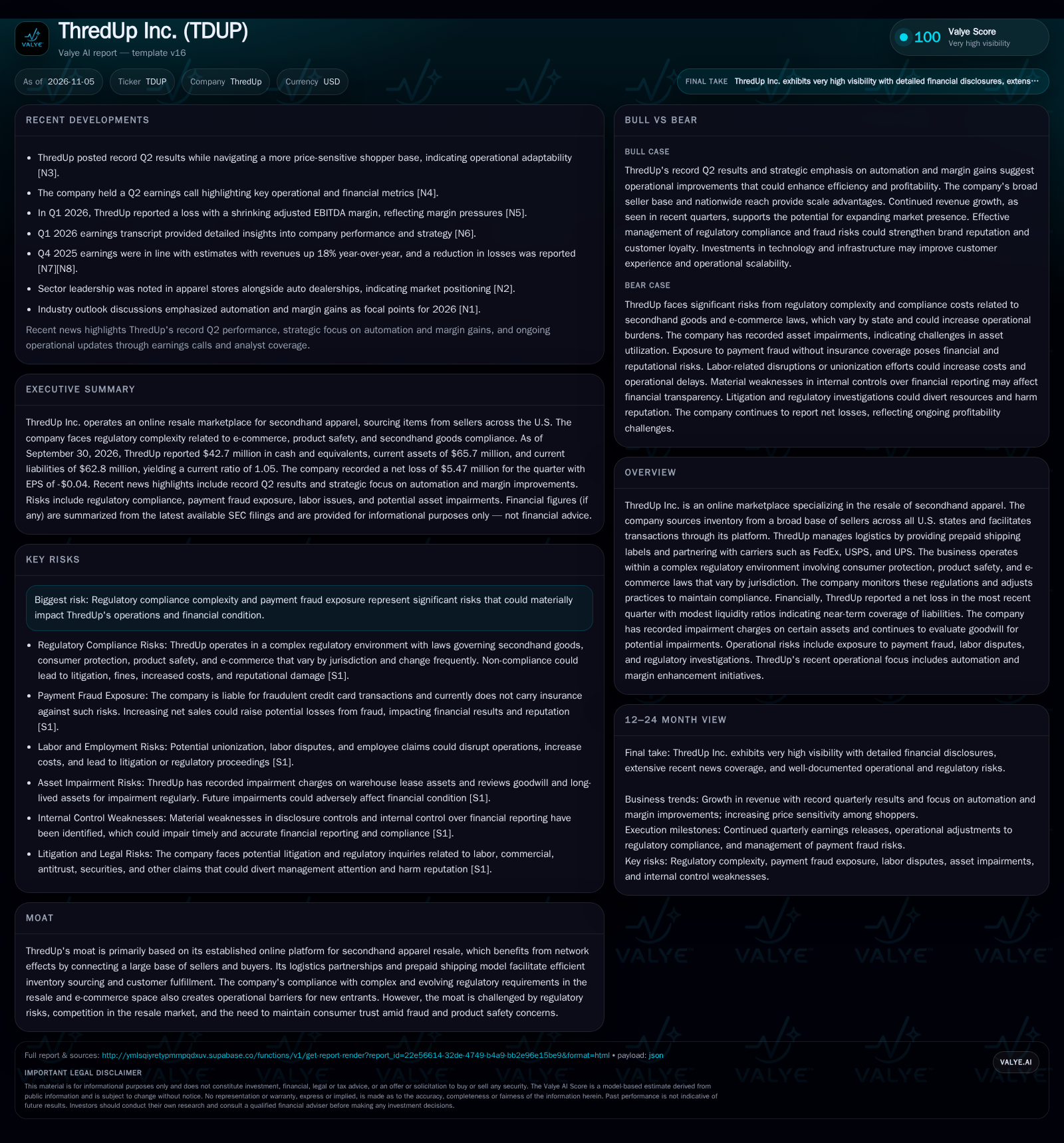
ThredUp reported a net loss of $5.47 million for the quarter ended September 30, 2026, with basic and diluted EPS of -$0.04. Cash and cash equivalents stood at $42.7 million, yielding a current ratio of 1.05 and a cash ratio of 0.68. The company reported cash and liquidity metrics for the period; these figures do not by themselves establish operating runway, investment capacity, financial flexibility, or financing capacity. [S2]
The company posted record Q2 results earlier in the year, a sign of operational adaptability despite increased price sensitivity among its shopper base. Management has emphasized automation and margin improvement as strategic priorities, responding to margin pressures highlighted in recent quarters. [N3] [N4] [N5]
ThredUp’s exposure to regulatory complexity, payment fraud (with no insurance coverage), and asset impairments continues to weigh on its risk and cost profile. Material weaknesses in internal controls over financial reporting have also been identified in the past. [S1] [S2]
How ThredUp’s Platform Seeks Profitable Scale—And Where the Frictions Lie
ThredUp’s business model centers on aggregating secondhand apparel from a dispersed network of individual sellers, processing and listing items on its online marketplace, and fulfilling orders to buyers nationwide. Revenue is generated primarily from sales commissions and fees, with the company facilitating logistics by providing prepaid shipping labels and leveraging third-party carriers.
The model is operationally intensive: fixed costs include warehousing, processing, technology infrastructure, and compliance, while variable costs encompass shipping, payment processing, and customer service. Theoretically, as sales volumes increase, fixed costs could be leveraged more efficiently, driving margin expansion. However, the need for physical inspection, handling, and storage of unique, one-off items makes true automation and unit cost reduction challenging compared to digital marketplaces or traditional retail.
Pricing power is limited by the price-sensitive nature of secondhand shoppers and the abundance of alternative resale channels. Volume growth depends on both consumer demand for affordable fashion and the willingness of individuals to consign or sell their items, which can be cyclical and sensitive to macroeconomic trends.
Recent strategic emphasis has been on automation—using technology to streamline intake, sorting, and fulfillment processes. If successful, these initiatives could reduce per-unit labor costs and improve gross margins. Yet, the need for ongoing investment in compliance, fraud prevention, and technology creates continued capital requirements. Without a clear path to durable operating leverage, profitability remains elusive.
Navigating a Crowded Resale Landscape and Regulatory Headwinds
ThredUp competes with a spectrum of secondhand and consignment platforms, including peer-to-peer marketplaces, vertically integrated resellers, and traditional thrift retailers moving online. While ThredUp’s national logistics platform and established brand create some barriers to entry, network effects are limited by low switching costs—sellers and buyers can easily use competing platforms for similar goods.
The regulatory environment acts as both a barrier and a drag. Compliance with a patchwork of state and local laws governing secondhand goods, consumer protection, and product safety requires substantial resources and creates operational risk. For smaller entrants, these hurdles may be prohibitive, but for ThredUp, they translate into ongoing cost and complexity.
Alternative channels—such as direct listing apps, donation-based models, and local consignment stores—continue to threaten margins and limit ThredUp’s pricing flexibility. The company’s exposure to payment fraud and lack of insurance further heighten relative risk, particularly as competitors invest in their own fraud prevention and automation capabilities.
If Automation and Scale Unlock Margin Expansion: What Would Signal a Structural Shift?
The favorable scenario for ThredUp hinges on successful execution of automation initiatives and continued revenue growth, leading to meaningful margin expansion. If technology investments enable substantial reductions in per-unit labor and logistics costs—while maintaining or improving customer experience—gross margins could rise even in a price-sensitive environment.
Signs that this scenario is playing out would include: sequential improvement in adjusted EBITDA margins, narrowing net losses, and evidence that automation is driving measurable reductions in cost of goods sold and fulfillment expenses per unit. Sustained double-digit revenue growth, coupled with stable or improving gross margins, would indicate that scale is translating to profitability.
Additional confirmation would come from improved internal controls, reduced asset impairments, and evidence that regulatory and fraud-related costs are being contained as a percentage of revenue.
Operational Progress Tempered by Enduring Margin and Compliance Headwinds
The most plausible trajectory for ThredUp over the next 12-24 months is continued revenue growth and incremental margin improvement, offset by persistent regulatory, operational, and cost pressures. Automation may yield some efficiencies, but high fixed and variable costs—combined with a need for ongoing compliance and risk management—are likely to limit the pace and extent of margin gains.
Net losses may narrow, but the company could remain unprofitable absent a step-change in either top-line growth or cost structure. Periodic asset impairments, payment fraud losses, and compliance-related expenses will continue to weigh on results, especially if consumer price sensitivity intensifies or macroeconomic conditions deteriorate.
When Compliance, Fraud, and Asset Impairments Overwhelm Operating Gains
The adverse scenario unfolds if regulatory complexity escalates—through new state or federal rules, enforcement actions, or litigation—driving up compliance costs and operational disruptions. Significant payment fraud incidents or labor disputes could result in unanticipated financial losses and reputational harm.
If automation initiatives stall, or if savings are offset by rising compliance and risk management costs, ThredUp could see margins stagnate or contract. Additional asset impairments—particularly for warehouse leases or technology investments—would further erode equity and investor confidence.
Evidence of this scenario would include widening net losses, negative operating cash flow, additional asset impairment charges, regulatory investigations, or a material increase in fraud-related write-offs. Liquidity could become a concern if current ratios deteriorate or access to external capital tightens.
Milestones That Will Determine ThredUp’s Margin and Compliance Trajectory
Sequential trends in adjusted EBITDA and gross margin—especially any inflection points attributable to automation or process improvements—would help test whether operational leverage is taking hold.
Disclosure of per-unit fulfillment and processing costs, if provided, would clarify the impact of automation and scale on cost structure.
The frequency, magnitude, and nature of asset impairment charges—particularly for warehouses and technology—should be monitored for signs of underutilization or overinvestment.
Updates on regulatory investigations, litigation, or changes in compliance costs will be critical for assessing operational risk and future expense burdens.
Any material payment fraud incidents, write-offs, or disclosure of new insurance coverage (if adopted) would shift the risk profile.
Employee turnover rates, labor dispute disclosures, or unionization efforts could signal potential operational disruptions.
Progress on remediating past internal control weaknesses, as evidenced by clean audit opinions or improved disclosure, would bolster confidence in financial reporting.
Disclaimer: This is research-only, informational analysis and not investment advice. It may include AI-generated interpretation and general industry context. Always verify important details using primary sources.

Comments