
Varonis Systems: SaaS Transformation, Product Expansion, and the Stakes of a $6.3B Privatization
Varonis Systems’ rapid SaaS transition, expanding data security portfolio, and robust renewal rates position it for long-term relevance in the enterprise security market. The pending $6.3 billion Proofpoint acquisition and the end-of-life for self-hosted products introduce both opportunity and revenue variability, testing the company’s operational discipline and customer loyalty as it moves to an all-SaaS future.
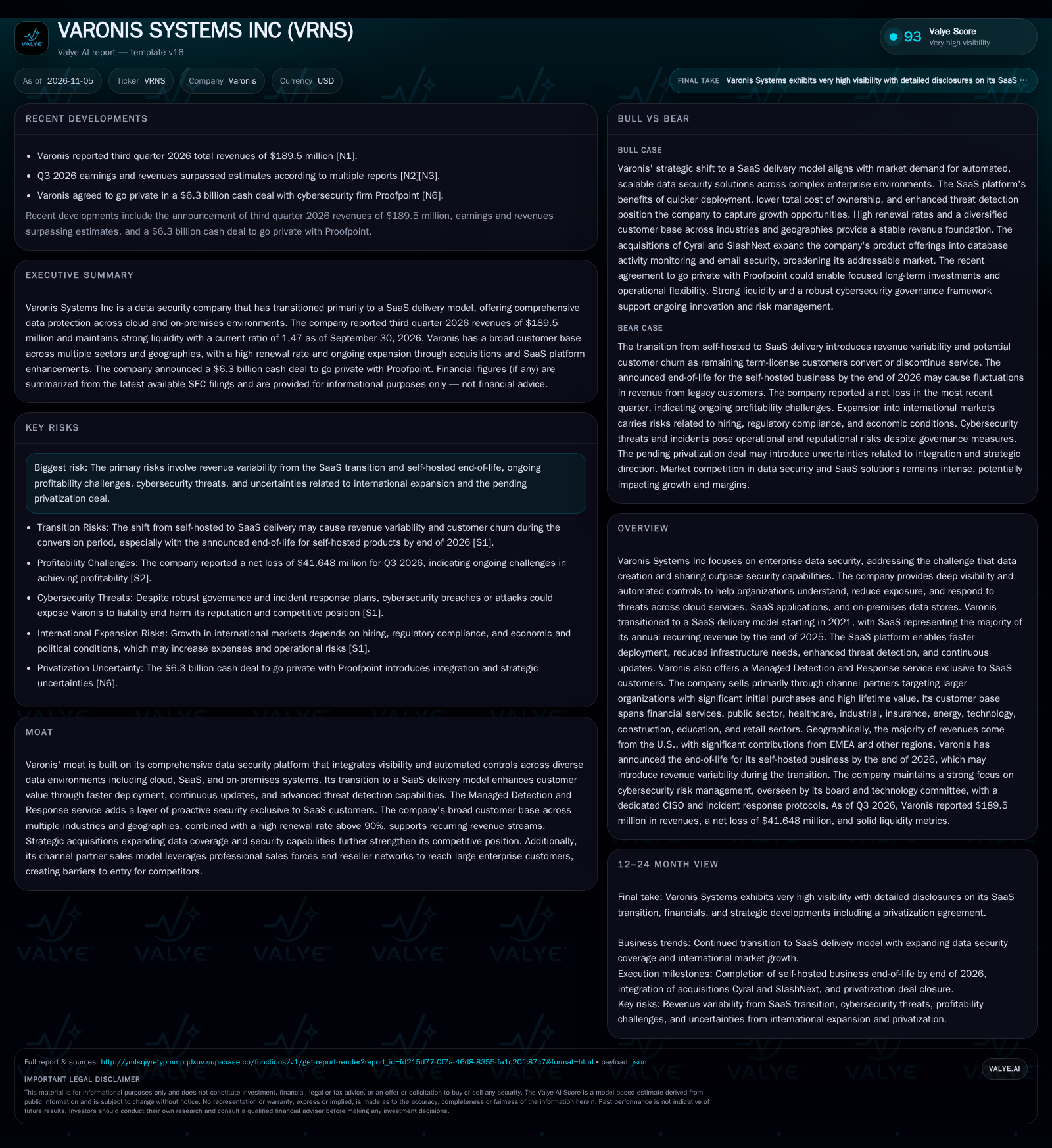
Varonis Systems has achieved 86% SaaS ARR and 13% annual revenue growth, underpinned by high renewal rates and major acquisitions expanding its security portfolio. The announced $6.3B buyout by Proofpoint and the phase-out of self-hosted offerings by end-2026 set the stage for a pivotal transition period, with revenue and customer retention dynamics in sharp focus. Sustainable margins and integration success will hinge on SaaS adoption, execution of new services, and Proofpoint’s strategic stewardship.
Varonis Systems is at a transformative crossroads. Having completed a rapid pivot from on-premises software to a SaaS-first business, it now derives the vast majority of recurring revenue from cloud-based subscriptions. This shift, coupled with targeted M&A that expands its coverage into critical adjacencies like database and email security, has fueled solid revenue growth and retention metrics. Yet, the company faces a crucial test: the impending sunset of its self-hosted business and its $6.3 billion privatization by Proofpoint will force Varonis to prove that its SaaS model can deliver sustainable economics, defend customer loyalty, and integrate new offerings in a fiercely competitive market.
SaaS Adoption, Revenue Growth, and Major Strategic Moves Define the Present
Varonis Systems has reached a significant milestone in its SaaS transformation, with approximately 86% of total annual recurring revenue (ARR) sourced from SaaS offerings as of December 2025 [S1]. This transition underpins a reported 13% revenue growth for the year ended December 31, 2025, even as the company navigates accounting variations tied to the SaaS shift [S1]. The company’s Q3 2026 revenue was $189.5 million, and renewal rates have remained above 90%, supporting the durability of its subscription model [S1] [N1]. In 2025, Varonis expanded its product breadth by acquiring Cyral (database activity monitoring) and SlashNext (email and collaboration app security), broadening its relevance in enterprise security [S1]. Strategically, the company announced a $6.3 billion cash acquisition by Proofpoint, signaling a pivotal forthcoming change in ownership and operational direction [N6]. The phase-out of self-hosted products by end-2026 will further accelerate SaaS adoption but may introduce near-term revenue variability as legacy customers transition or churn [S1].
Shifting Economics: SaaS Model, Margin Structure, and the Path to Profitability
Varonis’ pivot to a SaaS-first model fundamentally alters its revenue recognition, cost structure, and unit economics. SaaS delivery typically emphasizes high upfront customer acquisition costs but offers improved gross margins over time, driven by lower support and infrastructure requirements, faster deployment, and the potential for automated upselling. The company’s 90%+ renewal rates suggest a recurring revenue engine with long customer lifetimes, which can support high gross margins once scale is achieved [S1]. However, the company reported a net loss of $41.648 million for Q3 2026, indicating that profitability remains elusive, likely reflecting continued investment in R&D, sales, and cloud infrastructure during the transition phase [S2]. The Managed Detection and Response (MDDR) service, available only to SaaS customers, could improve wallet share and stickiness, but its margin profile will depend on automation versus human input. With the end-of-life for self-hosted products imminent, Varonis will need to manage churn, conversion incentives, and pricing strategies to maximize ARR while minimizing disruption to cash flow. The company reported cash and liquidity metrics for the period; these figures do not by themselves establish operating runway, investment capacity, financial flexibility, or financing capacity. [S2]
Defending Share in a Crowded and Evolving Enterprise Security Landscape
Varonis operates in an intensely competitive sector, facing both established cybersecurity vendors and cloud-native challengers. Its core differentiation lies in deep data visibility, automated controls, and the breadth of coverage across cloud, SaaS, and on-premises environments [S1]. The recent acquisitions of Cyral and SlashNext expand its addressable market and allow cross-selling into database and email security, areas where adjacent competitors also invest heavily. Varonis’ channel-driven sales model targets large enterprises, leveraging partners to access complex accounts with high initial deal sizes and potential for upsell. However, the SaaS transition reduces switching frictions for some customers—cloud-native competitors may offer faster onboarding or more modular pricing, increasing the risk of churn if Varonis’ value proposition is not continually refreshed. The company’s high renewal rates and industry-diverse customer base suggest some resilience, but maintaining this edge will require ongoing feature velocity, integration, and pricing discipline, especially as Proofpoint’s integration strategy unfolds.
If SaaS Conversion Accelerates and New Offerings Gain Traction, Margin Expansion Could Follow
A favorable scenario for Varonis would see a smooth transition of remaining self-hosted customers to its SaaS platform, preserving the high renewal rates and minimizing ARR contraction during the conversion window. Successful integration of Cyral and SlashNext could open new cross-selling opportunities, increasing average deal size and deepening customer stickiness. The Managed Detection and Response service, if scaled efficiently, could drive incremental ARR and differentiate Varonis in a crowded MDR market. If Proofpoint’s operational support accelerates investment in go-to-market or product, Varonis could achieve margin expansion by leveraging scale, higher attach rates, and reduced customer acquisition costs. Confirmation would come from continued double-digit ARR growth post-2026, improving gross and operating margins, and evidence of expanded share-of-wallet within existing enterprise accounts. Falsification would be signaled by a stall in SaaS ARR growth or a noticeable decline in renewal rates as self-hosted customers exit rather than convert.
Sustained Revenue Growth Amid Churn and Integration Friction as Legacy Business Winds Down
The most plausible outcome is a period of moderate revenue growth, offset by some churn from customers unwilling or unable to migrate from self-hosted solutions by the end of 2026. Varonis will likely see ARR volatility during the transition, with net retention supported by high renewal rates among SaaS adopters but partially offset by legacy attrition. Integration of Cyral and SlashNext may yield incremental growth, but synergies could take several quarters to materialize as product and channel alignment is executed. Operating margins may remain pressured in the near term as the company invests to support migration, enhance SaaS infrastructure, and absorb acquisition costs. Under Proofpoint’s ownership, capital allocation may prioritize SaaS R&D and customer success over short-term profitability. Confirmation of this scenario would be steady, if lumpy, revenue growth and stable to gradually improving renewal rates. Evidence to the contrary would include a sharper-than-expected decline in total ARR or a rise in customer churn as the end-of-life deadline approaches.
Revenue Disruption and Churn Risk If Self-Hosted Customers Resist SaaS Migration
A negative outcome would result if a material portion of Varonis’ remaining self-hosted customer base declines to transition to SaaS, leading to a sharper-than-expected revenue drop as these contracts expire at end-2026. Competitive alternatives—particularly from cloud-native or platform cybersecurity vendors—could accelerate churn if Varonis’ SaaS offering is not perceived as superior or appropriately priced. Integration challenges from the Cyral and SlashNext acquisitions may dilute focus or slow product roadmap execution, eroding competitive differentiation. The transition to private ownership could also disrupt sales execution or customer support during a critical migration window. This scenario would be confirmed by a pronounced decline in renewal rates, negative ARR growth, and margin compression as fixed costs outpace shrinking revenues. Evidence of customer defections to competing platforms or a decline in channel partner engagement would further validate downside risks.
Milestones That Will Define Varonis’ SaaS Transition and Value Creation
The pace of remaining self-hosted customer migrations to the SaaS platform—if disclosed—will indicate churn risk and ARR durability.
Net ARR growth rates post-2026, especially excluding acquired contributions, would help assess core SaaS momentum.
Renewal and gross retention rates by customer cohort (SaaS vs. legacy) would clarify stickiness and migration outcomes.
Gross margin trends, particularly as SaaS becomes the dominant delivery model, will test the scalability thesis.
Progress on integrating Cyral and SlashNext into unified go-to-market and product bundles—if disclosed—will reveal cross-sell execution.
Updates on the timeline and terms of the Proofpoint acquisition, including integration plans and leadership continuity.
Any large customer wins, competitive defections, or meaningful expansion deals in new verticals could validate differentiation or expose vulnerabilities.
Disclaimer: This is research-only, informational analysis and not investment advice. It may include AI-generated interpretation and general industry context. Always verify important details using primary sources.

Comments