
AMC's Post-Pandemic Recovery: Operational Gains, Capital Structure Strain, and the Stakes of Theatrical Resilience
The company’s ability to adapt its business model and manage capital structure risks will determine whether recent momentum can translate into sustainable recovery.
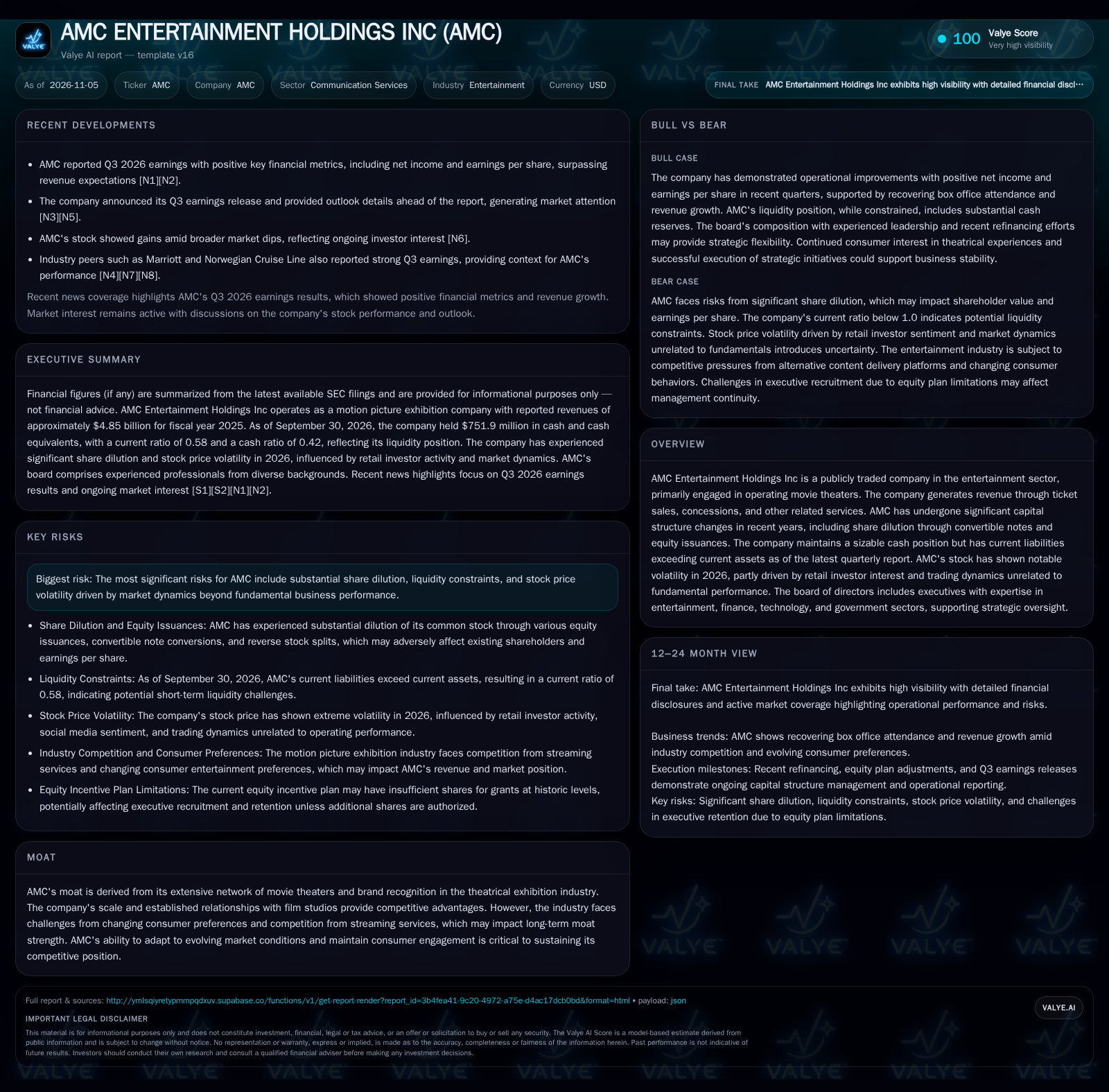
AMC reported strong Q3 2026 net income and revenue growth, signaling operational improvement. However, its current liabilities substantially exceed current assets, and the company continues to face significant share dilution and volatile stock performance, largely driven by retail trading. AMC’s future hinges on its ability to adapt to evolving consumer preferences, manage capital structure challenges, and defend its position against streaming competitors. [S2] [N1] [N2]
AMC Entertainment Holdings enters late 2026 at a crossroads: the company’s return to profitability in Q3 demonstrates that core theater operations can still generate positive earnings, but the underlying financial structure remains fraught with risk. The next phase will test whether improved box office performance and operational discipline can overcome capital structure vulnerabilities and the existential threat posed by streaming platforms.
Positive Earnings Amidst Persistent Financial Strains
In the third quarter of 2026, AMC reported net income of $109.3 million and earnings per share of $0.12, marking a notable operational upswing compared to prior periods. This performance was accompanied by fiscal year 2025 revenues of $4.85 billion, illustrating that the company continues to benefit from a recovering box office environment. However, as of September 30, 2026, AMC’s balance sheet remains under pressure: cash and cash equivalents totaled $751.9 million against current liabilities of $1.77 billion, resulting in a current ratio of 0.58 and a cash ratio of 0.42. These figures highlight ongoing liquidity constraints. At the same time, AMC’s share count has ballooned to nearly 893 million outstanding due to repeated dilutive events, with only 143 million authorized but unissued shares remaining, limiting future equity flexibility. Stock price volatility has also been extreme, mostly decoupled from operating performance and driven by retail speculation. [S2] [N1] [N2]
Revenue Streams, Cost Structure, and the Leverage Dilemma
AMC’s core economics are built on the high fixed-cost model typical of theater operators: substantial upfront investments in real estate, lease obligations, and digital projection infrastructure, offset by variable costs tied to labor, concessions, and film rental. The company’s primary revenue streams remain box office ticket sales and concessions, with ancillary revenues from advertising, loyalty programs, and alternative content. Operating leverage is significant—modest increases in attendance or per-patron spend can disproportionately expand margins, as seen in the Q3 2026 results. However, the capital intensity and lease obligations mean that any sustained downturn quickly erodes profitability.
Liquidity and funding needs remain elevated. The company reported cash and liquidity metrics for the period; these figures do not by themselves establish operating runway, investment capacity, financial flexibility, or financing capacity. The company’s ability to generate free cash flow is thus critical, as is its capacity to renegotiate or refinance debt on favorable terms.
The interplay between fixed and variable costs in AMC's business model creates a delicate balance for profitability, especially under fluctuating attendance levels. Because fixed costs such as leases and technology investments must be paid regardless of revenue, the company’s margin sensitivity to attendance is high. This means that small declines in customer turnout can disproportionately impact operating income, while gains can conversely amplify profits. The leverage dilemma is compounded by the capital structure, where high debt servicing obligations reduce potential financial flexibility. Consequently, AMC’s capacity to invest in innovation or enhancements is constrained unless free cash flow improves significantly, underscoring the importance of operational efficiency and cost control in sustaining profitability.
Moreover, the company’s reliance on ancillary revenue streams like concessions and premium experiences introduces both opportunity and risk. These segments typically have higher margins than ticket sales and can act as profit multipliers when attendance is stable or growing. However, shifts in consumer preferences—such as increased health concerns or alternative entertainment options—could depress ancillary spending, thereby weakening overall revenue quality. The variability of these streams further complicates forecasting and cash flow management. A useful metric would be the proportion of total revenue derived from these higher-margin sources over time, as this would indicate whether AMC is successfully leveraging experiential differentiation to buffer against ticket sales volatility.
Defending the Cinema: Scale, Brand, and the Streaming Onslaught
AMC’s competitive position is grounded in its status as one of the world’s largest theater chains, with broad geographic reach and brand recognition. This scale provides bargaining power with studios and some flexibility in programming and pricing. The company’s loyalty programs and premium offerings (such as IMAX and dine-in theaters) are designed to differentiate the theater experience from home viewing.
However, the core threat comes from streaming services and changing consumer preferences. The COVID-19 pandemic accelerated the adoption of at-home entertainment, and studios continue to experiment with shorter theatrical windows or direct-to-streaming releases. While AMC’s size and relationships with major studios offer some insulation, its moat is eroding as digital platforms capture more consumer attention and content distribution becomes increasingly fragmented. The challenge is to sustain enough exclusive, must-see content and experiential value to drive continued foot traffic.
AMC’s scale and brand recognition provide important competitive advantages but also expose the company to operational complexities and market risks. Large geographic footprint and numerous locations require significant coordination and capital expenditure, which can dilute returns if not managed efficiently. Additionally, the growing fragmentation of content distribution challenges AMC’s traditional role as a gatekeeper for first-run theatrical releases. Studios’ increasing willingness to shorten theatrical windows or release content directly to digital platforms threatens to erode exclusivity, which has historically been a key driver of theater attendance. AMC’s ability to negotiate favorable terms and maintain strong studio partnerships will be critical to preserving its competitive moat in an evolving landscape.
Furthermore, consumer behavior trends toward on-demand and personalized entertainment experiences could pressure AMC’s traditional value proposition. While premium formats and loyalty programs aim to create differentiated offerings, their success hinges on sustained consumer willingness to pay a premium for out-of-home entertainment. If streaming services continue to invest in exclusive, high-quality content and innovate user engagement, AMC may face intensified competition not just on content availability but also on convenience and cost. The company’s strategic response must therefore consider not only enhancing the theatrical experience but also integrating digital elements or partnerships that align with evolving consumer expectations, potentially blending physical and virtual engagement to remain relevant.
If Theatrical Demand Holds and Capital Structure Stabilizes
A bullish outcome for AMC would depend on continued recovery in box office attendance, supported by a strong film slate and successful marketing of premium formats. If AMC can drive higher per-patron spending and maintain cost discipline, margin expansion could offset some of the capital structure drag. Refinancing existing debt on more favorable terms, or generating sufficient free cash flow to reduce leverage, would ease liquidity pressure and potentially allow for modest reinvestment in theater upgrades or digital integration.
Confirmation of this scenario would come from sustained positive net income and free cash flow, consistent outperformance versus attendance and revenue expectations, and evidence of debt reduction or improved credit terms. A stabilization or increase in share price driven by fundamentals—not retail trading—would also signal that the market is recognizing improved business health.
Operational Recovery Meets Structural Headwinds
The most plausible near-term scenario is one where AMC continues to deliver modest profitability on the back of a gradually recovering theatrical market, but remains constrained by its capital structure and industry headwinds. Revenue and net income may fluctuate with the film release calendar and macroeconomic conditions, while liquidity stays tight and any material debt reduction proves difficult without asset sales or further equity issuance.
Evidence supporting this base case would include continued positive, but volatile, operating results; ongoing share price swings influenced by retail sentiment; and incremental, but not transformative, improvements in balance sheet health.
Liquidity Stress and Competitive Displacement
A negative outcome could materialize if box office attendance falters, either due to a weak film slate, renewed macroeconomic pressure, or a further shift in consumer habits toward streaming. In this case, AMC’s high fixed costs and low liquidity ratios would rapidly become unsustainable, forcing the company to seek emergency financing, restructure debt, or pursue asset sales under distressed conditions. Further equity dilution could become unavoidable, further eroding per-share value.
Confirmation would come from sequential declines in revenue and net income, negative cash flow, worsening liquidity ratios, or announcements related to emergency capital raises, distressed asset sales, or covenant breaches. A sustained drop in share price precipitated by operational underperformance—not just retail sentiment—would also indicate that the downside is playing out.
What Will Determine Whether AMC’s Comeback Is Durable—or a Mirage?
Quarterly trends in box office attendance and average per-patron spend, which would clarify whether the theatrical recovery is gaining traction or stalling.
Net cash flow from operations and free cash flow generation, as persistent negative cash flow would signal rising liquidity risk.
Progress in reducing net debt or refinancing existing obligations on improved terms, which would indicate whether capital structure risk is being mitigated.
Share count changes and further equity issuances, as continued dilution would further erode per-share economics and test investor patience.
Proportion of premium format and alternative content revenues, if disclosed, to assess whether experiential differentiation is driving incremental growth.
Shifts in windowing agreements or major studio relationships, which could impact AMC’s access to exclusive content and its competitive moat.
Updates on executive recruitment/retention and equity incentive plan approvals, as leadership stability is increasingly tied to the company’s ability to grant equity and attract talent.
Disclaimer: This is research-only, informational analysis and not investment advice. It may include AI-generated interpretation and general industry context. Always verify important details using primary sources.

Comments