
Lumen’s AI Backbone Ambitions: Fiber Network Leverage, Enterprise Focus, and the Stakes of Financial Strain
Lumen Technologies pivots to an enterprise-first strategy centered on AI-enabled digital networking, leveraging its global fiber footprint and strategic partnerships.
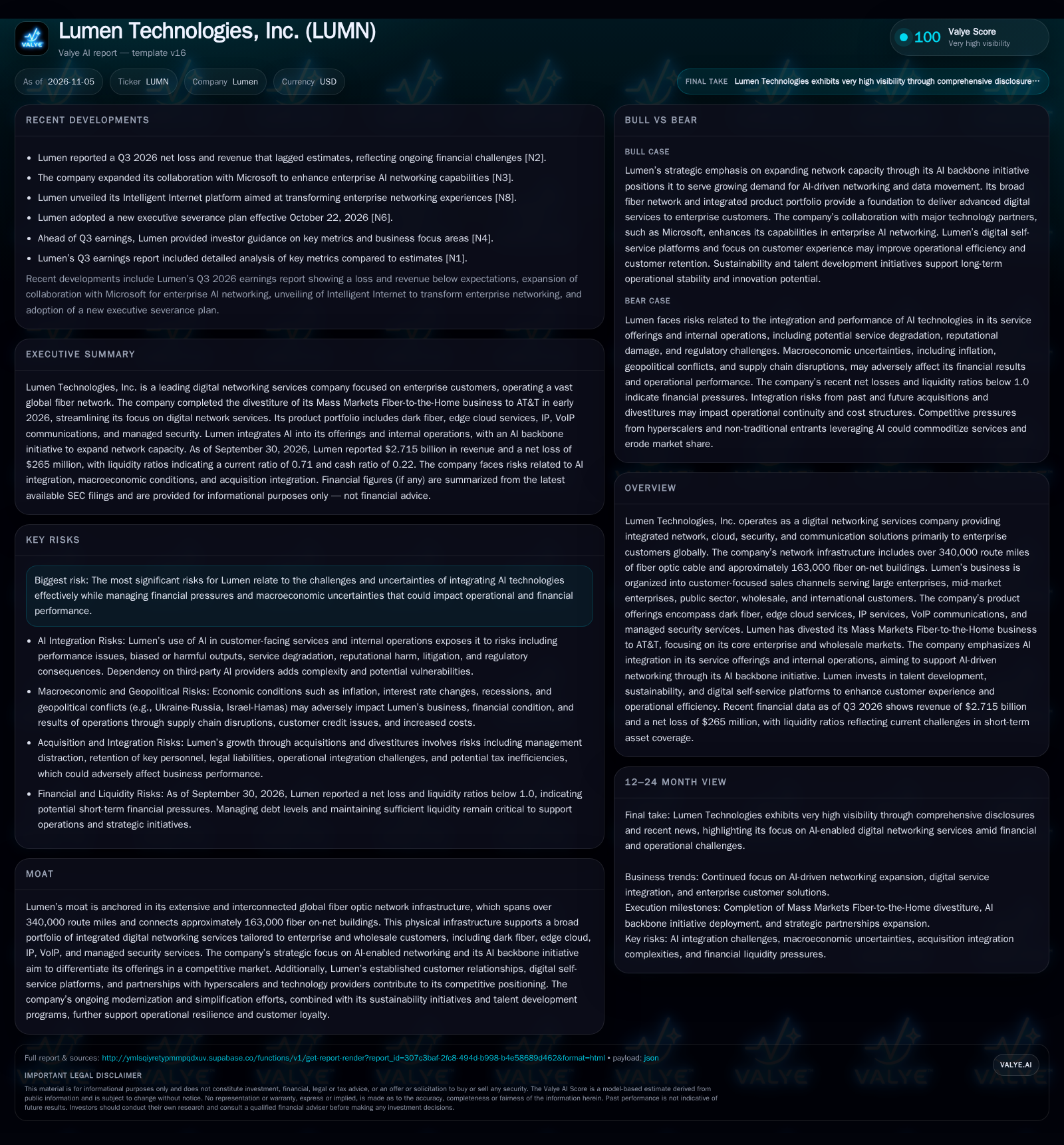
Lumen Technologies is advancing an AI-driven enterprise networking strategy, underpinned by its vast fiber infrastructure and collaborations with technology leaders like Microsoft. The success of Lumen’s AI backbone and enterprise focus will hinge on demonstrable adoption by large customers, improved operating leverage, and effective cost and debt management as legacy businesses are exited or restructured. [S2] [N2] [N3]
Lumen Technologies stands at a strategic inflection point: having divested its Mass Markets Fiber-to-the-Home business, the company is now singularly focused on leveraging its extensive fiber network and digital infrastructure to serve enterprise customers in an AI-first world. This pivot is reinforced by high-profile collaborations and product launches targeting the surging demand for secure, high-capacity, programmable connectivity. The company’s next phase will be defined by its ability to monetize AI-enabled networking at scale, control costs, and restore financial resilience.
Financial Strain and Strategic Refocus Define Lumen’s Present
Lumen reported Q3 2026 revenue of $2.715 billion and a net loss of $265 million, with both basic and diluted EPS at -$0.26. The company’s cash and equivalents stood at $978 million, while its current ratio of 0.71 and cash ratio of 0.22 reflect a shortfall in short-term asset coverage relative to liabilities. [S2] [N2]
In February 2026, Lumen completed the sale of its Mass Markets Fiber-to-the-Home business to AT&T, leaving the company focused almost exclusively on serving enterprise and wholesale customers through a single reporting segment. This marks a decisive pivot away from consumer markets toward enterprise digital networking. [S1]
Recent developments include an expanded collaboration with Microsoft to advance enterprise AI networking and the launch of the 'Intelligent Internet' platform, both aimed at reinforcing Lumen’s positioning as an enabler of AI-powered enterprise connectivity. [N3] [N8]
Enterprise Revenue Mix, Cost Structure, and the Leverage Challenge
Lumen’s core business economics now hinge on delivering integrated digital networking, edge cloud, and managed security services to enterprise clients. The company’s vast fiber network (340,000+ route miles, 163,000 on-net buildings) provides a fixed-cost base that, if sufficiently utilized, can yield strong operating leverage. However, the capital intensity of maintaining and upgrading this infrastructure remains high, especially as the company invests in its AI backbone and digital self-service platforms. [S1]
Revenue mix is shifting away from legacy telecom and consumer products toward higher-value enterprise solutions such as dark fiber, edge compute, and managed security. These offerings typically command higher margins and lower churn, provided Lumen can differentiate on performance, integration, and reliability. Yet, the company’s persistent net losses suggest that either unit margins, volumes, or both are yet to reach levels necessary for profitability.
The divestiture of non-core assets may help reduce debt and focus resources, but also reduces revenue scale and may delay operating leverage realization if fixed costs remain high. [S2]
Fiber Depth, Hyperscaler Partnerships, and the Threat of Commoditization
Lumen’s principal competitive asset is its global fiber infrastructure, which remains difficult and costly to replicate. This network supports differentiated offerings in dark fiber, programmable connectivity, and edge services, particularly for enterprises with distributed operations or stringent security requirements. The company’s established relationships and digital self-service platforms further support retention among large customers. [S1]
Strategic partnerships, such as the expanded Microsoft collaboration, enable Lumen to stay relevant as enterprise IT shifts to hybrid and multi-cloud environments. Integration with hyperscalers and AI providers helps Lumen co-innovate and potentially capture higher-value workloads.
However, the rapid evolution of cloud-native networking and the entrance of hyperscalers and non-traditional players into the connectivity space threaten to commoditize basic transport services. If Lumen cannot differentiate on programmability, security, or AI-driven performance, it risks margin compression and customer attrition to larger, more capitalized technology providers.
AI Backbone Monetization Drives Margin Expansion and Debt Reduction
If Lumen’s AI backbone initiative and Intelligent Internet platform gain traction with large enterprise customers, the company could see a shift toward higher-margin, software-defined network services. This would improve utilization of its fixed network assets, reduce churn, and enable premium pricing for programmable, secure connectivity tailored to AI and multi-cloud workloads.
Expansion of partnerships with major AI and cloud providers could accelerate integration into customer digital transformation projects, driving volume growth across edge, security, and managed services. Successful adoption of digital self-service ordering and automation could lower customer acquisition and support costs, further enhancing margins.
Confirmation would come from sequential growth in enterprise recurring revenue, a meaningful reduction in net losses (or return to positive operating cash flow), and evidence of major enterprise customer wins tied to AI-enabled services. Conversely, continued flat or declining enterprise revenue, persistent losses, or lack of new flagship customer announcements would falsify the upside scenario.
Incremental Adoption, Cost Discipline, and Slow Balance Sheet Repair
The most plausible path is one of gradual enterprise adoption of Lumen’s AI-enabled offerings, offset by ongoing declines in legacy services and continued cost rationalization. Revenue may stabilize as new enterprise wins compensate for churn elsewhere, but margin expansion is likely to be slow given competitive pricing pressure and the need to invest in both infrastructure and digital platforms.
Operating leverage could improve if fixed network costs are spread over a growing base of higher-value services, but this depends on Lumen’s ability to contain SG&A and reduce legacy support overhead. The company may need to prioritize debt repayment over aggressive expansion, limiting the pace of new product rollouts.
Evidence supporting this scenario would include modest sequential improvements in operating margins, stabilization of cash outflows, and a slow but steady improvement in liquidity ratios. Further deterioration in revenue or margins, or unplanned increases in capital spending or debt, would challenge this outlook.
Legacy Decline Outpaces Enterprise Growth, Forcing Restructuring
If enterprise adoption of Lumen’s new offerings is slower than anticipated, while legacy telecom and wholesale revenues continue to decline, the company could face a worsening cash flow squeeze. In this scenario, fixed network and operating costs become increasingly burdensome relative to a shrinking revenue base.
Failure to demonstrate clear differentiation in AI-enabled or programmable network services could result in further customer attrition to hyperscalers and next-generation competitors, accelerating revenue and margin erosion. Liquidity pressures could intensify, necessitating asset sales, workforce reductions, or even restructuring of debt obligations.
Confirmation of this scenario would come from continued widening of net losses, further deterioration in liquidity ratios, or announcements of additional divestitures, layoffs, or restructuring plans. Stabilization or reversal of these trends would be required to disprove the downside thesis.
Milestones That Will Determine Lumen’s AI-Driven Enterprise Transition
Sequential trends in enterprise recurring revenue, especially from AI-enabled and Intelligent Internet offerings, if disclosed.
Gross and operating margin progression as new services scale and legacy cost structures are rationalized.
Liquidity ratio and cash flow movements—specifically, whether operating cash flow turns positive or liquidity ratios improve above 1.0.
Major enterprise customer wins or renewals tied explicitly to Lumen’s AI backbone or digital networking services.
Updates on the pace and impact of cost-reduction, modernization, and simplification initiatives.
Evidence of successful integration and co-innovation with hyperscaler partners, such as expanded joint offerings or referenceable deployments.
Announcements of further asset sales, debt restructuring, or capital-raising measures, which would indicate financial stress or strategic repositioning.
Disclaimer: This is research-only, informational analysis and not investment advice. It may include AI-generated interpretation and general industry context. Always verify important details using primary sources.

Comments