
Miller Industries: Scaling for Military Opportunity, Navigating Capital Intensity and Operational Shifts
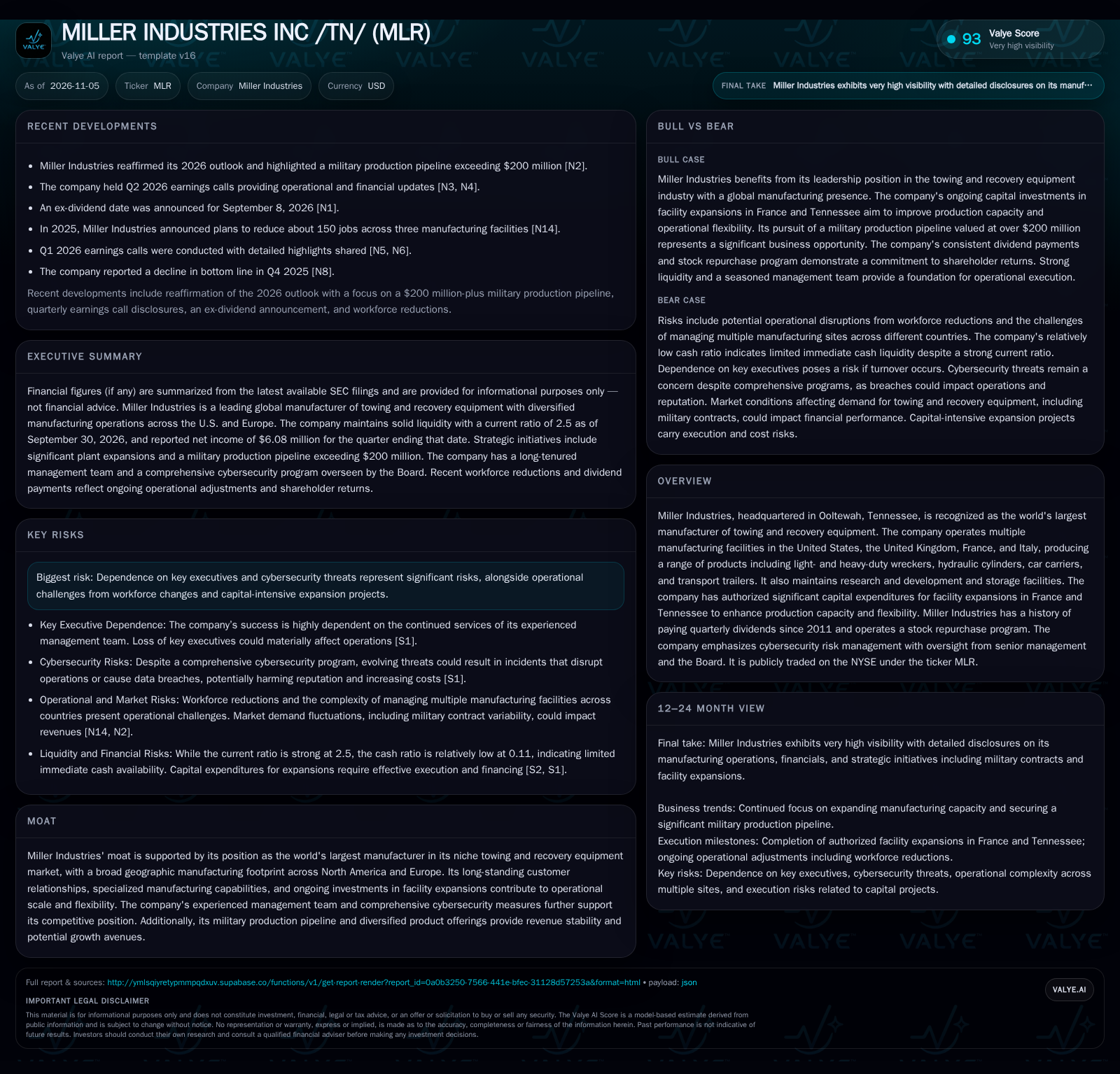
Miller Industries is expanding its manufacturing footprint and targeting a $200 million-plus military production pipeline, but must manage the capital burdens and operational risks of large-scale facility projects and workforce adjustments amid evolving end-market demand.
Workforce reductions and recent earnings volatility underscore the complexity of managing a geographically diverse manufacturing base. The company's long-term record of dividends and buybacks reflects a commitment to shareholder returns, but execution risks around expansion and market demand will define the next phase.
Miller Industries, the world's largest manufacturer of towing and recovery equipment, is at a pivotal juncture. With two major facility expansions underway and a targeted military production pipeline exceeding $200 million, the company is positioning itself for growth beyond its traditional commercial segments. The next phase for Miller will be defined by its ability to execute on large-scale projects, secure defense contracts, and maintain operational discipline across its global footprint.
Facility Expansions and Military Pipeline Reshape the Near-Term Landscape
Miller Industries has authorized a $100 million expansion at its core Ooltewah, Tennessee manufacturing facility and a $9.1 million expansion at a French plant, both aimed at increasing capacity and operational flexibility [S1]. These capital commitments signal a drive to meet anticipated demand, particularly as the company pursues a military production pipeline valued at over $200 million [N2]. As of September 30, 2026, Miller reported $18.98 million in cash and equivalents, a current ratio of 2.5, and a cash ratio of 0.11 [S2]. The cited source reports dividend-related activity; that disclosure alone does not establish dividend-policy continuity, management confidence, or a material constraint on capital flexibility. [S1] These developments are material, as they frame the company’s risk-reward profile around large-scale capital investment, evolving end-market focus, and internal cost management.
The timing and sequencing of these facility expansions are critical variables that will influence Miller's near-term financial profile and operational resilience. If the Tennessee and French plants come online in a staggered fashion aligned with contract awards and demand signals, the company can better manage capital deployment and mitigate the risks of overcapacity. Conversely, simultaneous ramp-ups without secured orders could exacerbate working capital demands and strain cash flows. Additionally, the geographic diversification of these expansions introduces currency exposure and regulatory compliance considerations, which may affect cost structures and operational agility in the face of shifting trade policies or labor market conditions.
How Expansion and Product Mix Could Shift Miller’s Margin Structure
Miller Industries generates revenue primarily by manufacturing and selling light- and heavy-duty wreckers, car carriers, hydraulic cylinders, and transport trailers. Its economics are driven by the volume and mix of these products—heavy-duty equipment and military contracts typically offer higher per-unit revenue and margin potential than standard light-duty products. The company’s cost structure is capital-intensive, with significant fixed costs tied to its global plant network and ongoing investments in automation and R&D.
The current facility expansions in Tennessee and France represent a major swing in fixed capital: if these projects result in higher throughput or allow Miller to capture new military and specialty contracts, they could drive operating leverage and margin expansion. However, this leverage cuts both ways—underutilization or delays in contract wins could leave the company with elevated depreciation and overhead, pressuring profitability.
The dividend and buyback programs, while shareholder-friendly, further constrain free cash in a period of heightened capital demands.
The margin impact of product mix evolution hinges on the relative contribution of military contracts versus commercial sales. Military contracts often entail stringent quality and compliance standards, which can increase production costs but are typically offset by higher pricing and longer contract durations. However, the incremental R&D and certification expenses necessary to meet defense specifications could compress margins in early phases until scale efficiencies are realized. Furthermore, the capital intensity of automation investments introduces a fixed-cost burden that requires sustained volume growth to achieve meaningful margin expansion. Should market demand soften or contract awards be delayed, the company’s ability to flex costs downward will be limited, underscoring the importance of adaptive cost management practices.
Scale, Specialization, and the Challenge of Global Manufacturing
Miller’s competitive advantage stems from its position as the world’s largest towing and recovery equipment manufacturer, with a broad geographic footprint spanning the U.S., U.K., France, and Italy [S1]. This scale provides procurement clout, diversified market reach, and the ability to serve both commercial and government customers with specialized needs.
However, the industry is exposed to cyclical demand from fleet operators, municipalities, and—potentially—defense agencies. The expansion into military contracts brings both an opportunity for higher-margin, longer-duration work and the risk of customer concentration and project timing volatility. Competitors may include other specialty vehicle manufacturers and defense contractors with established military relationships.
Managing a network of ten U.S. plants and additional sites in Europe introduces operational complexity, especially as the company implements workforce reductions and pursues automation. Switching frictions are moderate: specialized equipment, service requirements, and long-term relationships can create some stickiness, but price sensitivity and bid-based government contracts mean Miller cannot rely on customer inertia alone.
The interplay between scale advantages and specialization creates a nuanced competitive dynamic for Miller. While scale enables procurement efficiencies and broad customer reach, the specialized nature of military and heavy-duty equipment manufacturing demands deep engineering expertise and stringent quality controls. Competitors with entrenched defense relationships may possess advantages in contract navigation and compliance, requiring Miller to invest in relationship-building and certification processes to gain traction. Additionally, global manufacturing complexity introduces risks related to supply chain disruptions, geopolitical tensions, and labor market variability. Effective coordination across multiple sites will be essential to maintain delivery reliability and cost competitiveness, particularly as the company balances automation initiatives with workforce adjustments.
Unlocking Value through Military Contract Wins and Facility Ramp-Up
If Miller successfully secures substantial orders from its $200 million-plus military production pipeline, the company could realize a step-change in revenue mix—shifting toward higher-value, less cyclical contracts. The new and expanded facilities would enable Miller to deliver on these contracts efficiently, spreading fixed costs over larger volumes and potentially boosting gross margin.
Confirmation would come from announced contract awards, rising backlog, and evidence in earnings calls of improved throughput and margin expansion. Additional upside would result if Miller’s investments in automation or R&D yield differentiated products that command premium pricing or open new geographic markets.
Operational Execution Defines Returns as Expansion Meets Demand Realities
The most plausible outcome is that Miller completes its major facility expansions on time and budget, supporting existing commercial volumes while gradually ramping military production. Revenue growth is steady but not explosive, reflecting ongoing demand from fleet and municipal customers with incremental gains from government work. Margins are stable, with operating leverage from new capacity offset by the depreciation and fixed costs of larger facilities.
Evidence supporting this scenario would include consistent quarterly earnings, stable or modestly rising EPS, and no material delays or overruns in the expansion projects.
Expansion Risk: Overcapacity, Cost Overruns, and Military Pipeline Disappointment
The adverse scenario unfolds if Miller’s large-scale capital projects encounter significant delays, cost overruns, or fail to align with actual demand. If military contracts are delayed, reduced, or lost to competitors, the company could be left with excess capacity and elevated fixed costs, compressing margins and straining cash flows.
Additional downside could result from operational disruptions linked to workforce reductions, supply chain volatility, or cybersecurity incidents—despite the company’s robust risk management framework [S1]. Confirmation of this scenario would include missed project milestones, declining operating income, negative surprises in working capital trends, or reductions in the dividend or buyback pace.
Milestones That Will Clarify Miller’s Trajectory in Defense and Industrial Markets
Progress toward completion and ramp-up of the Tennessee and French facility expansions, including any disclosed cost or timeline revisions.
Announcements or disclosures of new military contract wins, backlog figures, or production milestones from the $200 million-plus pipeline.
Quarterly trends in gross margin and operating leverage as new capacity comes online—especially if broken out by product or contract category.
Liquidity dynamics: changes in the cash ratio, free cash flow, and the scale/timing of capital expenditures relative to operating cash generation.
Evidence of successful cost management post-workforce reductions—such as lower SG&A or improved productivity metrics (if disclosed).
Updates on cybersecurity incidents or disclosures, given the potential for operational or reputational disruption.
Disclaimer: This is research-only, informational analysis and not investment advice. It may include AI-generated interpretation and general industry context. Always verify important details using primary sources.

Comments