
Gold Rock Holdings: Small-Scale AI and Web3 Ambitions Confront Funding Reliance and Customer Concentration
Gold Rock Holdings, Inc. has narrowed its net loss and generated revenue from AI and Web3 offerings, but remains highly dependent on a few customers and external financing. The company’s ability to sustain operations hinges on expanding its customer base and securing new capital, while current liquidity leaves little margin for error.
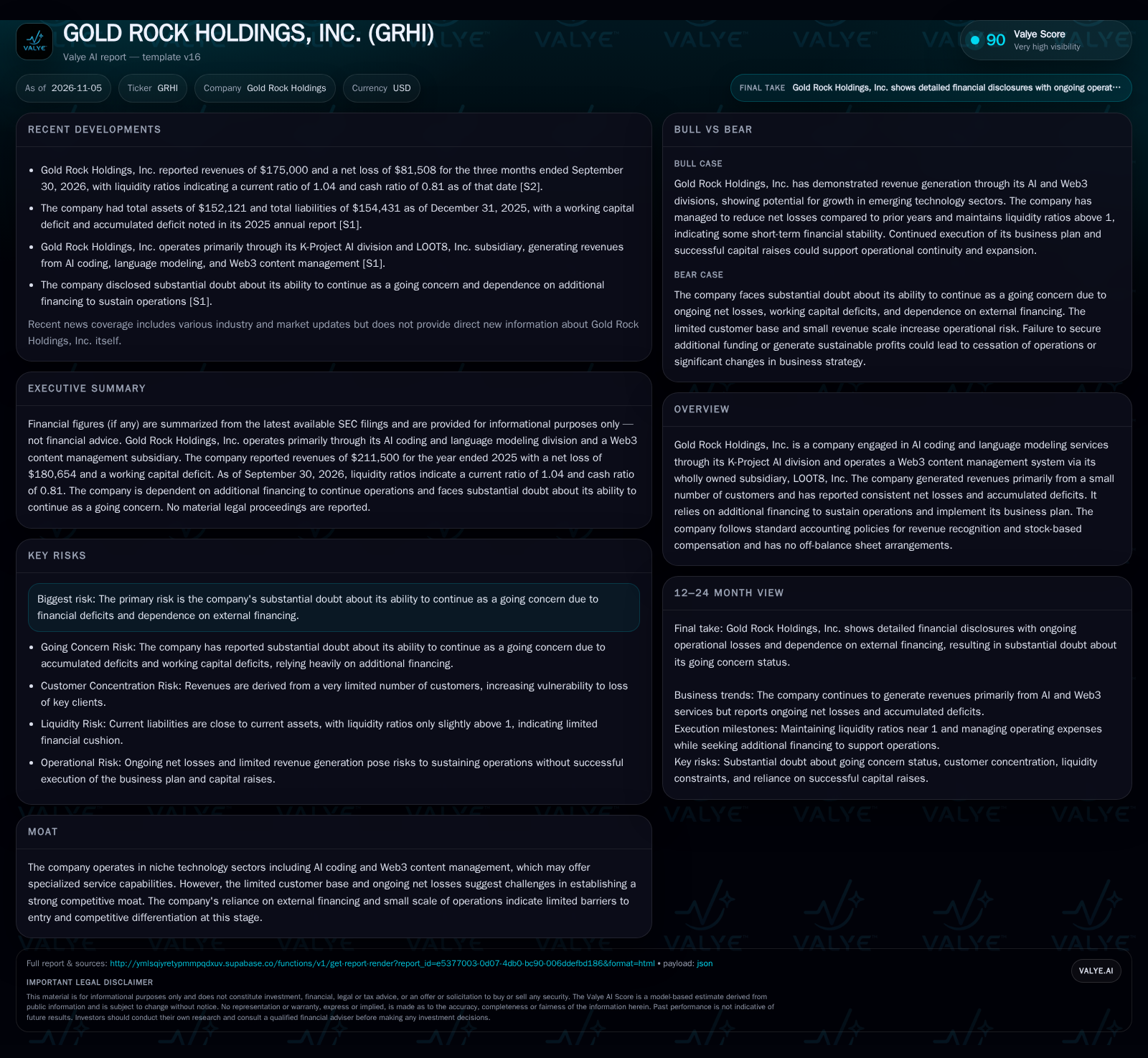
Gold Rock Holdings, Inc. reported a reduced net loss for 2025 and quarterly revenue momentum in 2026, but continues to rely on a handful of customers and external financing. [S1] [S2]
Gold Rock Holdings, Inc. operates on the frontier of AI coding and Web3 content management, but its business remains at an early stage, with revenue sourced from a narrow client base and persistent net losses. The near-term trajectory will be shaped by its ability to diversify revenue streams, tighten operational discipline, and access new capital in a competitive, fast-evolving technology landscape. [S1] [S2]
Recent Financial Results Highlight Narrow Revenue Base and Ongoing Losses
Gold Rock Holdings, Inc. generated $211,500 in revenue for the year ended December 31, 2025, with $210,000 coming from AI coding and language modeling and just $1,500 from its Web3 content management business. This revenue was derived from only two customers, underscoring a highly concentrated client base. For the three months ended September 30, 2026, the company reported $175,000 in revenue—a quarterly figure that suggests a potentially higher run-rate but does not establish a diversified or recurring revenue stream. Net losses persisted, with a 2025 annual loss of $180,654 (improved from $240,694 in 2024) and a Q3 2026 loss of $81,508. As of September 30, 2026, liquidity ratios were only slightly above 1, with $118,660 in cash against $146,375 in current liabilities, and the company continues to operate at a working capital deficit. The company’s filings explicitly state substantial doubt about its ability to continue as a going concern, reflecting ongoing reliance on external financing. [S1] [S2]
Economic Model: Service Revenue, Fixed Costs, and the Imperative of Scale
Gold Rock Holdings’ business economics are characterized by service-based revenue from AI coding and language modeling, supplemented by a nascent Web3 content management offering. The company’s cost structure is dominated by fixed operating expenses, including board and officer compensation ($225,000 in 2025) and engineering fees ($80,392), with total operating expenses of $392,064 in 2025. This fixed-cost base means that incremental revenue, if achieved without proportional expense growth, could drive operating leverage and narrow losses. However, the present revenue scale is insufficient to cover these overheads, resulting in persistent net losses.
The company’s capital requirements remain elevated due to ongoing losses and a lack of material asset base, necessitating periodic infusions of debt or equity capital to fund operations. The business model’s viability thus depends on achieving greater revenue volume and/or securing higher-margin projects, while controlling fixed costs and successfully accessing new capital.
Assessing Differentiation in Crowded AI and Web3 Service Markets
Gold Rock Holdings competes in two highly dynamic and competitive arenas: AI coding/language modeling and Web3 content management. Both sectors are characterized by rapid technological change, low barriers to entry for service providers, and a proliferation of both established firms and startups. In AI services, scale players and specialized boutiques compete on technical sophistication, project delivery, and customer relationships. In Web3 content management, the challenge is even more acute, with open-source solutions and well-funded platforms offering extensive functionality.
The company’s limited customer base and small revenue scale suggest it has not yet established a material competitive moat. Without proprietary technology, exclusive partnerships, or a sticky platform, Gold Rock Holdings may face pricing pressure and customer churn risk. Its current differentiation likely hinges on project-specific expertise or relationships, but these advantages can be transient unless transformed into recurring contracts, proprietary IP, or a broader ecosystem offering.
What a Breakout Would Require: Scaling Revenues and Securing Recurring Business
A favorable trajectory for Gold Rock Holdings would involve converting its early customer relationships into multi-year or recurring contracts, expanding its client roster, and demonstrating the ability to win larger or higher-margin projects in AI and Web3. This could be catalyzed by the successful deployment of proprietary tools, the launch of a differentiated platform, or strategic partnerships that provide access to new markets. If operational leverage takes hold—where incremental revenue flows through with limited additional cost—the company could approach break-even or even profitability, which in turn would reduce dependence on external capital.
Key evidence confirming this scenario would include a material increase in the number of customers, public disclosure of multi-year or subscription-based agreements, sequential revenue growth that outpaces expense escalation, and a shift from one-off project fees to recurring revenue streams. Falsification would be indicated by continued reliance on a handful of clients, flat or declining revenues, or further dilution from emergency financings without operational progress.
Sustained Strain: Incremental Progress Amid Persistent Funding Needs
The most plausible near-term outcome is continued revenue generation at a modest scale, with gradual improvements in net loss but ongoing dependence on outside funding. The company may add a few new clients or projects, but unless there is a step-change in demand or pricing power, the fixed-cost structure will likely keep Gold Rock Holdings in a cycle of periodic capital raises and thin liquidity. Customer concentration remains a vulnerability: the loss of a key customer could result in a sharp revenue drop, while a stable but narrow client base limits visibility and bargaining power.
Confirmation of this scenario would come from financials showing slow revenue growth, persistent but narrowing losses, and ongoing working capital deficits. Additional equity or debt issuances, or statements in filings about the need for further funding, would reinforce the view that the company is operating in a holding pattern—sustaining operations but not breaking out from its current constraints.
Funding Gaps or Customer Loss Could Trigger a Strategic Reset
The adverse scenario is defined by a failure to secure sufficient new financing or the loss of one of the company’s few major customers. Either event could rapidly exhaust the company’s limited cash resources, forcing a drastic reduction in operations, asset sales, or even a wind-down. The lack of diversification in both customers and product offerings exacerbates this risk: even a short-term disruption in collections or project pipeline could have outsize consequences.
This downside would be confirmed by missed payroll or vendor payments, a sharp drop in disclosed cash balances, the announcement of a going-concern warning without a parallel funding solution, or evidence of customer attrition. A forced sale, delisting, or bankruptcy filing would be the most severe signals, but earlier warning signs would include delayed filings, management turnover, or unsuccessful capital-raising attempts.
Milestones That Will Determine Gold Rock Holdings’ Viability
Disclosure of new customers or projects, especially if accompanied by multi-year or recurring revenue commitments, would help assess whether the company is diversifying its revenue base.
A useful metric would be gross margin by service line (AI vs. Web3), if disclosed, to evaluate the potential for operating leverage and profitability.
Tracking quarterly revenue growth and client concentration will clarify whether the business is scaling or remains reliant on a few clients.
Any announced strategic partnerships, platform launches, or proprietary product releases could signal a shift from project-based to platform-based economics.
Evidence of successful capital raises, including the size, terms, and dilution impact, will be crucial for evaluating operational runway.
Monitoring operating expense trends, especially board/officer compensation and engineering fees, will indicate whether the company is tightening costs in line with revenue reality.
If the company discloses customer retention rates or backlog, these would provide visibility into future revenue and business durability.
Noting any changes to going concern language in filings will help gauge whether management and auditors see improved financial stability.
Disclaimer: This is research-only, informational analysis and not investment advice. It may include AI-generated interpretation and general industry context. Always verify important details using primary sources.

Comments