
Grainger's Dual-Model Momentum: Digital Scale, High-Touch Depth, and the Stakes of Focused MRO Growth
W.W. Grainger, Inc. continues to post robust growth, with strong Q3 2026 results and a strategic narrowing to North America and Japan after its U.K. exit. The company’s blend of high-touch solutions and expansive online platforms positions it to capture demand across the MRO spectrum, but competitive and cost pressures, geographic concentration, and supply chain complexity remain meaningful variables for its future trajectory.
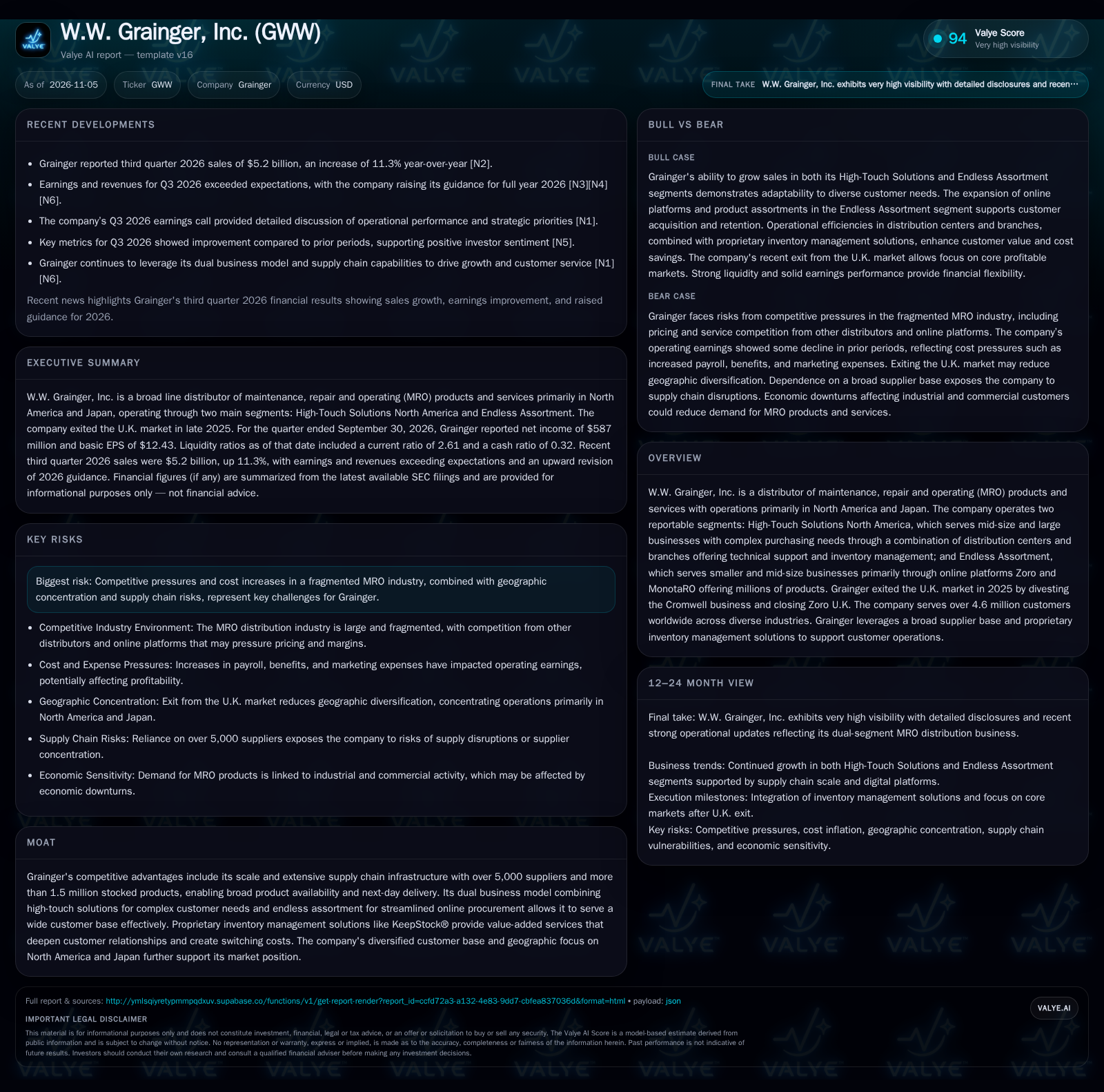
Grainger delivered 11.3% year-over-year sales growth in Q3 2026, surpassing expectations and raising full-year guidance. The company’s exit from the U.K. sharpens its focus on core markets in North America and Japan, while its dual-segment model—combining high-touch service and vast eCommerce reach—continues to drive both scale and customer stickiness. Competitive intensity, cost inflation, and exposure to industrial cycles remain key factors to watch as the company integrates recent operational changes and seeks further margin expansion. [N2] [N3] [N6] [S1] [S2]
W.W. Grainger, Inc. is demonstrating the rewards—and risks—of a focused MRO distribution strategy. The company’s latest quarter saw double-digit revenue growth and an upward revision to its 2026 outlook, driven by continued expansion in both its traditional high-touch and online ‘endless assortment’ businesses. Having divested its U.K. exposure in 2025, Grainger is now betting on operational intensity and digital breadth in North America and Japan. The question for investors: can scale, service, and technology-driven procurement outpace margin and supply chain risks as the MRO landscape evolves?
Recent Performance and Strategic Refocus Define Grainger’s Near-Term Outlook
Grainger reported Q3 2026 sales of $5.2 billion—a year-over-year increase of 11.3%—with both earnings and revenue surpassing analyst estimates and prompting a raise in full-year guidance. This momentum follows a period of strategic narrowing, as the company exited the U.K. market in late 2025 by selling its Cromwell business and closing Zoro U.K. operations, allowing management to concentrate resources on North America and Japan. The company reported cash and liquidity metrics for the period; these figures do not by themselves establish operating runway, investment capacity, financial flexibility, or financing capacity. [S1] [S2] [N2] [N3] [N6]
How Grainger Monetizes Scale and Service in the MRO Value Chain
Grainger’s business model is anchored in the distribution of MRO products, with two distinct economic engines: the High-Touch Solutions segment serves larger, more complex customers with tailored services, technical support, and proprietary inventory management (such as KeepStock®), while Endless Assortment leverages eCommerce platforms to deliver a vast catalog to smaller and mid-sized customers at lower transaction costs. Pricing power in High-Touch Solutions is typically supported by service depth and integration into customer workflows, whereas Endless Assortment competes on selection, convenience, and transparent pricing. Both models benefit from Grainger’s scale—over 5,000 suppliers and 1.5 million stocked SKUs—enabling next-day delivery and breadth of offering.
Operating leverage is realized through distribution network density and technology investments, particularly as digital adoption grows. The capital intensity of the business is moderate, reflecting investments in inventory, logistics, and IT infrastructure rather than heavy fixed plant. Gross margin dynamics are shaped by product mix (higher in high-touch, lower in pure eCommerce) and the company’s ability to optimize procurement and working capital. Variable costs are tied to labor, fulfillment, and marketing, with recent periods showing upward pressure from payroll and benefits expenses.
Digital Reach Meets Service Depth: Where Grainger Stands Amid MRO Rivals
Grainger’s core advantages stem from a hybrid model that combines the high-switching-cost, relationship-driven business of high-touch distribution with the scale and efficiency of online platforms. This allows it to serve both large, complex organizations and smaller, price-sensitive buyers, broadening its addressable market relative to pure-play digital or traditional distribution peers.
Competitive intensity in MRO distribution remains high, with fragmentation persisting across geographies and customer segments. Grainger faces competition from national and regional distributors, specialized MRO firms, and increasingly, digital-first platforms that may undercut on price or offer differentiated procurement technology. The company’s proprietary inventory management solutions and embedded customer relationships create some stickiness, but switching costs are not absolute, especially for commoditized SKUs that can be sourced elsewhere.
Recent strategic focus on North America and Japan may sharpen Grainger’s execution, but also increases exposure to regional economic cycles and reduces the buffer of geographic diversification. The breadth of its product assortment and reliability of its supply chain—enabled by a large supplier base and robust logistics—remain key competitive levers, but are vulnerable to industry-wide shocks or supplier concentration risks.
Digital Penetration and Supply Chain Execution Drive Accelerating Profitable Growth
The most favorable outcome for Grainger would see its Endless Assortment segment continue to outpace overall MRO market growth, as small and mid-sized businesses shift procurement online and the company leverages its vast product catalog and logistics backbone to capture incremental share. Enhanced adoption of proprietary inventory management tools like KeepStock® could deepen customer integration in the high-touch business, reducing churn and supporting premium pricing.
Margin expansion could materialize if operating leverage from digital sales and distribution network optimization offsets wage and cost inflation. The company’s geographic focus would allow for sharper resource allocation and faster innovation cycles, with supply chain resilience enabling Grainger to outperform less integrated rivals during periods of disruption. Evidence confirming this scenario would include sustained double-digit growth in Endless Assortment, improving segment margins, increased adoption of inventory management solutions by large customers, and continued upward guidance revisions.
Sustained Share Gains Tempered by Economic Sensitivity and Competitive Headwinds
The most plausible trajectory is for Grainger to maintain moderate growth across both segments, driven by continued eCommerce adoption and solid execution in its core North American and Japanese markets. High-Touch Solutions may see stable but unspectacular expansion, reflecting the maturity of its customer base and the incremental nature of service-based differentiation. Endless Assortment is likely to remain the faster-growing engine, but as digital penetration matures, growth rates could normalize.
Margins may remain under pressure from wage inflation, fulfillment costs, and periodic supply chain challenges, partially offset by efficiency gains and procurement scale. The company’s diversified customer base should buffer against cyclical swings, but exposure to industrial and commercial activity means downturns could slow growth. Confirmation would come from steady mid-single-digit revenue growth, stable gross and operating margins, and consistent, if measured, increases in digital platform traffic and transaction volume.
Cost Pressures, Supply Chain Disruptions, and Economic Weakness Erode Gains
Adverse outcomes for Grainger could stem from a combination of intensifying price competition—especially from pure-play digital entrants—persistent cost inflation, and supply chain disruptions that erode service reliability. If large customers increasingly commoditize MRO procurement or shift volume to alternative platforms, Grainger’s high-touch model could lose pricing power and margin stability. Digital rivals may accelerate customer acquisition with lower-cost structures and more aggressive pricing.
Geographic concentration after the U.K. exit increases exposure to a downturn in North American industrial activity, while supplier disruptions could impact product availability and customer satisfaction. Evidence of this downside scenario would include declining margins, loss of share in key customer segments, negative operating leverage, and downward revisions to guidance in the face of weak demand or execution missteps.
Milestones and External Forces That Could Shift Grainger’s Competitive Trajectory
Sustained double-digit growth in Endless Assortment segment sales would indicate that Grainger’s digital strategy is extending its addressable market and competitive moat.
Gross and operating margin trends—particularly relative to wage, fulfillment, and procurement costs—will reveal whether scale and efficiency can offset inflationary pressures.
Customer adoption rates of proprietary inventory management solutions (e.g., KeepStock®), if disclosed, would help test the thesis that service integration creates durable switching costs.
Market share changes in core North American and Japanese MRO markets, if available, will signal competitive resilience or erosion.
Supply chain performance metrics—such as on-time delivery rates, inventory turns, and supplier concentration—would provide early warning of operational vulnerabilities.
Evidence of significant customer churn or pricing concessions in the High-Touch Solutions segment would challenge assumptions about retention and pricing power.
Quarterly guidance revisions (upward or downward) and management commentary on demand trends will be critical for tracking momentum and market sensitivity.
Any material change in the composition or concentration of Grainger’s customer base—especially if a major customer approaches 10% of sales—would alter risk dynamics.
Disclaimer: This is research-only, informational analysis and not investment advice. It may include AI-generated interpretation and general industry context. Always verify important details using primary sources.

Comments