
DHI Group, Inc.: Profitable Operations Confront Tight Liquidity and Unclear Competitive Position
With ongoing investor engagement but little public detail on its sector dynamics, the company’s ability to sustain performance depends on underlying business economics and its capacity to manage near-term obligations.
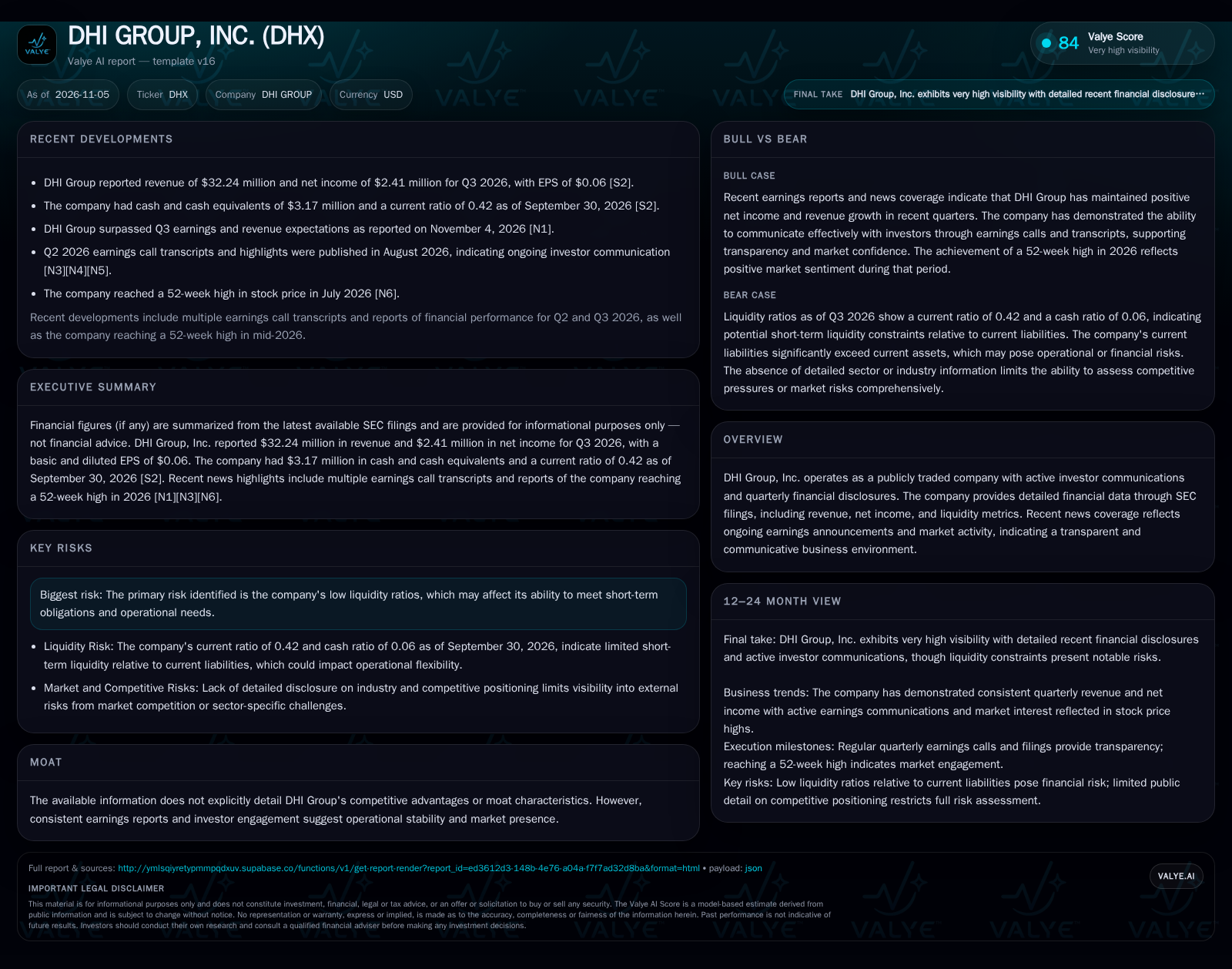
DHI Group, Inc. posted a profitable Q3 2026, but its current assets and cash are dwarfed by short-term liabilities. The company’s persistent investor communications and recent stock price strength reflect market engagement, yet the absence of detailed competitive disclosures makes it difficult to assess its long-term positioning.
DHI Group, Inc. enters late 2026 with a record of quarterly profitability and revenue growth, as evidenced by its Q3 results and ongoing investor communications. However, its balance sheet reveals a stark mismatch between current assets and liabilities, with just $3.17 million in cash against $52.34 million in current liabilities.
Recent Profitability and Liquidity Constraints Shape the Near-Term Outlook
DHI Group, Inc. reported Q3 2026 revenue of $32.24 million and net income of $2.41 million, translating to basic and diluted EPS of $0.06 [S2]. As of September 30, 2026, the company’s cash and cash equivalents totaled $3.17 million, with current assets of $21.78 million and current liabilities of $52.34 million—resulting in a current ratio of 0.42 and a cash ratio of 0.06 [S2]. These figures indicate that while the company is generating profits, its short-term financial obligations far exceed its liquid resources. The company’s stock reached a 52-week high in mid-2026, suggesting market confidence at that time [N6]. Ongoing earnings calls and disclosures highlight transparency and investor engagement [N1] [N3] [N5]. The tension between profitable operations and tight liquidity is now the pivotal dynamic for the business.
How DHI Group’s Business Model Could Translate Earnings into Sustainable Value
While current disclosures do not specify DHI Group’s sector, the company’s consistent revenue and net income imply an established customer base and recurring business activity. If DHI operates in a digital marketplace or information services segment—as its history and typical business model suggest—its revenue could be driven by subscription fees, job posting services, or software licensing, where high gross margins and scalable fixed costs are common. In such models, incremental revenue typically flows through at high incremental margins after a fixed-cost threshold, creating operating leverage.
The company reported cash and liquidity metrics for the period; these figures do not by themselves establish operating runway, investment capacity, financial flexibility, or financing capacity. If much of its revenue is billed in arrears or collected late, or if it relies on upfront payments to suppliers, cash conversion could lag reported earnings. The low current and cash ratios suggest that DHI may need to secure additional short-term financing, renegotiate payment terms, or accelerate receivables to fund operations and growth.
In addition to the revenue drivers and cost structure considerations, DHI Group's ability to sustain profitability hinges on its operational scalability and cost control mechanisms. If the company operates with a predominantly fixed-cost base, incremental increases in revenue could disproportionately enhance margins, but this also means that any revenue decline could rapidly erode profitability. Conversely, if variable costs compose a significant portion of expenses, the company might have greater flexibility to adjust spending in response to market conditions, albeit with potentially lower operating leverage. Understanding the cost behavior relative to revenue fluctuations would help clarify the resilience of earnings under different demand scenarios.
Furthermore, the timing and structure of revenue recognition and cash collections critically affect liquidity beyond reported earnings. If DHI Group's business model includes subscription-based or contractually recurring revenue, the predictability of cash inflows may be higher, enabling better cash flow forecasting and working capital management. However, if revenue is heavily dependent on transactional or project-based sales, cash receipts could be more volatile and less predictable. This distinction matters because even profitable companies can experience liquidity stress if cash inflows are uneven or delayed relative to obligations. Thus, the interplay between revenue model characteristics and cash conversion efficiency is central to evaluating the sustainability of operations.
Assessing Competitive Dynamics Without Direct Disclosure
The available information does not reveal DHI Group’s precise industry or primary competitors. Historically, DHI Group has operated digital platforms for specialized recruitment and career management, competing against both traditional job boards and newer, AI-driven talent platforms. If this structure holds, DHI faces competition from large horizontal employment sites, niche vertical platforms, and potentially enterprise HR software providers.
Competitive advantages in this space are typically grounded in network effects (the value of a platform increases with more users and employers), data-driven matching algorithms, and customer retention through subscription or contract renewal. However, switching costs are often modest for job seekers and moderate for enterprise clients, depending on integration depth. Without explicit disclosures, it is unclear whether DHI currently benefits from high customer retention, differentiated technology, or proprietary datasets. The risk is that larger or more agile entrants could erode market share or pressure pricing. Conversely, DHI’s history of consistent earnings and investor engagement may reflect a defensible niche or loyal customer base.
Competitive positioning in digital marketplaces or information services often depends on the ability to innovate and adapt to evolving customer needs and technology trends. If DHI Group can leverage proprietary data analytics or machine learning algorithms to enhance matchmaking accuracy or user experience, it could establish a meaningful differentiation. However, such technological investments require capital and may strain liquidity in the near term. The company’s capacity to balance innovation spending with cash constraints will influence whether it can maintain or improve its competitive stance. Additionally, the presence of network effects can create barriers to entry, but only if the platform sustains active and engaged participants on both sides of the market.
Another important dimension is the degree of customer concentration and contract terms. High customer concentration may increase revenue volatility and bargaining power of key clients, potentially pressuring margins or payment terms. On the other hand, diversified clientele with long-term contracts could provide revenue stability and reduce churn risk. The extent to which DHI Group can cultivate sticky relationships, possibly through integrated service offerings or value-added features, would affect its vulnerability to competitive incursions. Without explicit disclosures, assessing these factors requires inference from industry norms and the company’s historical performance trends.
From Earnings Momentum to Cash Flow Strength: What Could Unlock Re-Rating
The most favorable outcome would see DHI Group converting its reported profitability into robust operating cash flow, resolving its liquidity pressures without dilutive financing or operational disruption. This could occur if the company accelerates collections, optimizes working capital, or demonstrates that its liabilities are largely non-cash or timing-related rather than immediate cash drains.
A further catalyst would be evidence of high customer retention, recurring contracts, or pricing power, supporting revenue visibility and margin resilience. Confirmation could come from future filings showing improved cash flow from operations, a reported liquidity-ratio trends, or disclosures of multi-year client agreements. Sustained stock price performance above prior highs would suggest market recognition of improved fundamentals. Falsification would involve continued or worsening liquidity ratios despite earnings, signaling structural cash flow issues.
Profitable, But Tightly Managed: The Most Likely Near-Term Trajectory
Absent new sector disclosures or a major operational shift, the most plausible scenario is that DHI Group continues to generate modest net income and revenue growth while managing liquidity risk through tight working capital controls and potential short-term financing.
Confirmation of this scenario would appear as stable or slightly improved net income, steady revenue, and incremental improvements in liquidity metrics. If DHI discloses new financing arrangements, extended supplier terms, or improved cash flow conversion, it would support this base case. A decline in reported profitability or further deterioration in liquidity would challenge the thesis that the company can balance operations with near-term obligations.
Liquidity Pressures Escalate into Operational Disruption
In an adverse scenario, DHI Group’s reported liquidity position could force asset sales, emergency financings, or curtailment of core business activities. If accounts payable mount or suppliers demand cash upfront, the company could face service interruptions, lost customers, or reputational damage. Tight cash may also limit the ability to invest in technology or marketing, eroding competitive position over time.
This scenario would be confirmed by negative operating cash flow, rising short-term borrowings, missed payments, or disclosures of going-concern risks in future filings. A sudden drop in revenue or net income, or public signals of customer churn, would further validate a downside trajectory. Mitigating actions—such as a significant equity raise or asset divestiture—would indicate management is prioritizing liquidity over growth or innovation.
What Will Determine DHI Group’s Ability to Convert Profits into Lasting Value?
Cash flow from operations in upcoming quarters—if disclosed—will be crucial to assess whether accounting earnings translate into actual liquidity.
Disclosure of new or renewed client contracts, especially if multi-year or recurring, would clarify revenue visibility and customer stickiness.
Any announcements regarding debt refinancing, short-term credit facilities, or equity offerings would indicate management’s approach to liquidity risk.
Evidence of customer retention rates, net churn, or platform usage metrics—if disclosed—could reveal the strength of DHI’s competitive position.
Changes in accounts receivable and payable balances: a useful metric to track working capital management and potential cash conversion issues.
Management commentary on sector trends, technology investment, or competitive threats in future earnings calls or filings would help illuminate external risks and opportunities.
Disclaimer: This is research-only, informational analysis and not investment advice. It may include AI-generated interpretation and general industry context. Always verify important details using primary sources.

Comments