
Edwards Lifesciences: Clinical Momentum, Liquidity Strength, and the Competitive Stakes in Structural Heart Disease Devices
The central question is whether clinical advantages and operational scale can sustain growth amid regulatory, reimbursement, and competitive headwinds.
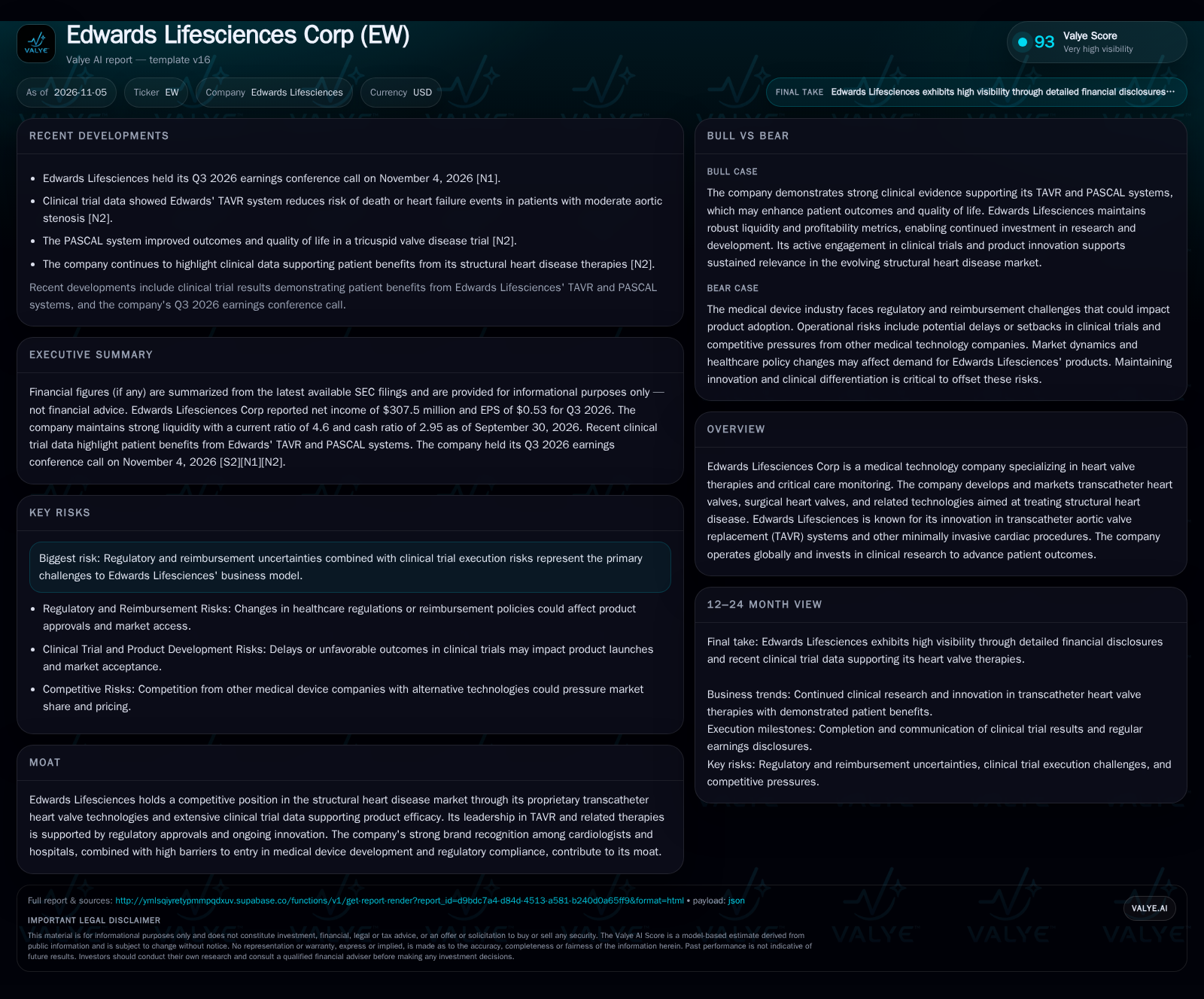
Edwards Lifesciences reported Q3 2026 net income of $307.5 million and maintains $4.64 billion in liquid assets. Recent clinical trials show its TAVR and PASCAL systems deliver meaningful patient benefits, potentially expanding addressable markets. The company’s reported balance sheet position supports ongoing R&D, but regulatory and competitive risks remain material. The next phase depends on translating clinical wins into durable adoption and commercial momentum. [S2] [N2]
Edwards Lifesciences enters late 2026 with a reinforced clinical reputation and a reported liquidity position cushion, but faces a shifting landscape in structural heart disease treatment. With recent trials showing strong outcomes for its TAVR and PASCAL systems, the company is well-positioned to capitalize on expanding indications and the global trend toward minimally invasive cardiac care. The challenge is sustaining commercial momentum in the face of regulatory scrutiny, evolving reimbursement models, and persistent competition from both established and emerging device makers. The next year will test whether Edwards can translate clinical validation into durable market share and revenue growth.
Recent Clinical Results and Financial Position Shape the Strategic Outlook
Edwards Lifesciences reported net income of $307.5 million and earnings per share of $0.53 for the third quarter of 2026, reflecting ongoing profitability at scale [S2]. As of September 30, 2026, the company had approximately $4.64 billion in combined cash and short-term investments, resulting in a current ratio of 4.6 and a cash ratio of 2.95 [S2]. This provides Edwards with substantial flexibility to support R&D, navigate regulatory cycles, and potentially pursue strategic initiatives.
Recent clinical trial highlights include evidence that its TAVR system reduces the risk of death or heart failure events in patients with moderate aortic stenosis, a finding that could expand the addressable patient pool beyond severe disease [N2]. Additionally, the PASCAL system demonstrated improved outcomes and quality of life in tricuspid valve disease trials [N2]. These results bolster Edwards’ clinical narrative and may support future regulatory approvals and guideline expansions.
How Product Innovation and Operating Scale Drive Profitability in Structural Heart Devices
Edwards Lifesciences’ core business economics revolve around high-value, procedure-driven device sales—primarily transcatheter heart valves and critical care monitoring systems. The company’s products are typically priced at a premium, reflecting clinical differentiation, regulatory approval costs, and the high stakes of cardiac interventions. Pricing power is supported when clinical data demonstrate superior outcomes or enable treatment of new patient populations, as with the recent TAVR and PASCAL trial results.
Variable costs are significant, given the complexity and regulatory requirements of manufacturing implantable devices, but the business also benefits from operating leverage as volumes scale. Fixed costs include R&D, large clinical trials, and regulatory compliance, which can be amortized over a broadening product portfolio if innovation leads to expanded indications. The company reported cash and liquidity metrics for the period; these figures do not by themselves establish operating runway, investment capacity, financial flexibility, or financing capacity.
Reimbursement is a crucial economic lever: strong clinical evidence can support premium pricing and broader coverage, but any negative changes in reimbursement policy or cost-containment pressures could erode margins. The shift toward value-based healthcare means that Edwards must continually prove real-world therapeutic and economic benefits to payors and providers.
Barriers, Differentiation, and the Dynamics of a Crowded Medtech Landscape
Edwards Lifesciences’ competitive position is underpinned by a combination of proprietary technology, clinical trial leadership, regulatory experience, and entrenched relationships with cardiac centers. Its early and sustained investment in transcatheter valve platforms, particularly TAVR, has made it a reference brand among interventional cardiologists and surgeons.
However, the structural heart device market is intensely competitive. Large diversified medical device companies and focused cardiovascular players continue to invest in alternative technologies, including competing transcatheter valve systems and future non-implant-based therapies. The barriers to entry—clinical data requirements, regulatory hurdles, and provider trust—are high, but not insurmountable for well-resourced rivals.
Switching costs for hospitals are meaningful in terms of training and procedural workflow, but payor-driven price sensitivity and new clinical evidence from competitors could pressure Edwards’ share or pricing. Ultimately, sustained differentiation depends on a pipeline that continues to demonstrate clear clinical and economic value, as well as the ability to navigate evolving reimbursement and regulatory standards.
Expanding Indications and Clinical Validation Fuel Market Expansion
In the most optimistic scenario, Edwards Lifesciences leverages recent clinical trial results to secure regulatory approvals for expanded use of its TAVR system in moderate aortic stenosis and its PASCAL device in broader tricuspid valve indications. If guideline bodies and payors rapidly endorse these indications, the company could see accelerated procedure volumes and deeper penetration into previously untapped patient segments.
Such an outcome would likely be accompanied by sustained pricing power, high gross margins, and increased operating leverage as fixed R&D investments are spread across more procedures. Confirmation would come in the form of regulatory approvals for new indications, updated clinical guidelines, rapid procedure growth in new patient populations, and continued robust revenue and margin expansion.
Falsification would occur if regulatory or reimbursement bodies delay or deny expanded indications, or if real-world outcomes fail to match trial results, limiting commercial uptake.
Clinical Progress Yields Incremental Growth Amid Policy and Competitive Frictions
The most plausible path is that Edwards continues to grow its core TAVR and PASCAL franchises incrementally, translating clinical trial wins into gradual adoption in expanded patient populations. Regulatory approvals and payor acceptance may proceed at a measured pace, with some regional variability and ongoing scrutiny of cost-effectiveness.
Revenue and profit growth would likely remain solid but not explosive, as competitive responses (including pricing moves, new product launches, or alternative therapies) moderate Edwards’ share gains. Fixed-cost leverage remains favorable, but margin upside could be capped by pricing pressure or increased investment in next-generation platforms.
Evidence supporting this scenario would include steady growth in procedure volumes, ongoing clinical trial success, and resilience in gross and operating margins. A shift away from this trajectory would be signaled by abrupt reimbursement changes, unexpected trial setbacks, or aggressive competitive disruption.
Regulatory, Reimbursement, or Clinical Setbacks Disrupt Growth Trajectory
A negative scenario emerges if Edwards faces regulatory or reimbursement setbacks that limit the adoption of expanded indications for TAVR or PASCAL, or if adverse events or lackluster real-world outcomes undermine recent clinical trial gains. Such disruptions could curtail revenue growth, pressure margins, and force the company to increase spending on new clinical trials or product modifications.
Intensifying competition—especially if rivals achieve superior outcomes, lower prices, or faster regulatory approvals—could accelerate share loss or pricing erosion. In this scenario, Edwards’ reported liquidity position would provide a buffer, but not fully offset the impact of a sustained commercial or regulatory reversal.
Early warning signs would include negative regulatory feedback, reimbursement denials, high-profile adverse events, or stagnating procedure growth despite positive trial data.
Milestones That Will Test Edwards Lifesciences’ Clinical and Commercial Thesis
Regulatory decisions and timelines for expanded indications of TAVR in moderate aortic stenosis and PASCAL in tricuspid valve disease.
Updates to clinical guidelines and payor coverage policies in key markets, especially the U.S. and Europe.
Quarterly trends in procedure volumes for TAVR and PASCAL systems; a useful metric would be disclosed volume growth by indication.
Gross and operating margin trajectories, particularly in the context of R&D investment and pricing dynamics.
Competitive product launches and the pace at which rival platforms gain regulatory approval and commercial traction.
Real-world outcome data, including adverse event rates and patient-reported quality of life improvements, if disclosed.
Changes in reimbursement frameworks or cost-containment policies affecting structural heart intervention economics.
Pipeline progress and initiation or completion of pivotal clinical trials for next-generation devices.
Disclaimer: This is research-only, informational analysis and not investment advice. It may include AI-generated interpretation and general industry context. Always verify important details using primary sources.

Comments