
HubSpot’s AI Platform Strategy: Subscription Leverage, Mid-Market Reach, and the Stakes of Expansion
HubSpot’s integrated, AI-driven customer platform continues to scale in the mid-market B2B segment, supported by strong Q3 2026 financial results and a global customer base. The company’s freemium model, extensible architecture, and international momentum position it for further growth—but execution, competition, and churn management remain critical levers.
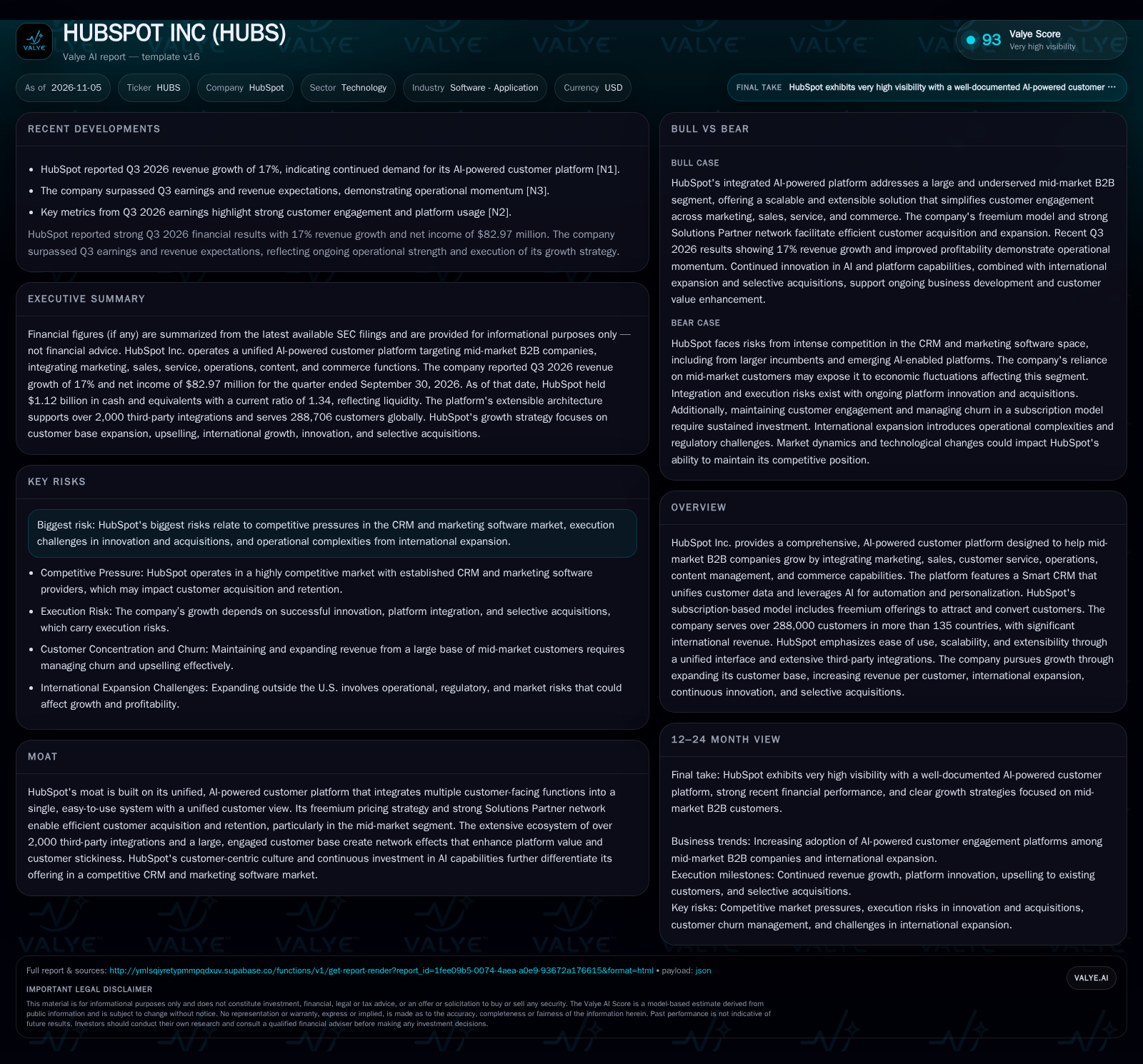
HubSpot posted robust Q3 2026 results, with 17% revenue growth and $82.97 million in net income. Its AI-powered, subscription-based platform now serves nearly 289,000 customers globally, with half its revenue from outside the US. Freemium entry, upselling, and innovation drive expansion, but execution risks and competitive intensity could test its ability to sustain momentum. Watch customer retention, international growth, and the depth of AI-driven differentiation as the next phase unfolds. [S1] [S2] [N1] [N3]
HubSpot’s recent financial performance highlights the growing relevance of its AI-powered customer platform for mid-market B2B companies. Reporting 17% revenue growth and $82.97 million in net income in Q3 2026, HubSpot has expanded its global customer base and reinforced its position as a subscription software leader. The company’s unified platform—encompassing marketing, sales, service, and commerce tools—relies on a freemium entry point, robust third-party integrations, and AI-driven automation to drive adoption and upselling. However, as HubSpot deepens its international footprint and faces intensifying competition, its ability to innovate, execute, and retain customers will determine whether this momentum can translate into sustained, profitable growth. [S1] [S2] [N1] [N3]
Recent Financial Momentum and Global Scale: What’s Changed for HubSpot in 2026
HubSpot delivered 17% revenue growth in Q3 2026, surpassing analyst expectations and achieving net income of $82.97 million for the quarter. This performance continues a trend of operational momentum and signals that demand for its integrated, AI-powered customer platform remains strong. As of December 2025, HubSpot’s customer count reached 288,706 across more than 135 countries, with 53% of customers and 48% of revenue coming from outside the US—demonstrating meaningful international penetration. The company ended Q3 2026 with $1.12 billion in cash and equivalents, a current ratio of 1.34, and a cash ratio of 0.72, reflecting a reported liquidity position. These facts collectively highlight that HubSpot is not only scaling revenue but also extending its reach and maintaining operational flexibility, setting the stage for further global expansion and platform investment. [S1] [S2] [N1] [N3]
How HubSpot Monetizes: Subscription Dynamics, Upsell Engines, and Platform Economics
HubSpot’s core business model is built on a subscription-based platform serving mid-market B2B customers. The company’s freemium model lowers barriers to initial adoption, enabling self-service onboarding and rapid expansion of its customer base. Revenue is generated through a tiered subscription structure, with higher-value plans offering advanced AI, automation, and integration capabilities. Upselling and cross-selling are central: as customers mature, they often adopt additional modules (marketing, sales, service, commerce), driving up average revenue per user (ARPU) over time.
Operating leverage is a key feature of SaaS economics. HubSpot’s high gross margins are likely supported by the scalability of its cloud infrastructure and software delivery, though sales and marketing expenses remain significant due to customer acquisition costs and ongoing engagement investments. The extensible architecture—with over 2,000 third-party integrations—enables ecosystem revenue opportunities but also requires continuous platform development. Capital needs are moderate relative to many tech peers, with the business funding innovation, international expansion, and selective acquisitions primarily from cash flow and balance-sheet resources. If HubSpot can continue increasing ARPU and reduce churn, incremental margin expansion is plausible as fixed costs are leveraged over a growing base.
HubSpot’s Defenses: Integrated Experience, Ecosystem Effects, and the Reality of Intense Competition
HubSpot faces a deeply competitive landscape, ranging from large enterprise CRM vendors to emerging AI-first SaaS entrants. Its differentiation stems from a unified platform that integrates marketing, sales, service, and commerce into a single, easy-to-use system—tailored for mid-market B2B customers. The Smart CRM, powered by AI, enables automation and personalized engagement, while the freemium model and extensive Solutions Partner network lower customer acquisition friction.
Network effects are plausible but not absolute: the value of HubSpot’s ecosystem grows as more customers and partners participate, but switching costs remain moderate compared to entrenched enterprise platforms. The breadth of third-party integrations enhances stickiness, yet the absence of high-friction lock-in means customers can theoretically migrate to alternatives if value diminishes. The core challenge is maintaining product leadership and customer-centricity as competitors invest heavily in AI, integration, and user experience. Winning in this segment will require sustained innovation and operational discipline.
What If AI and International Expansion Accelerate? The Case for Durable Margin and Growth Upside
The most favorable scenario for HubSpot involves a reinforcing cycle: rapid adoption of its AI-powered platform, continued international customer wins, and successful upselling of premium modules. If the Smart CRM and automation features drive demonstrable improvements in customer outcomes—such as higher conversion rates, improved retention, and measurable ROI—HubSpot could further entrench itself as the default choice for mid-market B2B firms.
Evidence that would confirm this scenario includes sustained high double-digit revenue growth, broadening international revenue mix, increasing ARPU, and declining churn rates. Successful integration of new AI features, positive customer case studies, and expansion of the third-party ecosystem would also validate the platform’s strategic trajectory. Margin expansion would likely follow as fixed costs are leveraged and customer lifetime value increases.
Sustaining Growth in a Competitive SaaS Environment: The Most Likely Trajectory
The most plausible outcome is that HubSpot maintains solid, though gradually moderating, growth as it expands its platform and customer base. Revenue continues to rise at low-to-mid double-digit rates, fueled by a mix of new customer acquisition, upselling, and international momentum. Margins improve incrementally as scale effects offset ongoing investments in R&D, sales, and platform innovation.
This scenario would be confirmed by continued expansion of the customer base, stable or improving ARPU, and manageable churn. Operational execution—particularly in integrating acquisitions and rolling out new AI capabilities—remains a key variable. Signs of competitive encroachment, margin pressure, or slowing international growth would challenge the sustainability of this base case.
When Competitive and Execution Risks Collide: How HubSpot’s Momentum Could Falter
Adverse outcomes could emerge if HubSpot faces intensifying competitive pressure from both larger incumbents and nimble AI-native challengers, leading to slower customer acquisition and heightened churn. If customers perceive less differentiation, or if new features fail to deliver measurable value, HubSpot’s pricing power and expansion potential could erode.
Execution missteps—such as delayed or poorly integrated platform enhancements, failed acquisitions, or international expansion setbacks—could amplify these risks. Evidence supporting a downside scenario would include declining net new customer adds, rising churn, flattening ARPU, or margin compression due to elevated customer acquisition and retention costs. Regulatory and operational challenges in international markets could further complicate the picture.
Testing the HubSpot Thesis: What Will Matter Most in the Next Phase
Net new customer additions by quarter—particularly in international markets—would help gauge the strength of ongoing adoption and expansion.
Changes in average revenue per user (ARPU) and the attach rate of premium modules, if disclosed, would indicate the effectiveness of upselling and cross-selling strategies.
Churn and net revenue retention rates, if reported, would clarify the durability of HubSpot’s subscription model and customer stickiness.
The pace and impact of new AI feature rollouts: product adoption metrics and customer feedback would test whether innovation translates into real differentiation.
Gross and operating margin trends: improvement would validate operating leverage, while deterioration could signal competitive or execution pressures.
Geographic revenue mix shifts: increasing international share would support the expansion thesis, while stagnation could indicate market saturation or local barriers.
Third-party ecosystem growth: new integration partners and solutions, if disclosed, would help assess the strength of HubSpot’s platform network effects.
Disclaimer: This is research-only, informational analysis and not investment advice. It may include AI-generated interpretation and general industry context. Always verify important details using primary sources.

Comments