
Pursuit Attractions & Hospitality: Profitability, Liquidity, and the Levers Shaping Future Resilience
Pursuit Attractions & Hospitality, Inc. posts strong Q3 2026 profitability and liquidity, but faces the cyclical and competitive realities of the attractions and hospitality sector. The company’s ability to convert operational momentum into durable growth will hinge on pricing power, capital allocation, and managing external risks.
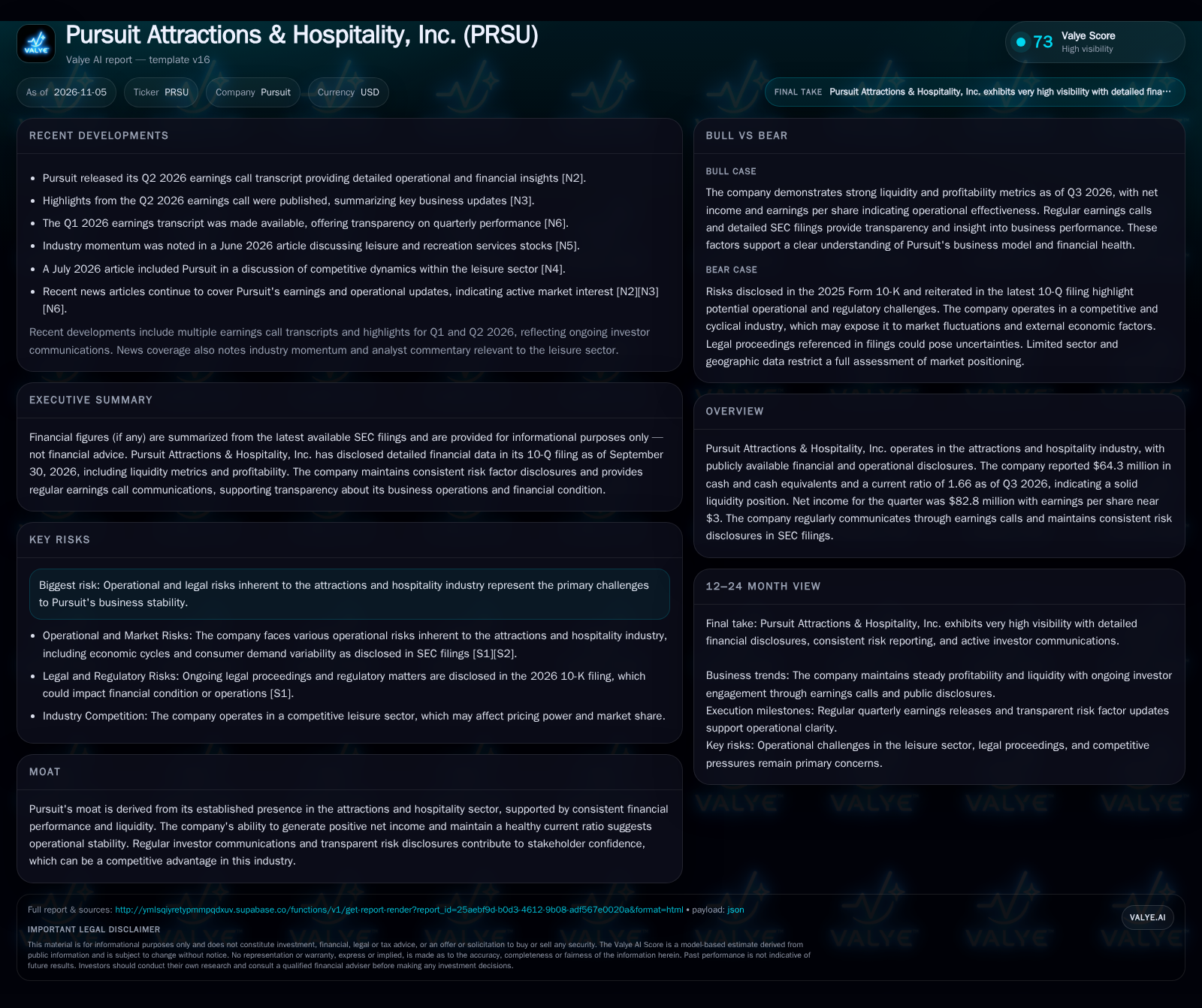
Pursuit Attractions & Hospitality reported $82.8 million in Q3 2026 net income and maintains a reported liquidity position cushion. While strong financials and investor transparency bolster confidence, the company’s long-term trajectory depends on its ability to navigate industry cyclicality, defend margins, and differentiate amid intensifying competition. Monitoring revenue mix, cost discipline, and guest demand trends will be critical for assessing whether current performance is sustainable or vulnerable to reversal.
Pursuit Attractions & Hospitality, Inc. enters late 2026 with notable financial strength: a robust Q3 net income of $82.8 million, nearly $3 per share in earnings, and a liquidity position that sets it apart from many peers in the attractions and hospitality sector. These figures, paired with regular earnings disclosures and risk transparency, create a compelling case for stability. Yet, beneath the surface, Pursuit must contend with the industry’s trademark volatility—ranging from swings in consumer demand to competitive pricing and regulatory headwinds. Whether the company can transform its current operational momentum into enduring value creation will depend on how it balances growth ambitions, capital discipline, and the realities of a cyclical market.
Solid Q3 Profitability and Liquidity Set the Stage, but Sector Risks Persist
Pursuit Attractions & Hospitality reported net income of $82.8 million for the quarter ending September 30, 2026, translating to basic earnings per share of $2.99 and diluted EPS of $2.95 [S2]. The company reported cash and liquidity metrics for the period; these figures do not by themselves establish operating runway, investment capacity, financial flexibility, or financing capacity. [S2] These metrics signal operational effectiveness and prudent balance sheet management. However, the company continues to reiterate operational, legal, and competitive risks in its SEC filings—highlighting the inherent volatility and external pressures in the attractions and hospitality industry [S2].
How Pursuit Converts Guest Experiences into Earnings: The Economics Behind the Numbers
The core revenue model for attractions and hospitality companies typically blends admissions, lodging, food and beverage, and ancillary services. Pricing power often hinges on location, brand strength, and the uniqueness of the guest experience—factors that can support higher margins during periods of robust demand. Fixed costs, such as property leases, maintenance, and staffing, are substantial, but high operating leverage means incremental revenue growth can significantly boost profitability in peak periods. Conversely, slowdowns can quickly compress margins if fixed costs are not sufficiently flexible.
Pursuit’s strong net income in Q3 2026 suggests it is currently benefiting from favorable pricing, volume, or a positive mix in its portfolio [S2]. But the sustainability of this performance will rely on the company’s ability to manage labor and input costs, optimize occupancy rates, and adjust offerings to changing consumer preferences. Capital expenditures for property upgrades or new attractions can be significant, so disciplined reinvestment and careful cash management remain essential to avoid overextension—especially as the sector’s cyclicality can mask underlying vulnerabilities during strong quarters.
In addition to managing fixed and variable costs, Pursuit’s ability to leverage data analytics and customer insights can materially influence its revenue optimization strategies. By analyzing guest behavior patterns, spending habits, and feedback, the company can tailor pricing tiers, promotional offers, and experience bundles that maximize per-guest revenue while enhancing satisfaction. This data-driven approach also aids in demand forecasting, allowing for better alignment of staffing and inventory levels, which is critical in an industry where labor costs and perishability of services directly impact profitability. The integration of technology platforms to support dynamic pricing and personalized marketing could further strengthen Pursuit’s margin resilience amid fluctuating demand.
Capital allocation decisions in the attractions and hospitality sector require a delicate balance between growth investment and maintaining potential financial flexibility. Pursuit must evaluate the return on invested capital (ROIC) of potential projects against the backdrop of cyclical demand and evolving consumer preferences. Investments in property enhancements or new attractions should be prioritized based on their ability to generate incremental revenue above the company’s weighted average cost of capital (WACC). Moreover, the timing of these investments is crucial; deploying capital during peak demand phases may yield better payback periods, whereas overinvestment during downturns could exacerbate financial strain. A disciplined capital allocation framework that incorporates scenario planning and sensitivity analyses will help Pursuit navigate these complexities.
Defending the Moat: Differentiation, Scale, and the Threat of Substitution
Attractions and hospitality is a notoriously fragmented and competitive sector, with barriers to entry that vary by market segment. Large, established operators may benefit from brand recognition, economies of scale, and the ability to cross-sell or bundle experiences, but regional and niche competitors can quickly erode pricing power if differentiation is weak. The threat of substitution—from alternative leisure activities, digital entertainment, or new experiential concepts—remains ever-present.
Pursuit’s current financial health and regular investor communication suggest it enjoys some degree of operational stability and stakeholder confidence [S2] [N2] [N3] [N6]. However, the report does not establish the extent of its geographic footprint, brand strength, or customer loyalty. In this environment, the company’s long-term defensive position will depend on its ability to deliver a compelling guest experience that is difficult for competitors or substitutes to replicate, while maintaining cost discipline and adaptability to shifting consumer trends.
Operational Leverage and Unique Offerings Drive Outperformance—If Demand Holds
If Pursuit can continue attracting strong guest volumes, optimize pricing, and enhance its service mix, the company could realize substantial incremental profitability thanks to the sector’s operating leverage. Upside would be amplified by successful deployment of capital into high-ROI property upgrades, new attractions, or strategic partnerships that differentiate its portfolio and attract higher-spending customers.
Confirmation of this scenario would come from sustained or accelerating revenue and net income growth, rising average guest spend, and evidence of expansion into new markets or segments. Additional signals would include positive commentary on forward bookings and occupancy rates during earnings calls, and disclosures of successful product launches or margin expansion. Conversely, a plateau or decline in these metrics—particularly if accompanied by rising costs or muted guest demand—would challenge the bullish thesis.
Steady Demand and Disciplined Cost Control Sustain Current Profitability
The most plausible trajectory is one in which Pursuit maintains steady operational execution, with guest demand and pricing holding at or near current levels. Cost management remains a focus, allowing the company to preserve healthy margins even as the competitive environment limits outsized growth. Incremental improvements—such as modest property upgrades, targeted marketing, or operational efficiencies—support stable cash flows and continued investor confidence.
Evidence supporting this scenario would include consistent quarterly earnings, stable or gently rising occupancy and guest spend figures (if disclosed), and an absence of major legal or regulatory disruptions. Any material deterioration in cost control, guest demand, or the emergence of new competitive threats could shift the company toward a less favorable trajectory.
Demand Shock or Margin Compression Exposes Vulnerabilities
A pronounced downturn in consumer demand—triggered by macroeconomic weakness, changing travel patterns, or negative publicity—could quickly erode Pursuit’s revenue base. Given the sector’s high fixed-cost structure, even a modest decline in guest volumes or pricing could have an outsized impact on margins and cash flow. Intensifying competition or the emergence of compelling substitutes could further pressure pricing and occupancy rates.
This scenario would be confirmed by declining quarterly revenues, shrinking net income, or negative earnings surprises. Rising operating costs without offsetting revenue growth would also signal margin compression. Legal or regulatory setbacks, if material, could further exacerbate financial strain.
Testing Pursuit’s Resilience: What Will Distinguish Durable Performance from Cyclical Upswings?
Quarterly revenue growth and net income trends—particularly in relation to peer performance and broader sector demand—would help distinguish enduring momentum from temporary strength.
Average guest spend and occupancy rates, if disclosed, would provide insight into pricing power, product mix, and guest engagement.
Trends in operating expenses as a percentage of revenue will reveal cost control effectiveness and margin resilience.
Capital expenditure disclosures and commentary on property upgrades or new attraction investments will clarify management’s growth ambitions and risk appetite.
Updates on legal proceedings or regulatory investigations, as referenced in SEC filings, could materially impact operational flexibility or financial results.
Forward-looking commentary on booking trends, pipeline projects, or geographic expansion, if provided in earnings calls, would offer visibility into future growth potential.
Management’s approach to cash deployment—such as share repurchases, dividends, or debt reduction—will signal confidence in the sustainability of current performance.
Disclaimer: This is research-only, informational analysis and not investment advice. It may include AI-generated interpretation and general industry context. Always verify important details using primary sources.

Comments