
OPKO Health’s Pursuit of Global Endocrine and Renal Franchise: Funding, Foreign Exchange, and the Stakes of Commercial Execution
OPKO Health’s broad regulatory wins for its long-acting growth hormone and commercial launches of Rayaldee and Mazdutide position the company as a potential global specialty pharma player—but persistent losses, heavy foreign currency exposure, and ongoing funding needs underscore the importance of operational discipline and market penetration.
The company’s ability to translate product approvals into sustained cash flow is critical, as ongoing losses and funding needs could limit its strategic flexibility if commercial execution lags [S2] [N1].
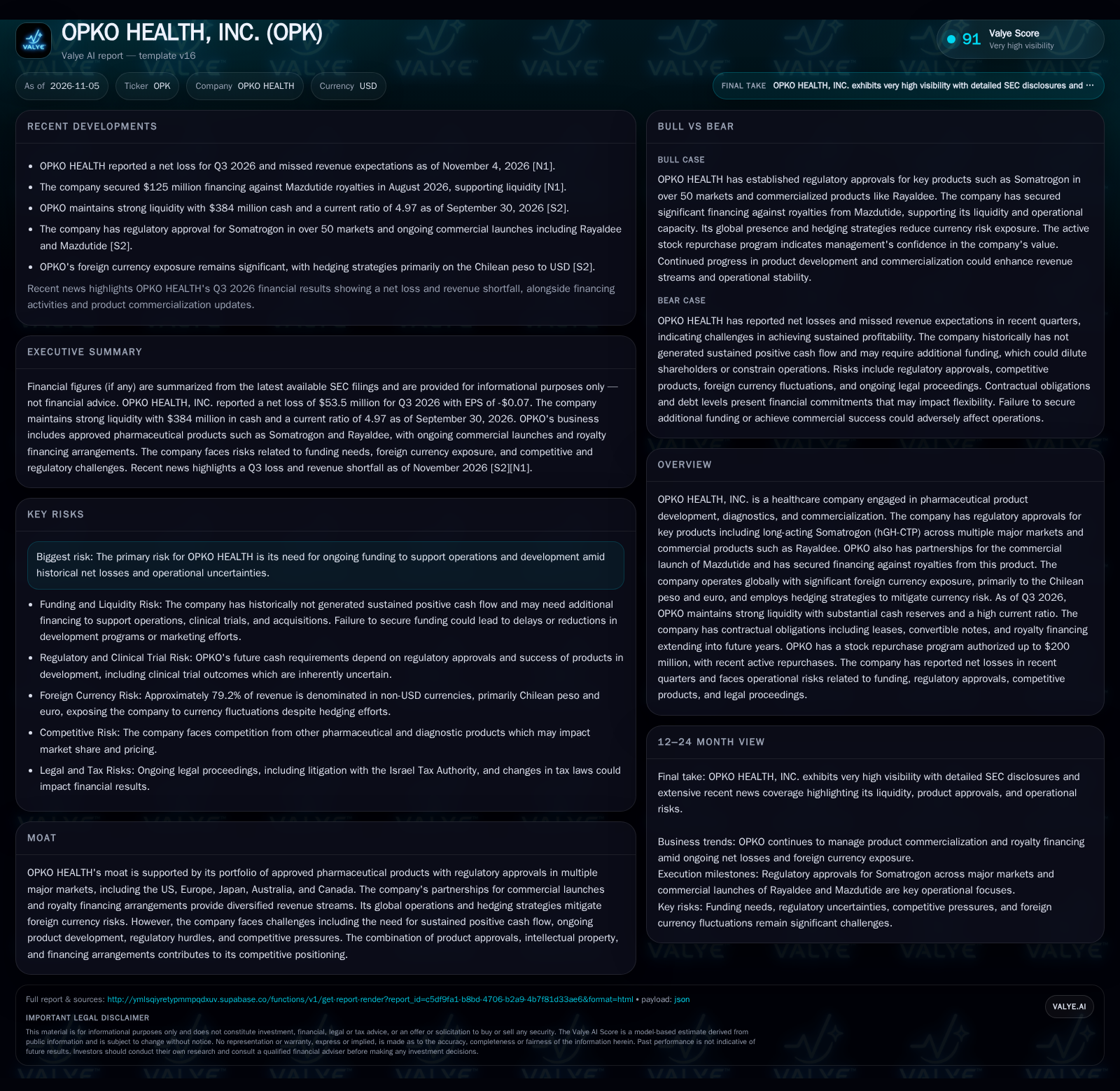
OPKO Health, Inc. stands at a strategic crossroads: it has achieved broad international regulatory approval for its long-acting growth hormone Somatrogon and is actively commercializing products like Rayaldee and Mazdutide through partners. Yet, despite reported liquidity position—$384 million in cash and a robust current ratio—the company reported another net loss for Q3 2026 and continues to miss revenue expectations. With nearly 80% of its revenue denominated in non-USD currencies and ongoing funding requirements to support development, OPKO’s next chapter depends on converting its product portfolio into reliable, growing cash flows while navigating the twin headwinds of foreign exchange and operational risk [S2] [N1].
Recent Losses and Global Product Approvals Define the Current Landscape
OPKO Health reported a net loss of $53.5 million for the quarter ended September 30, 2026, with basic and diluted EPS of -$0.07. This loss accompanied a miss on revenue expectations, as highlighted in recent news [N1] [S2]. Despite this, the company held $384 million in cash and cash equivalents and reported liquidity-ratio trends of 4.97, reflecting reported liquidity position as of the quarter's end [S2].
A key operational milestone is OPKO’s regulatory approval for Somatrogon (hGH-CTP) in more than 50 global markets, spanning the US, Europe, Japan, Australia, and Canada. The company also continues commercial launches of Rayaldee and, through partners, Mazdutide [S2].
Approximately 79.2% of OPKO’s revenue is denominated in currencies other than USD, primarily the Chilean peso and euro, exposing the company to significant foreign exchange fluctuations—though hedging strategies are in place, particularly for the Chilean peso [S2].
Product Mix, Cost Structure, and the Challenge of Achieving Sustainable Cash Flow
OPKO Health’s business model hinges on pharmaceutical product development, regulatory approval, and commercialization—either directly or through partnerships. The economics of this model are defined by high upfront R&D and regulatory costs, followed by the potential for high-margin recurring revenue streams if products successfully penetrate their target markets.
Somatrogon, as a long-acting recombinant human growth hormone, targets the pediatric and adult growth hormone deficiency markets—segments historically dominated by a handful of large specialty pharma and biotech firms. If OPKO can secure meaningful market share, the product’s once-weekly dosing and broad regulatory footprint could translate into pricing power and steady volume over time. However, payer dynamics and competition from established products and biosimilars may constrain realized prices and uptake.
Rayaldee addresses secondary hyperparathyroidism in chronic kidney disease—a large, often undertreated population—while Mazdutide (licensed to partners) targets metabolic indications. Both offer multi-year revenue tail potential if adoption accelerates.
Fixed costs remain substantial due to ongoing clinical development, regulatory compliance, and global commercial infrastructure. Variable costs, including manufacturing and royalties, should scale with volume, but persistent net losses indicate that OPKO has yet to reach the critical mass of revenue needed for operational breakeven. The company’s ongoing funding needs suggest negative operating cash flow, a material risk if commercial momentum stalls or if additional capital must be raised on unfavorable terms.
Market Positioning, Foreign Exchange, and the Battle for Share in Endocrine and Renal Markets
OPKO faces a bifurcated competitive landscape: on one hand, its broad regulatory approvals and partnerships provide global reach and a diversified product base; on the other, the company contends with entrenched competitors in both the endocrine (growth hormone) and renal (secondary hyperparathyroidism) categories.
In the growth hormone space, OPKO’s Somatrogon must compete with established long-acting products from major pharmaceutical companies, some of whom possess deeper commercial infrastructure and larger sales forces. While once-weekly dosing is a clear differentiator, switching costs may be moderate for physicians and payers, especially if alternatives are already reimbursed or bundled with broader specialty offerings.
Rayaldee’s competitive set consists of both branded and generic therapies for secondary hyperparathyroidism and vitamin D insufficiency. Success here relies on payer coverage, guideline inclusion, and real-world evidence to drive provider adoption.
OPKO’s exposure to non-USD markets could be a double-edged sword: while it opens up growth in Latin America and Europe, it also introduces earnings volatility due to foreign currency movements—a risk only partially mitigated by hedging. This currency exposure makes OPKO’s reported results more sensitive to macroeconomic and geopolitical factors than many US-centric peers.
If Commercial Execution Accelerates: Pathways to Margin Expansion and Self-Funding
A favorable scenario for OPKO Health hinges on the successful translation of its regulatory approvals into accelerated product adoption and revenue growth—particularly for Somatrogon and Rayaldee. If the company can convert approvals into significant market share, leverage its global partnerships, and drive volume in both developed and emerging markets, the business could reach operational breakeven and ultimately generate sustained free cash flow.
Upside could be amplified if foreign exchange rates stabilize or move favorably, enhancing reported revenues and margins. Further, if Mazdutide and other pipeline assets achieve strong uptake through partner launches, OPKO could benefit from high-margin royalty streams with limited incremental expense.
Confirmation of this scenario would include a sustained inflection in quarterly revenue, narrowing losses, positive operating cash flow, and evidence of market share gains in key geographies. Additional product launches or label expansions—especially in the US, EU, or Japan—would further strengthen the thesis. Conversely, failure to show sequential revenue growth or continued cash burn would undermine the upside case.
Execution Risks Temper Near-Term Outlook Despite Product Breadth
The most plausible outlook for OPKO Health is one of ongoing operational volatility: the company continues to commercialize its approved products, but faces slow ramp in adoption and persistent margin pressure due to competition, payer dynamics, and foreign currency fluctuations.
OPKO’s large non-USD revenue base means that even if underlying product volume grows, reported results could remain choppy if currency headwinds persist. While the company’s liquidity position is currently strong, historical negative cash flow and recurring net losses suggest that additional capital raises may be necessary if commercial execution lags or development costs spike.
Confirmation of this scenario would involve continued net losses and only gradual improvement in revenue and margin trends, with product launches offset by FX and competitive headwinds. Conversely, a decisive move into operating profitability, or a material reduction in cash burn, would challenge the base case.
Persistent Losses, Currency Headwinds, and Funding Gaps Erode Strategic Options
In a negative scenario, OPKO Health’s product launches fail to gain traction—either due to competitive pushback, slower-than-expected adoption, or pricing pressure. With nearly 80% of revenue exposed to foreign exchange fluctuations, a strengthening USD or continued volatility in the Chilean peso and euro could further depress reported results.
If commercial execution falters and negative cash flow persists, the company may be forced to seek additional funding under less favorable terms, potentially diluting existing shareholders or triggering cost-cutting that impacts R&D and commercial support. Additionally, setbacks in ongoing clinical trials or regulatory hurdles could push out revenue inflections, exacerbating the funding gap.
Evidence for this scenario would include widening net losses, deteriorating cash balances, delayed or failed product launches, and announcements of dilutive financings. Mitigating factors would be unexpected success in new launches, favorable FX movements, or significant cost containment without sacrificing growth.
Milestones and Metrics That Will Test OPKO’s Commercial and Financial Trajectory
Quarterly revenue growth for Somatrogon and Rayaldee, especially in the US, EU, and Japan—if disclosed, this would be a primary indicator of commercial traction.
Operating cash flow trends: sustained movement toward breakeven would signal improved business health.
Updates on foreign exchange impacts and effectiveness of hedging strategies, particularly regarding the Chilean peso and euro.
The pace and terms of any new funding rounds or debt issuances, which would reveal the company’s access to capital markets and potential dilution risk.
Progress reports or partner disclosures on Mazdutide and other pipeline product launches.
Regulatory or reimbursement milestones in key markets, especially new label expansions or payer coverage wins.
Changes in share repurchase activity, which could reflect management’s evolving view of intrinsic value and balance sheet priorities.
Material developments in ongoing legal or tax proceedings, as outcomes here could affect operational flexibility or net cash.
Disclaimer: This is research-only, informational analysis and not investment advice. It may include AI-generated interpretation and general industry context. Always verify important details using primary sources.

Comments