
Crane NXT’s Earnings Outperformance: Dissecting Resilience, Liquidity Constraints, and the Stakes of Volatility
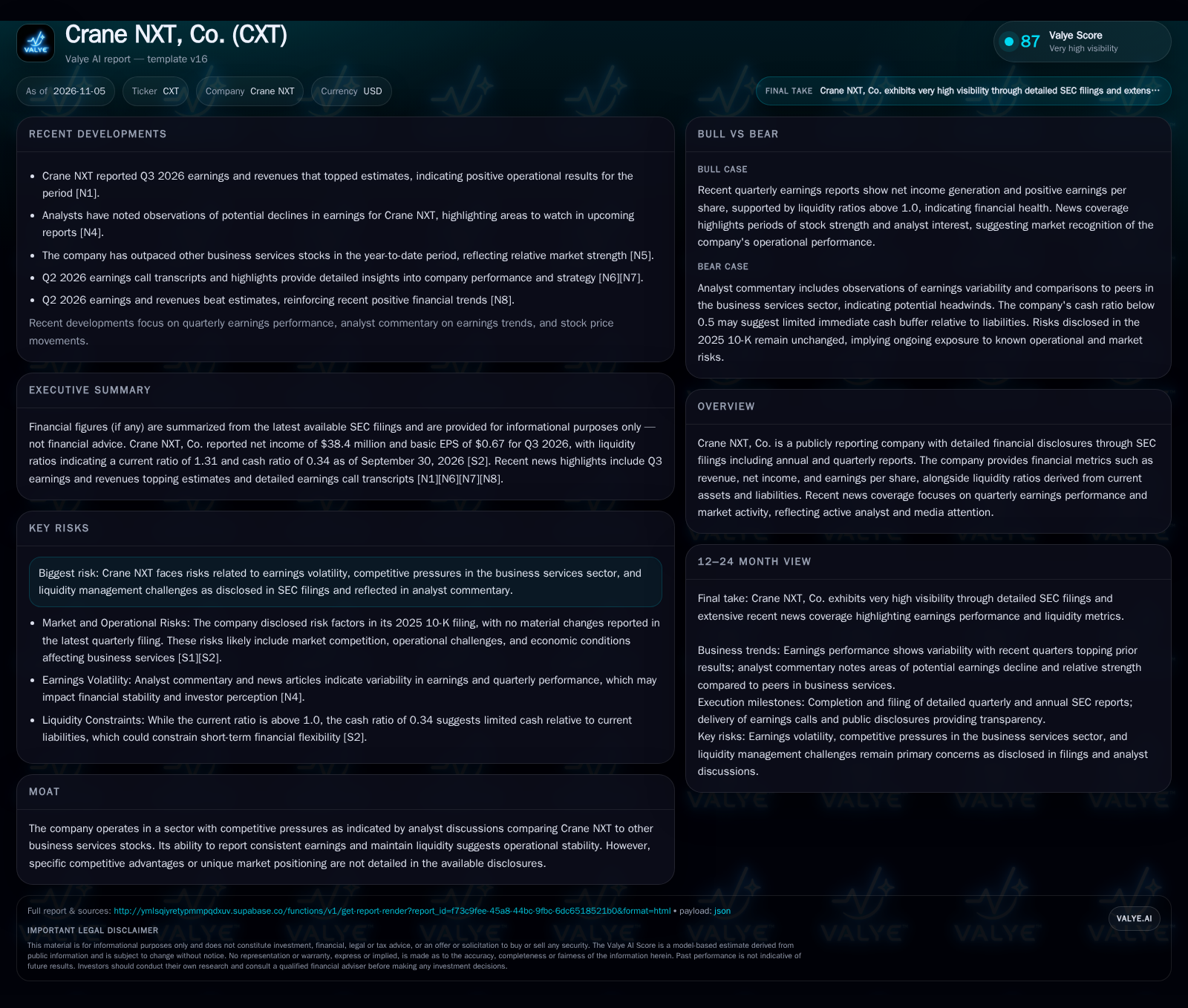
Crane NXT posted Q3 2026 net income of $38.4M and beat revenue estimates, signaling operational momentum.
Crane NXT posted Q3 2026 net income of $38.4M and beat revenue estimates, signaling operational momentum. The company’s ability to sustain outperformance will likely hinge on translating short-term operational wins into durable advantages while managing risk factors disclosed in recent filings. [S2] [N1] [N4] [N5]
Crane NXT, Co. has delivered a string of quarterly earnings and revenue beats, most recently posting $38.4 million in net income for Q3 2026 and topping analyst expectations. This operational momentum has set the company apart from its business services peers so far this year. Crane NXT’s next challenge is to demonstrate that its recent outperformance can be sustained, even as sector competition and cash management pressures persist. [S2] [N1] [N4] [N5]
Recent Outperformance Meets Persistent Financial Constraints
Crane NXT’s third quarter of 2026 marked a period of operational strength, with net income of $38.4 million and diluted EPS of $0.66, as well as revenues topping analyst estimates. This performance continues a trend of positive earnings surprises, including a Q2 2026 beat. While Crane NXT has outpaced other business services companies year-to-date, as noted by analysts, concerns linger regarding the sustainability of earnings momentum and the company’s ability to navigate periods of volatility with limited immediate cash resources. Risk disclosures from the previous year’s 10-K remain unchanged, underscoring ongoing operational and market risks. [S2] [N1] [N4] [N5]
How Crane NXT’s Revenue Model Could Translate to Sustainable Profitability
Crane NXT’s financials illustrate a business model that produces substantial revenue and positive net income, but the underlying economic levers are not fully disclosed in the available reports. It is plausible, given the business services context, that revenue is generated through a mix of service contracts, recurring maintenance, and possibly technology or equipment sales—each carrying distinct margin and capital implications. If the company relies on long-term service agreements, this could provide revenue visibility and operating leverage as fixed costs are spread over a growing base. The company’s ability to manage variable costs, optimize pricing, and drive mix toward higher-margin offerings would directly impact its free cash flow generation and capital requirements. Without disclosure of contract structure, customer concentration, or gross margins, the sustainability of recent net income levels remains an open question.
Moreover, the capital intensity of Crane NXT’s operations is a critical factor influencing its profitability trajectory. If the business requires significant upfront investment in technology, infrastructure, or human capital to secure and service contracts, this could impose a lag between revenue recognition and free cash flow generation. Conversely, a lower capital expenditure profile combined with scalable service delivery could enable the company to convert incremental revenue growth into disproportionate profit expansion. The interplay between fixed and variable cost structures will thus shape the company’s operating leverage and resilience to demand fluctuations. A detailed breakdown of cost categories and capital deployment strategies would therefore provide valuable insight into the durability of earnings momentum.
Another dimension to consider is the pricing power embedded in Crane NXT’s customer agreements. If the company operates in a segment where service differentiation or regulatory requirements limit substitution, it may be able to implement price escalations aligned with inflation or value delivered, thereby protecting margins. However, if contracts are subject to competitive bidding cycles or benchmarked against commoditized offerings, pricing flexibility may be constrained, making margin expansion challenging. The presence of contractual escalation clauses or volume-based incentives would be indicative of embedded pricing dynamics that could either cushion or amplify the impact of market volatility on profitability.
Sector Rivalry and the Challenge of Defensible Differentiation
Crane NXT operates in the business services sector, which is marked by intense competition, frequent benchmarking against peers, and persistent pricing pressure. Analyst commentary and news coverage suggest that while the company has outperformed sector peers in recent periods, this leadership is not necessarily durable without a clear source of differentiation. The lack of explicit disclosure regarding proprietary technology, unique service capabilities, or customer lock-in mechanisms means Crane NXT may be vulnerable to price-based competition and substitution by more nimble or better-capitalized rivals. In this environment, advantages could stem from operational efficiency, customer relationships, or integrated offerings, but these would need to be evidenced by sustained margin outperformance or recurring revenue growth. The unchanged risk factors in the 2025 10-K imply that competitive intensity and the risk of market share erosion remain material concerns. [S1] [N5]
If Operational Momentum Catalyzes a Virtuous Cycle
The most favorable scenario for Crane NXT is that its recent earnings and revenue beats are not merely cyclical but signal a structural shift—perhaps through improved cost management, successful pricing strategies, or the ramp-up of higher-margin offerings. If the company can demonstrate growing revenue visibility (for example, through multi-year customer contracts or recurring service fees), operating leverage could expand margins even as topline grows. Confirmation of this scenario would include disclosure of increasing backlog, rising gross or operating margins, and evidence of customer retention or expansion. Falsification would come if subsequent quarters show reversion to volatile or declining earnings, or if competitive pressures force price concessions that erode profitability.
Sustained Outperformance Remains Elusive Without Structural Change
The most plausible path is that Crane NXT continues to deliver competitive results in line with sector averages, swinging between quarters of outperformance and periods of earnings pressure. Without evidence of a defensible moat or recurring-revenue engine, performance is likely to remain tied to broader business services demand cycles and the company’s ability to execute operational improvements.
Liquidity Stress and Competitive Erosion Could Trigger Earnings Volatility
In this situation, the company could face pressure to discount services, accept less favorable contract terms, or draw on external financing—each with implications for margins and balance-sheet risk. Confirmation of this downside would include a declining current ratio, shrinking cash reserves, missed earnings expectations, or negative revisions to forward guidance. A useful early warning would be a sudden spike in short-term borrowing or evidence of increased customer churn, if disclosed.
What Will Reveal Whether Crane NXT’s Outperformance Is Durable
Quarterly gross and operating margin trends, if disclosed, would clarify whether recent net income strength is due to sustainable operational improvements or temporary factors.
Any disclosure of contract duration, recurring revenue proportion, or backlog growth would help test the durability of Crane NXT’s revenue streams.
Customer concentration metrics, if provided, would reveal sensitivity to key account losses and the degree of revenue diversification.
Competitive win and loss rates, or commentary on new product/service launches, would help assess whether Crane NXT is gaining or ceding market share.
Updates to risk disclosures, especially relating to market conditions or operational execution, would show whether management perceives an evolution in threat levels.
Earnings guidance and management commentary on future quarters would clarify whether recent outperformance is expected to persist or moderate.
Disclaimer: This is research-only, informational analysis and not investment advice. It may include AI-generated interpretation and general industry context. Always verify important details using primary sources.

Comments