
3D Systems: Integrated Additive Manufacturing Pushes for Recurring Revenue as Healthcare Applications Gain Traction
Despite persistent net losses, 3D Systems' broad technology portfolio, proprietary materials, and recent FDA-cleared healthcare applications highlight both the promise and the execution risks of scaling additive manufacturing for industrial and medical markets.
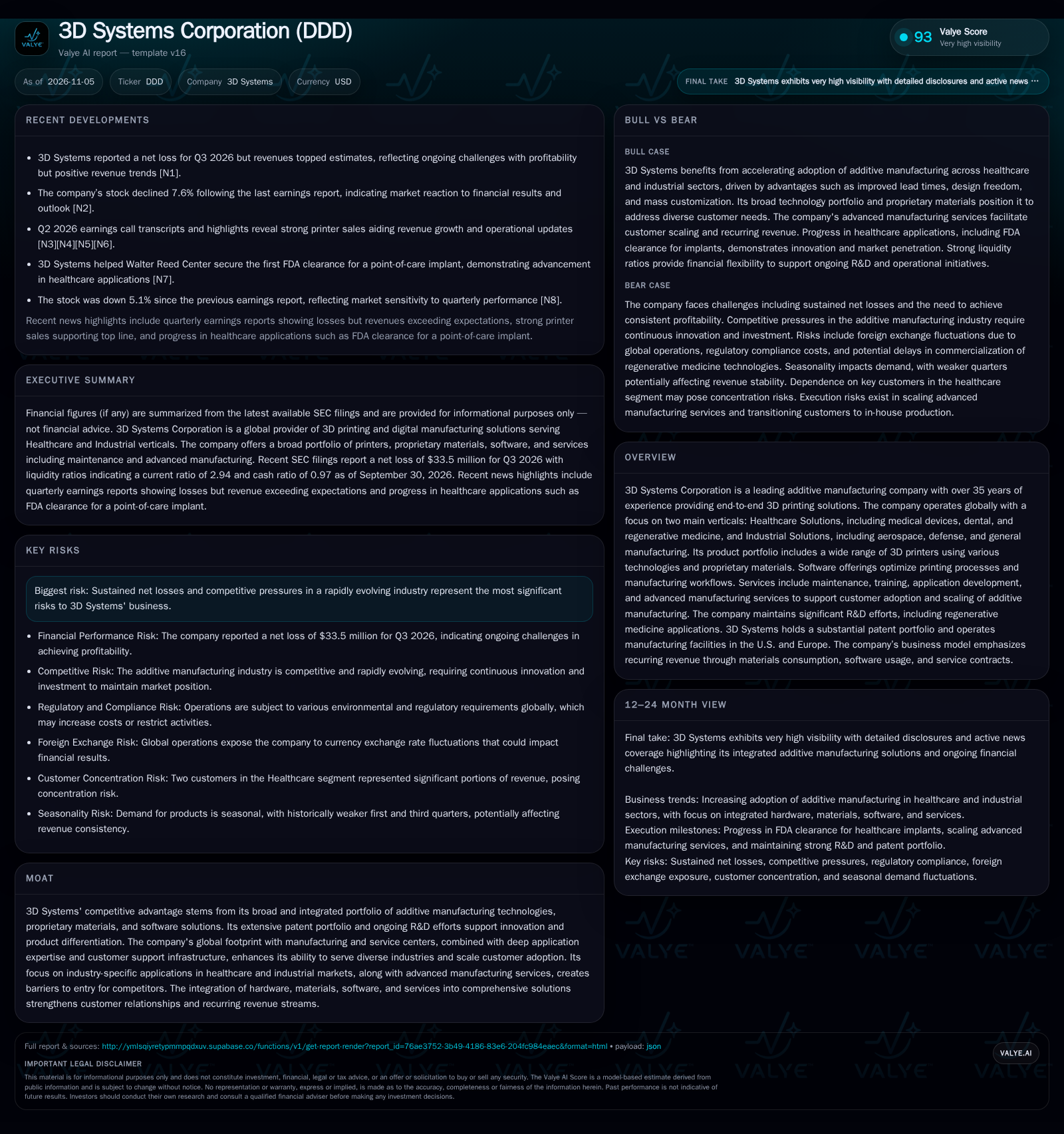
3D Systems remains a core player in 3D printing, reporting ongoing net losses yet exceeding revenue estimates in recent quarters. Its strategy hinges on expanding recurring revenue from materials, software, and services, while progress in healthcare—such as helping secure FDA clearance for a point-of-care implant—reflects the potential for high-value applications. However, profitability, competitive intensity, and the challenge of moving customers from pilot to scaled production remain central hurdles. [N1] [N7]
3D Systems Corporation stands at a pivotal moment in additive manufacturing. While its recent net losses underline the ongoing challenge of scaling profitability in a competitive, capital-intensive sector, the company’s broad portfolio and proprietary technology enable it to address a diverse set of industrial and healthcare needs. Notably, 3D Systems has demonstrated tangible progress in high-value healthcare applications, such as helping Walter Reed Center secure FDA clearance for a point-of-care implant. The core question is whether 3D Systems’ integrated approach—blending hardware, software, materials, and services—can accelerate adoption fast enough to generate durable, recurring revenue streams and ultimately shift the business to sustained profitability. [N1] [N7]
Recent Results Highlight Revenue Momentum and Healthcare Progress Amid Losses
3D Systems reported a net loss of $33.5 million for Q3 2026, continuing a pattern of negative earnings despite revenue exceeding analyst estimates. This revenue outperformance was aided by strong printer sales, pointing to ongoing customer demand for capital equipment even as profitability remains elusive. [N1]
The company’s role in helping the Walter Reed Center secure FDA clearance for a point-of-care implant marks a significant milestone for its healthcare segment, suggesting that 3D Systems is gaining traction in high-value, regulated medical applications. [N7]
As of September 30, 2026, 3D Systems reported $91.3 million in cash and equivalents, $27.1 million in short-term investments, and a current ratio of 2.94—metrics that provide a snapshot of current liquidity but do not, by themselves, resolve questions about the sustainability of ongoing losses. [S2]
Seasonal demand patterns and customer concentration in healthcare continue to influence quarterly performance, contributing to volatility and underscoring the execution risks in scaling both industrial and medical verticals.
How 3D Systems Seeks Profitable Growth: Recurring Revenue and the Challenge of Scale
3D Systems’ business model is built around selling 3D printers (both plastics and metals), proprietary materials, software, and a suite of value-added services. The economic engine depends on converting initial hardware sales into recurring revenue streams through ongoing materials usage (resins, powders, biocompatible polymers), software licenses, and maintenance or advanced manufacturing contracts.
Theoretically, once a printer is installed, customer switching costs and workflow integration may create a captive revenue base for consumables and software upgrades. However, the actual stickiness of these revenue streams is tested by the ease with which customers can substitute third-party materials or migrate to alternative platforms if economics or technology shift.
Gross margins in additive manufacturing can be attractive on proprietary materials and software, but hardware sales are often competitive and may be discounted to seed the installed base. As a result, the mix of revenue from high-margin consumables and services versus lower-margin hardware is a critical driver of overall profitability.
The capital intensity of maintaining a broad product portfolio, investing in R&D (especially in regenerative medicine), and supporting global manufacturing and service operations creates significant fixed costs. Operating leverage may improve as adoption scales, but the company’s persistent net losses underscore the challenge of achieving break-even at current volume and mix.
Integrated Solutions and Application Depth: 3D Systems’ Relative Advantages and Exposures
3D Systems competes in a fragmented and rapidly evolving additive manufacturing landscape, facing rivals ranging from specialist 3D printer OEMs to vertically integrated industrial conglomerates and nimble software/materials startups.
The company’s main differentiators are its breadth of 3D printing technologies (SLA, SLS, DMP, MJP, polymer extrusion, bioprinting), proprietary materials portfolio, and its end-to-end solution offering that integrates hardware, software, and services. This integration can create deeper customer relationships and facilitate cross-selling, especially in regulated or complex applications like healthcare and aerospace.
A substantial patent portfolio (854 granted patents as of year-end 2025) and ongoing R&D in areas such as regenerative medicine provide barriers to entry and support product differentiation. However, these advantages are not absolute: rapid technological change, open-materials ecosystems, and customer desire for flexibility may erode traditional moats.
Competitive intensity is amplified by the industry’s push toward open platforms, price competition in hardware, and the risk that large customers could insource production or multi-source across multiple vendors to optimize costs.
If Recurring Revenue Accelerates and Healthcare Adoption Scales, Profitability Could Follow
The most favorable scenario for 3D Systems involves rapid scaling of recurring revenue from proprietary materials and software as the installed base of printers grows, especially in high-value sectors like healthcare and aerospace. If the company can leverage its FDA-cleared applications and deepen integration with medical device partners, it could secure long-duration, higher-margin consumables contracts and services agreements.
Proof points would include accelerating revenue growth from materials and software, expanding gross margins, and new regulatory clearances or major medical adoption milestones. A sustained reduction in net losses (or a move to profitability) as fixed costs are leveraged by higher recurring revenue would strongly support this scenario.
Successful commercialization of regenerative medicine applications, such as bioprinted tissues or implants, would further strengthen the thesis by opening new, defensible markets with significant pricing power.
Confirmation would come from disclosures of growing materials/software revenue mix, multi-year healthcare contracts, and margin expansion, while falsification would be signaled by stagnating recurring revenue or continued reliance on low-margin hardware sales.
Mixed Progress, Ongoing Losses: Most Likely Outcome Is Incremental Adoption and Margin Pressure
The most plausible outcome is that 3D Systems continues to grow its installed base and recurring revenue, but at a pace offset by industry competition, pricing pressure, and the slow ramp of new healthcare applications. Incremental wins—such as additional FDA clearances or new industrial partnerships—support top-line growth, but operating leverage remains limited due to high fixed costs and the need for ongoing R&D investment.
Margins may remain under pressure as hardware sales are used to seed adoption, and as customers negotiate for open-materials compatibility or seek pricing concessions. The company likely oscillates between quarters of revenue outperformance and periods of margin compression, with persistent (though possibly narrowing) net losses.
Evidence for this scenario would include continued revenue growth but flat or modestly improving gross margins, ongoing but slow expansion of healthcare applications, and disclosures indicating that recurring revenues are not yet large enough to offset cost structure.
Sustained Losses and Competitive Erosion Threaten Business Model Viability
In a negative scenario, 3D Systems is unable to scale recurring revenue fast enough to cover its fixed costs. Increased competition in both hardware and materials erodes pricing power, while key customers in healthcare or industrial sectors shift to alternative providers or in-house solutions.
The failure to convert high-profile healthcare milestones into durable revenue streams—either due to slow regulatory adoption, limited reimbursement, or customer reluctance—would exacerbate operating losses and could force strategic retrenchment or asset sales.
Persistent net losses deplete liquidity, raising the risk of dilutive capital raises or cost-cutting that undermines future innovation. Regulatory setbacks or significant customer churn would further pressure the business.
Confirmation of this scenario would come from accelerating losses, declining revenue, loss of major customers, or disclosures of severe cost containment measures.
Milestones and Metrics That Will Reveal 3D Systems’ Ability to Transform Its Model
Trends in recurring revenue from materials, software, and services—especially as a percentage of total revenue—would help test whether the business is moving beyond hardware dependence (if disclosed).
Gross margin evolution, particularly improvement tied to higher materials/software mix versus hardware sales, would indicate progress toward profitability.
Number and scale of new regulatory clearances or major healthcare partnerships, especially involving bioprinted implants or tissues.
Quarterly disclosures on customer concentration and churn in both healthcare and industrial segments.
Operating expense discipline relative to revenue growth, as measured by R&D and SG&A trends.
Cash burn rate and changes in liquidity or capital-raising activity, to assess runway and funding risk.
Evidence of major customer transitions to in-house production or alternative suppliers, which could undermine recurring revenue streams.
Updates on seasonality effects, particularly whether the company can smooth demand volatility across quarters.
Disclaimer: This is research-only, informational analysis and not investment advice. It may include AI-generated interpretation and general industry context. Always verify important details using primary sources.

Comments