
NETGEAR’s Strategic Crossroads: Liquidity Resilience Meets Structural Profitability Pressures
NETGEAR’s recent performance juxtaposes reported liquidity position with persistent operating losses and revenue contraction, raising fundamental questions about the sustainability of its hardware-centric model in a rapidly evolving networking market. With board-level cybersecurity governance and international revenue focus, the company’s next phase will hinge on its ability to adapt its economics and defend relevance against intensifying competition and technological disruption.
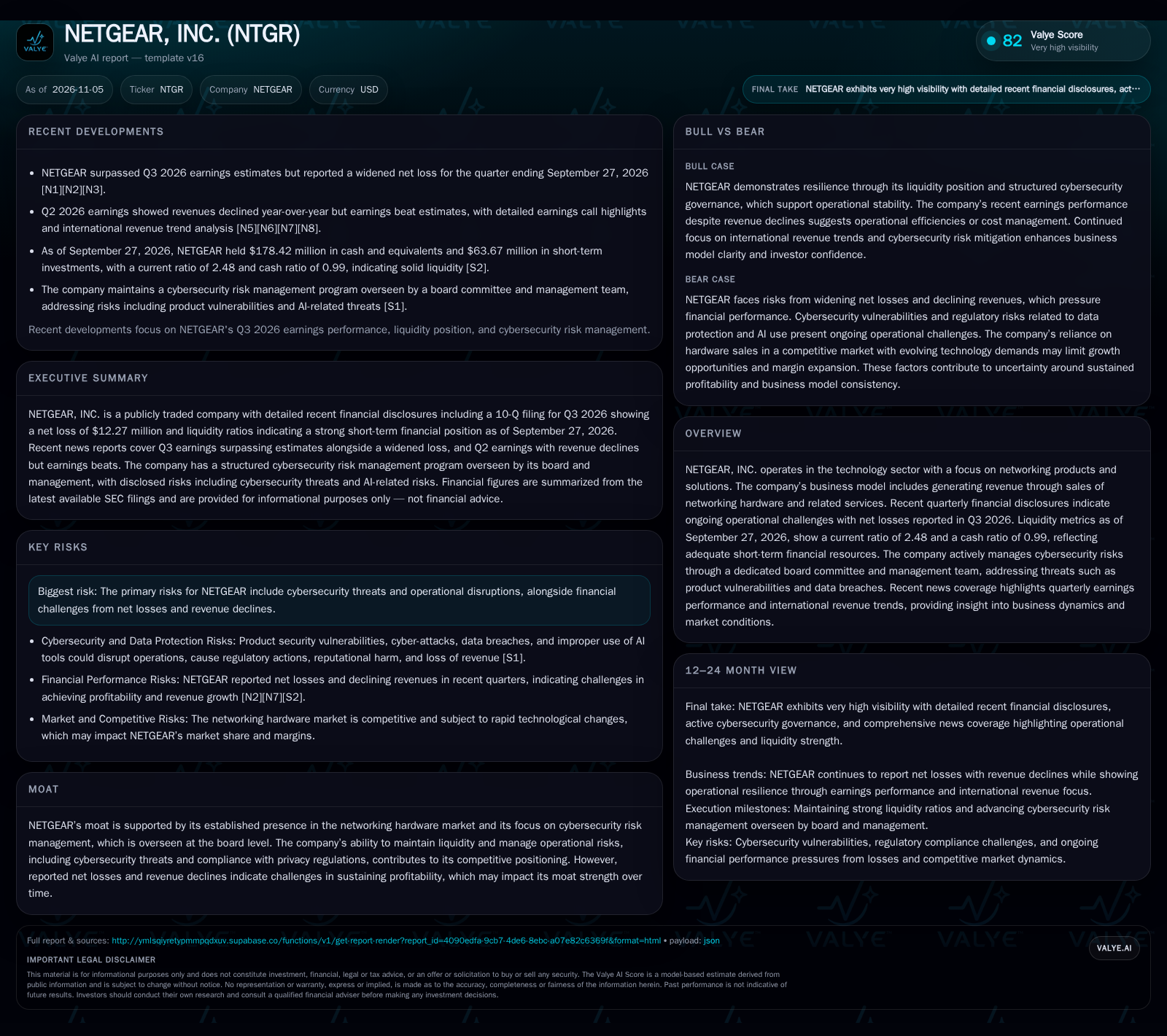
NETGEAR reported a widened net loss in Q3 2026 despite beating earnings estimates, with liquidity metrics showing a current ratio of 2.48 and $242 million in cash and short-term investments. Revenues declined year-over-year, highlighting ongoing top-line headwinds. Board-level cybersecurity oversight is in place, but the company faces structural pressures from hardware reliance and market competition. The path forward depends on NETGEAR’s ability to either stabilize revenues or transition toward higher-margin, recurring-revenue models in a shifting landscape. [S2] [N1] [N2] [N3] [N5] [N7] [N8]
NETGEAR, long a fixture in consumer and SMB networking hardware, now finds itself contending with a combination of reported liquidity position and deepening operational losses. Its Q3 2026 results underscore the tension between a reported balance sheet position and a challenged income statement, as the company’s revenue base continues to contract and net losses widen—even while earnings beat consensus estimates. Against this backdrop, NETGEAR’s board-driven cybersecurity governance and international revenue initiatives represent attempts to stabilize and reposition the business. The central strategic question is whether these efforts can offset the structural headwinds facing a hardware-centric model in a market defined by commoditization, shifting customer preferences, and the rise of software-driven networking.
Recent Financial Performance Highlights a Disjoint Between Liquidity and Profitability
In Q3 2026, NETGEAR reported a net loss of $12.27 million, with basic and diluted EPS of -$0.45, marking a widening loss despite surpassing earnings estimates. This loss extends a pattern of negative profitability, as Q2 2026 also saw revenues decline year-over-year. The company’s liquidity position is reflected in $178.42 million in cash, $63.67 million in short-term investments, and a current ratio of 2.48 as of September 27, 2026. While these figures indicate the company holds substantial short-term financial resources, they coexist with deteriorating top-line and bottom-line results. Board-level cybersecurity oversight continues, reflecting ongoing risk management focus. [S2] [N1] [N2] [N3] [N5] [N7] [N8]
Hardware-Centric Model Faces Margin Compression and Revenue Volatility
NETGEAR’s primary business remains the sale of networking hardware—routers, switches, and related devices—with some ancillary services and software features. This model typically entails high fixed costs (R&D, supply chain, inventory management) and substantial variable costs tied to hardware production and distribution. Pricing power is limited by intense competition and commoditization, especially as new entrants and incumbents expand in both consumer and SMB segments.
Operating leverage in hardware can be a double-edged sword: when revenue grows, fixed costs are spread more efficiently, but in the current environment of revenue contraction, those same fixed costs amplify losses. The lack of material high-margin, recurring-revenue streams (such as SaaS-based network management, security subscriptions, or cloud services) constrains NETGEAR’s ability to offset margin pressures. The company’s ability to convert its installed base into recurring software or service revenue remains a critical but unproven lever.
Capital requirements are moderate relative to heavy industrials, but inventory cycles and working capital management are persistent risks—particularly when sales volumes are volatile. The company reported cash and liquidity metrics for the period; these figures do not by themselves establish operating runway, investment capacity, financial flexibility, or financing capacity.
The cyclical nature of hardware demand further complicates NETGEAR’s margin profile. In periods of economic slowdown or supply chain disruptions, inventory write-downs and obsolescence risks can materially impact profitability. Conversely, in growth phases, accelerated product innovation cycles require sustained R&D investment to avoid falling behind competitors, which pressures margins even as revenues rise. Additionally, the capital intensity of maintaining a global supply chain and logistics infrastructure, especially with fluctuating component costs, introduces volatility that can exacerbate earnings variability. This dynamic underscores the importance of balancing inventory levels and production planning against uncertain demand forecasts.
Defending Relevance in a Crowded and Evolving Networking Landscape
NETGEAR competes with a spectrum of players, from large enterprise networking giants to low-cost consumer hardware manufacturers. The core challenge is differentiation: in consumer and SMB segments, features and price points are rapidly copied, and brand loyalty is limited. Competitors with integrated ecosystems or proprietary software (e.g., managed Wi-Fi, security overlays) can lock in customers more effectively and extract higher margins.
Substitution risk is rising as customers shift from traditional hardware toward cloud-managed networking, mesh Wi-Fi, and integrated security solutions—areas where pure hardware vendors may be disadvantaged. The emergence of managed service providers and telco-bundled solutions further erodes the need for stand-alone hardware purchases in some customer segments.
NETGEAR’s moats—brand recognition, channel relationships, and breadth of product portfolio—are meaningful but not insurmountable. The company’s board-level commitment to cybersecurity and privacy may help preserve trust, but absent a clear pivot to recurring models or unique software offerings, competitive pressures are likely to persist.
Market dynamics also reflect increasing customer sophistication and evolving purchasing behaviors that challenge traditional hardware vendors. Enterprise and SMB customers are progressively prioritizing integrated solutions that offer seamless management, security, and scalability, often bundled as subscription services. This trend diminishes the appeal of standalone hardware purchases and shifts the competitive battleground toward software ecosystems and service platforms. NETGEAR’s ability to forge partnerships or develop proprietary software that complements its hardware could be pivotal in mitigating substitution risk. Failure to do so may result in further margin erosion as price competition intensifies and customer retention becomes more difficult.
Unlocking Value Through Recurring Revenue and International Expansion
The bull case for NETGEAR hinges on successfully leveraging its installed hardware base to drive adoption of value-added services, such as cloud-based network management, advanced parental controls, or cybersecurity subscriptions. If the company can demonstrate meaningful traction in converting one-off hardware buyers into recurring-revenue customers, margins could expand and revenue volatility could decrease.
Additional upside could come from international expansion—especially if NETGEAR tailors products to emerging market needs or capitalizes on regional distribution partnerships. Evidence confirming this scenario would include a rising proportion of revenue from services or subscriptions (if disclosed), stabilization or growth in international sales, and narrowing operating losses despite flat or modestly declining hardware revenue.
Navigating Structural Headwinds with Defensive Liquidity and Incremental Adjustments
The most plausible near-term outcome is continued operational resilience anchored by NETGEAR’s reported liquidity, but with persistent profitability challenges. Revenues may stabilize at a lower base, reflecting ongoing competition and commoditization. The company could make incremental progress in cost management and modest service revenue, but not enough to fundamentally alter its economics.
Falsification would require either a breakthrough in service/subscription revenue or a sharp deterioration in liquidity and/or revenue base.
Deepening Losses and Erosion of Liquidity Amid Continued Hardware Market Pressures
A negative scenario would unfold if revenue declines accelerate—due to market share losses, further price compression, or obsolescence from technology shifts—while fixed costs remain high. In this case, operating losses could widen, and the reported cash balance would begin to erode, potentially leading to restructuring, asset sales, or a need to raise additional capital.
This downside could be confirmed by a sharp drop in quarterly revenues, a rapid increase in net losses, or a significant decline in cash and short-term investments. Additional warning signs would include negative working capital trends or disclosures of strategic reviews or cost-cutting beyond normal course adjustments.
Moreover, the potential for technological disruption—such as the proliferation of alternative connectivity methods or open-source networking solutions—could accelerate commoditization and reduce barriers to entry. If NETGEAR’s product development cycle does not keep pace with innovation trends, the company risks losing relevance in key segments. Coupled with fixed cost structures, this scenario could precipitate a feedback loop of declining sales, margin compression, and liquidity strain. In such an environment, strategic responses like asset divestitures or restructuring may become necessary, but these actions often come with execution risks and may not fully restore competitiveness if underlying market shifts continue unabated.
Benchmarks That Will Define NETGEAR’s Strategic and Financial Trajectory
Quarterly revenue trends—particularly any inflection toward stabilization or renewed growth—will be decisive for assessing the durability of NETGEAR’s business model.
Disclosure of service or subscription revenue growth (if provided) would help test whether the company is making progress toward higher-margin, recurring business.
International revenue mix and growth rates, especially in emerging markets, could indicate whether geographic diversification is a viable lever.
Gross margin trends will signal whether pricing pressure is intensifying or if product/service mix is improving.
Operating expense discipline—monitoring SG&A and R&D as a percentage of revenue—will clarify whether cost controls are offsetting revenue headwinds.
Cash and short-term investment balances should be tracked for any signs of accelerated drawdown or working capital stress.
Updates on cybersecurity incidents, regulatory disclosures, or board-level risk management changes could impact operational stability and reputational standing.
Any announced partnerships, product launches, or pivots toward software/platform offerings would be significant for evaluating strategic transformation.
Disclaimer: This is research-only, informational analysis and not investment advice. It may include AI-generated interpretation and general industry context. Always verify important details using primary sources.

Comments